Table of Contents (click to expand)
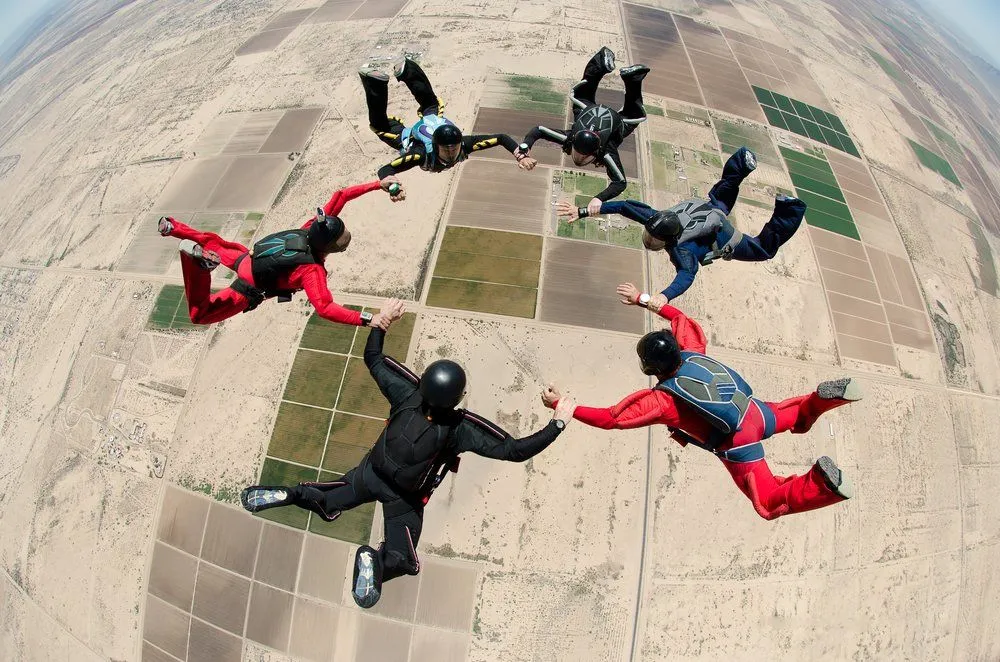
In a stable belly-to-earth position, a skydiver falls at a terminal velocity of roughly 195 km/h (120 mph), or about 54 meters per second. The exact speed depends on the person's weight and body orientation: falling headfirst is far more streamlined and can push the speed past 320 km/h (200 mph).
Skydiving is one of the most popular leisure activities for people looking for some thrills in their life – not to mention a solid shot of adrenaline! Just put on all your safety equipment, board a plane, fly to the drop zone, and boom! In no time, you’ll be falling through the sky – plummeting towards the ground! The amazing speeds that one experiences during free-fall are simply phenomenal.
The question remains, is it a constant speed at which skydivers fall through the sky? Or does the speed continuously increase as you tumble down from the heavens?
What Is Skydiving?
Skydiving or parachuting is a popular sport in which a person flies to a certain altitude in an airplane and then jumps out, returning to Earth as gravity pulls you down; to avoid slamming into the ground, your fall is slowed down thanks to the parachute on your back. The part of the jump when a person is falling rapidly and the parachute is not yet deployed is called being in ‘free-fall’.
Although skydiving is a popular adventure sport, it also has applications in other fields, particularly in the military, when troops are required to land at specific sites after jumping out of an aircraft.
Terminal Velocity
Let’s first talk about one of the most important aspects of skydiving: speed. A person falls through the air because the gravitational pull of Earth is at play, meaning that it pulls the person towards the ground. As a result of this force, the person falling to the ground acquires a certain speed. Now, does the speed keep increasing as one falls, or does it remain constant?
Actually, both of those things occur.
As one jumps out of the helicopter or airplane, the individual initially gains speed due to acceleration, which is caused by Earth’s gravity. However, this speed does not keep on increasing indefinitely. There is a certain point at which the acceleration becomes zero; from that point onwards, the speed of the person is constant. The constant speed that a falling body achieves is called the terminal velocity.
Why Does The Speed Become Constant?
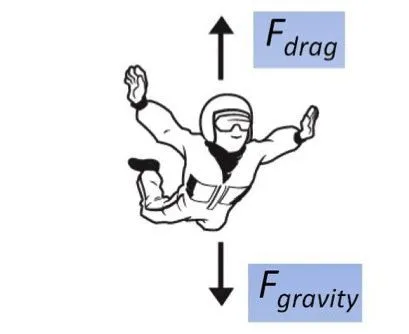 As one falls through the air, the particles present in the air constantly strike the person in the opposite direction of their descent, creating a resistance to their free-fall. This interaction creates a drag, which results in a decrease in acceleration until it becomes zero and terminal velocity is achieved.
Factors Affecting Terminal Velocity
Two factors affect terminal velocity:
1. Weight of the person: The heavier the person, the higher the terminal velocity will be. This is because a falling body’s terminal velocity squared is proportional to its weight, so a heavier skydiver has to reach a greater speed before air resistance balances out gravity.
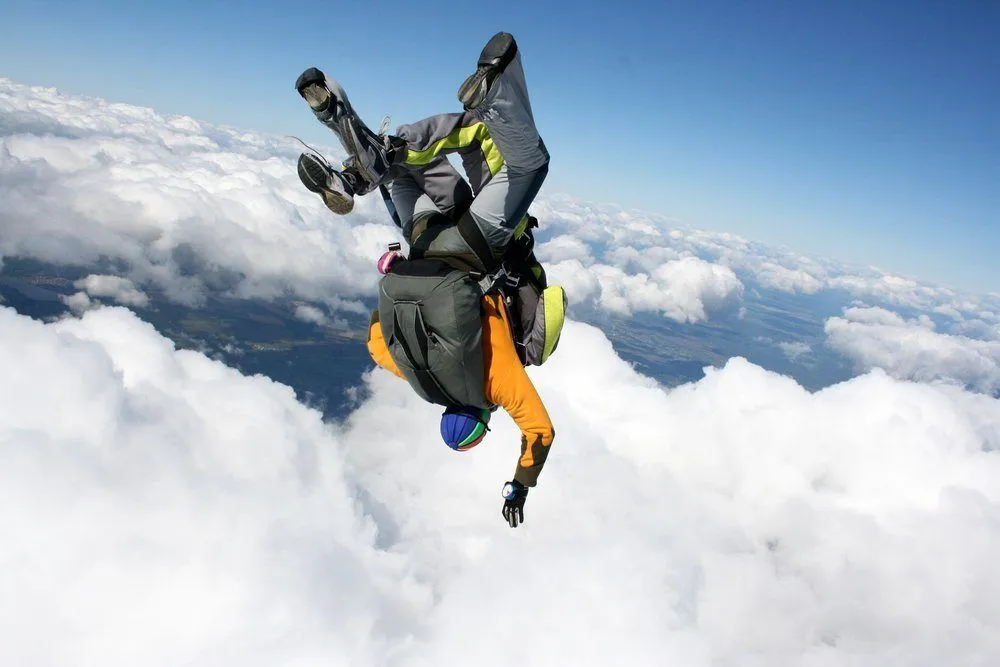
2. Orientation of the person: If a skydiver is falling in a headfirst position, then their terminal velocity will be higher. This is because a smaller surface area of the body is perpendicular to the direction of motion, so the resistance is lower and the terminal velocity is higher.
Actual Values Of Terminal Velocity
For a skydiver in a stable belly-to-earth position, terminal velocity is usually around 54 meters per second, which works out to roughly 195 kilometers per hour (120 miles per hour). This value varies with the weight of the person and the orientation of their body while falling.
In a face-down position, the average value of terminal velocity is reported to be 193 kilometers per hour (120 miles/hour), but in a tucked, headfirst position, terminal velocity can climb to around 320 kilometers per hour (200 miles per hour), and sometimes even more than that!
The discipline of speed skydiving pushes this to the extreme. Competitors fly head-down in the most streamlined position possible to reach the highest speed they can over a measured window. The fastest competition speed on record is a blistering 539.51 kilometers per hour (335.24 miles per hour), clocked by Spain’s Sebastián García Gutiérrez in a single round at the FAI World Cup in Hohenems, Austria, in August 2025, which is faster than the top speed of most production sports cars. (The official FAI-ratified world record, measured as the highest average speed over a 3-second window, still belongs to Germany’s Marco Hepp at 529.77 kilometers per hour, or 329.18 miles per hour, set in 2022.)
How Long Does It Take To Reach Terminal Velocity?
Here is the part that surprises most first-time jumpers: you do not hit that 195 km/h (120 mph) cruising speed the instant you leave the plane. You build up to it. In the first moment of free-fall, air resistance is almost nothing, so gravity has its way and you accelerate hard. As you speed up, drag climbs steeply (it grows with the square of your speed), and the gap between your falling speed and your terminal velocity narrows.

The approach is gradual rather than sudden. A typical jumper reaches about 50% of terminal velocity in roughly 3 seconds, and around 99% of it after about 15 seconds. After that, you are essentially at top speed for the rest of the dive, which means most of your free-fall happens at that steady maximum rather than during the brief sprint up to it.
How Long Do You Actually Free-Fall?
So if you are cruising at terminal velocity, how much sky do you get before you have to pull the chute? It depends almost entirely on your exit altitude. A common jump from around 4,000 meters (about 13,000 feet) gives you in the region of 45 to 60 seconds of free-fall before you deploy your parachute at roughly 1,500 meters (5,000 feet). Step out higher, from 4,300 meters (14,000 feet), and you can stretch that to about 60 to 65 seconds.
A useful rule of thumb skydivers use: the first 300 meters (1,000 feet) takes around 10 seconds because the plane's forward motion has not yet been traded for vertical speed, and every 300 meters after that takes only about 5 to 6 seconds once you are at full speed. At a belly-to-earth terminal velocity of roughly 54 meters per second, you are covering ground fast, so those tens of seconds vanish quicker than you might expect. The moment the canopy opens, drag rockets up, your terminal velocity collapses, and you drift the rest of the way down at a gentle 8 to 16 km/h (5 to 10 mph).
How Does Changing Your Body Position Change Your Speed?
Your terminal velocity is not fixed for the whole dive. You can change it in real time, just by changing your shape. Picture a skydiver cruising belly-to-earth at terminal velocity, where the downward pull of gravity and the upward push of air resistance are perfectly balanced. Now she tucks into a streamlined, head-down dive.

By going head-down, she shrinks the cross-sectional area she presents to the oncoming air, which slashes the drag force. For that instant, air resistance no longer balances gravity, so the net force points down and she speeds up. As she accelerates, drag builds again until a fresh balance is struck, this time at a much higher terminal velocity, close to 320 km/h (200 mph) rather than the belly-to-earth 193 km/h (120 mph). Spread back out into a wide arch and the opposite happens: drag suddenly exceeds gravity, she briefly slows, and settles back at the lower belly-to-earth speed. This is exactly why a belly-down skydiver and a head-down skydiver, dropped together, do not fall at the same rate, even though Earth's gravity is identical for both. The variable is the air, not the gravity.
Skydiving is definitely a fun way to get your heart pounding, so it comes as no surprise that so many people engage in it. Obviously, there are certain considerations that you have to look out for while skydiving, just to be safe, but you’ll definitely have a lot of fun as you plummet through the clouds. Don’t go too fast and don’t forget to pull your chute!
References (click to expand)
- Terminal velocity - Wikipedia. Wikipedia
- Terminal Velocity - NASA. The National Aeronautics and Space Administration
- Terminal velocity - Encyclopaedia Britannica
- Speed skydiving - Wikipedia. Wikipedia
- Terminal Velocity. NASA Glenn Research Center
- Mathematics of Skydiving. EBSCO Research Starters
- 6th FAI World Cup of Speed Skydiving, 2025. Official Results
- Fastest speed in speed skydiving (FAI-approved, male). Guinness World Records