Table of Contents (click to expand)
No. Jumping just as a free-falling elevator hits the ground will not save you. From, say, the 20th floor an elevator slams into the ground at roughly 30 m/s (≈108 km/h); even an Olympic-level vertical jump can only subtract about 4 m/s from your downward speed (a 15% reduction in velocity and roughly 27% in kinetic energy). You would also have to time it to within milliseconds while disoriented and weightless, which is essentially impossible. The best survival posture is to lie flat on your back to spread the impact force across your whole body, but the most reliable advice is simpler still: trust the multiple safety brakes that mean modern elevators almost never go into true free fall in the first place.
When you climb in an elevator, you essentially enter an enclosed metal ‘box’ that relies entirely on machinery, which depends on electricity. That leads to a relatively natural question: what if there is a power failure when you’re inside an elevator?

A particular idea or “rumor” related to elevators makes the rounds from time to time. It says, ‘If you happen to be in an elevator that is in free fall, you can jump at the precise moment when the elevator hits the ground. This little leap will save your life or at least reduce the degree of your injuries.
That sounds rather cool, but is there any actual truth to this?
A Free Falling Elevator
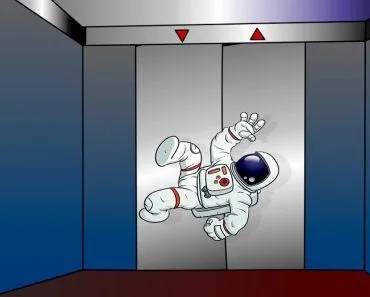
An elevator is said to be in free-fall when it falls through the levels of the shaft after being ‘freed’ from the effect or control of the tools and systems responsible for its safety. In other words, the free fall of an elevator is very bad news. Being in one while it plummets to Earth is even worse.
An elevator travels through different levels of a building with the help of several systems; these ‘security’ systems keep the elevator in place and the riders safe.
However, due to certain technical complexities, these systems may cease functioning suddenly (although the probability of that happening is very low).

If you are really unlucky and happen to be in an elevator as it plummets to the ground, what would happen?
Standing Still In A Free-falling Elevator
Since the elevator is in free fall, gravity is the only force contributing to its fall. Therefore, the elevator will travel downwards with an acceleration of 9.8 meters per second squared (the standard acceleration value due to gravity).
Since you are inside the elevator, you are also moving downwards at the same velocity as the elevator.
Note that this happens only when you are standing completely still, not moving at all in the free-falling elevator.
Jumping As The Elevator Hits The Ground
Let’s assume that you walked out of a Physics class just before entering that fateful elevator that is now falling freely to Earth. Just as it nears the ground, you time your leap and jump! An impressive achievement in that panicked moment, but would it actually help?
NO.
Let’s look at the factors involved here; first off, it would be almost impossible for you to know what floor you were level with while experiencing a free fall. Assuming that there was a power outage, how would you know the precise moment at which to jump? Even if, by some miracle, you jumped at precisely the right moment, would you be able to walk away unscathed?
No, you would definitely still sustain injuries. The severity of those injuries would depend on the height of your fall; the higher you fall, the more acceleration and force of impact, increasing the severity of your injuries.
Why Jumping In A Falling Elevator Is A Terrible Idea
Firstly, the intensity of impact you experience upon hitting the ground is determined by your momentum. Momentum is the product of your mass and velocity. The injuries would be more severe if the elevator had been in free fall for longer. The reason is that a longer period of free fall results in greater momentum, ultimately causing more overall damage.
Also, if you jumped even a little before the elevator struck the ground, you would crack your head against the elevator’s ceiling, causing even more damage. Even if you jumped at the exact moment of impact, you would change your velocity only a tiny amount. This minute change in your velocity would be insignificant regarding the severity of injuries you would sustain.
After learning all that, don’t let anyone infect you with the idea that jumping in a free-falling elevator is some fail-safe method to avoid injuries; there is no way that you can walk out of a disaster like that unscathed unless you are just really, really lucky. The most famous real-world data point is Betty Lou Oliver, an elevator operator at the Empire State Building in 1945: a B-25 bomber struck the building, snapped her elevator’s cables, and she fell 75 stories to the basement. She survived, thanks largely to compressed air and the cushion of cables piling up under the car, not anything she could have done mid-fall. The lesson is the same: trust the engineering. Elevators are incredibly safe. Don’t fret, and enjoy the ride!
What About Jumping In A Normal, Working Elevator?
Free fall is the dramatic version of the question, but most people who type ‘what happens if you jump in an elevator’ are thinking about a perfectly ordinary, fully functioning lift. Is bouncing up and down in there actually dangerous? Will it break the elevator, or leave you stranded between floors?

The honest answer is that you are very unlikely to do any structural damage. A modern traction elevator hangs from several steel hoist ropes (more than are actually needed to carry a full load), and the whole car is balanced against a heavy counterweight that runs on its own guide rails. That system is built with a generous margin of strength, so a person hopping around inside it is a tiny disturbance compared to the loads it is designed to hold.
What you can do is annoy the safety system. When you jump, the ropes stretch a little and the car can briefly twitch downward faster than its rated speed. Elevators carry an overspeed governor that is set to react when the car exceeds roughly 115% of its rated speed, and a hard enough jump can momentarily fool it. If it trips, mechanical ‘safety gear’ wedges grip the guide rails and bring the car to a firm, controlled stop, usually between floors. The lift then locks itself out for inspection, and you get to wait, sometimes for an hour or more, for a technician to release you. So jumping in an elevator is far more likely to leave you embarrassed and stuck than injured, and there is really no good reason to do it.
If An Elevator Really Were Falling, What Should You Do?
Let’s say you ignore all the reassuring statistics and insist on a plan for that one-in-many-millions plunge. Jumping is out, as we have seen. So what is the least-bad option? Here the physics is genuinely interesting, because even the experts do not fully agree.
One school of thought, echoed by physicists at the University of Illinois, is to lie flat on your back on the floor. The logic is force distribution: spreading your body over the largest possible area means the impact is shared across your whole frame rather than driven through your ankles and spine, and your long bones end up lying across the direction of the force instead of along it, which makes them less likely to snap.
The competing view, argued by astrophysicist Luke Barnes, is that the priority should be your head, since head injury is the leading cause of death in falls. From that angle you are better off standing with your knees bent and your legs ready to fold, turning them into a crude crumple zone that lengthens the time over which you decelerate while keeping your skull as far from the impact as possible. There is no tidy winner here: more contact area protects your bones, while bent legs protect your brain.
The catch that undermines both plans is the same one that kills the jumping trick. In a true free fall you are weightless, floating freely inside the car with nothing pressing you against the floor, so calmly arranging yourself into any posture is far harder than it sounds. The reassuring reality is that you will almost certainly never have to find out.
How Can Elevators Be So Safe?
All of this rests on one comforting fact: a true free fall is something modern elevators are specifically engineered to prevent. The reassurance is not blind faith; it is a stack of independent safety layers, any one of which can stop the car on its own.

The idea is older than the skyscraper. In 1852, Elisha Otis invented an elevator safety brake, a spring-loaded mechanism that jammed toothed bars against the guide rails the instant the hoisting rope went slack. In 1854 he proved it theatrically at New York’s Crystal Palace, standing on a raised platform and ordering an assistant to cut the rope. Instead of plummeting, the platform dropped only a few centimeters and locked in place. That single demonstration is a large part of why we trust ourselves to tall buildings today.
A present-day elevator improves on that idea many times over. It hangs from multiple steel hoist ropes, far more than are needed to hold a fully loaded car, so the failure of any one rope is not a crisis. A spinning overspeed governor watches the car’s speed, and if it descends too fast, flyweights inside it fling outward and trip the safety gear, which clamps onto the rails. Should a car somehow reach the bottom too quickly, buffers in the pit, essentially giant shock absorbers, soak up the remaining energy. Crucially, the brakes are mechanical and spring-applied, so they still work during a total power failure. As physicist Christopher Baird of West Texas A&M University bluntly puts it, ‘elevators never plummet down their shafts’: even if every cable were cut, the car would drop only a few feet before the safeties bit down. So the next time you feel a flicker of elevator anxiety, remember that you are stepping into one of the most over-engineered safety systems you will ever ride.
Last Updated By: Ashish Tiwari
References (click to expand)
- If You're in a Falling Elevator | Physics Van | UIUC
- How to Survive an Elevator Free Fall.
- Baluković, J., Slisko, J., & Cruz, A. C. (2018, March 1). A Person Stands on a Balance in an Elevator: What Happens When the Elevator Starts to Fall?. The Physics Teacher. American Association of Physics Teachers (AAPT).
- Can I Avoid Harm By Jumping At The Last Second? Christopher S. Baird, West Texas A&M University.
- If You're In A Falling Elevator, Can You Save Yourself By Jumping? Luke Barnes, The Conversation.
- High-Rise Safety Systems. Otis Elevator Company.
- Elisha Otis: Safety Brake And Elevator Design. Encyclopaedia Britannica.