Ripples in water are more formally known as capillary waves, and are caused by the subtle interaction of wind and water, or the physical interaction of the water with another object.
Have you ever stood at the edge of a lake on a hot summer day and stared out across the water? Even if there isn’t a whisper of wind against your face, you will likely still see faint lines and irregularities in the water. The light will reflect off movement at the surface, and small ripples will be seen in patches, sometimes appearing to move in different directions. Imagine picking up a stone and chucking it into the lake, where it lands with a satisfying splash, and an expanding ring of ripples will appear.
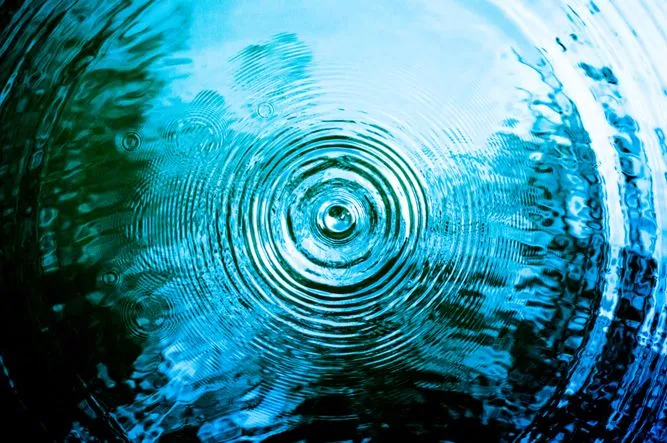
These patterns and shapes that we see or create in water bodies are commonly referred to as ripples, but why do they form and what affects how long they last?
What Is A Ripple?
Even on a day when you don’t feel any wind, there will always be some movement in the air, and at the surface of a water body, that movement causes small ripples to form. Wind energy is being transferred to the minuscule water molecules, which begin to move up and down, gently rising and falling, pulling along with the molecules beside them. However, the surface tension of water is quite strong, due to the polar nature of water molecules, and this tension will stop the ripples from perpetuating very far or for very long. The energy transferred into the water is quickly used up in moving those molecules up and down, so the ripples fade. This is what gives the ripples on a lake their transient, sparkling appearance, as they briefly rise and catch the light before settling back into stillness.
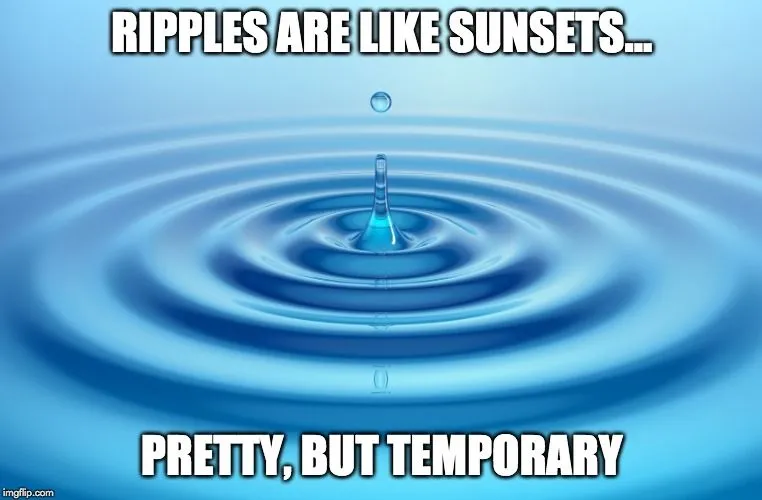
When you throw a rock into a body of water, the rock will push water out of its way as it enters, causing ripples to move away from its point of entry in a circle or ring shape. Water will then rush back in to fill the empty space, which can often cause a splash, resulting in more ripples forming. You can try this yourself by dropping a marble straight down into a bowl of water. Watch the resultant splash rise straight up and then fall back in, sending out a second ring of ripples. The larger the rock, the greater the effect and the stronger the ripple, meaning that it will last longer before disappearing. The reason that these ripples don’t behave like waves on a beach is because they aren’t strong enough; they lack the energy to persist in the face of water’s strong surface tension.
These types of ripples may also form when water is moving in a certain direction and encounters an obstacle, such as a fishing boat, a breakwall, or even your feet as they dangle off a dock! Water molecules will encounter an object and move upwards against it, before being pulled back down by the neighboring molecules. This interaction causes a ripple to form that moves in the opposite direction of the water’s initial motion.
Now, while a ripple is a type of wave motion—a capillary wave, to be precise—when we are talking about water bodies, there is a clear difference between a ripple and a wave.
Ripples Vs Waves Vs Swells
As mentioned above, a ripple is a transient, short-lived phenomena that quickly disappears once its input energy is used up. However, if wind continually moves over a body of water, creating a steady stream of ripples, they can begin to accrue more energy, and will turn into waves, like those you might see crashing on a beach. While ripples are unable to overcome the force of surface tension, waves can build up enough energy to do so if the wind blows steadily over a large enough patch of water. Such waves will always flow in the same direction as the wind, and will shift direction if the wind changes.
When waves move into shallower water, the bottom part of the wave will decrease in speed, and the top part of the wave will overtake it, causing the wave to break. This can also be seen in the open ocean, particularly during a storm or when the seas are choppy, i.e., when different weather systems are interacting, or when the wind is rapidly changing direction.
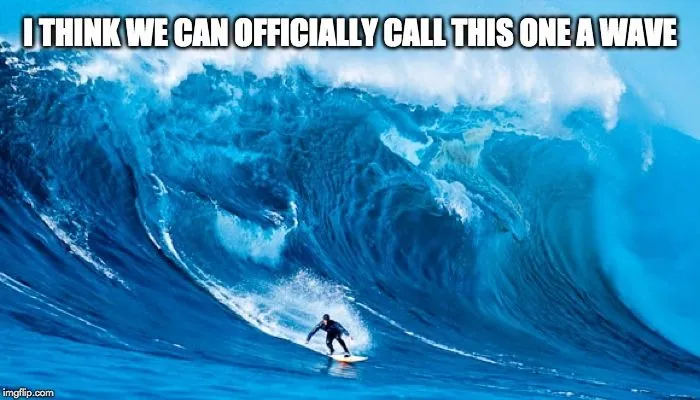
If the wind is persistent and strong, it can begin to generate the most persistent type of movement—a swell. While waves always move in the same direction as the wind, a swell forms when those waves move out of the area they were initially made. The water of a swell has gathered enough energy and momentum that it can actually move against the wind, sometimes traveling vast distances, across entire oceans, without losing its energy. A swell is typically difficult to see against the horizon, as it is often longer, more even and has a longer period than normal wind waves. Counterintuitively, because the phase speed of a deep-water wave grows with its wavelength, swells actually travel faster than the choppy wind waves you see during a storm — which is why long-period swells from a distant storm reach a coastline well before the storm itself. Also, the distance between the troughs and peaks of a swell is usually much greater than that distance in waves formed by the wind.
What Is A Ripple In Physics?
In the language of physics, a ripple is a capillary wave, a surface wave so small that the force pulling the disturbed water back toward flat is the water's surface tension rather than gravity. That is the heart of the distinction. On a big ocean roller, gravity does the restoring work; on a tiny ripple, surface tension does. The crossover between the two sits at a wavelength of roughly 1.7 cm (about 0.7 in). Waves shorter than that are capillary waves, the true ripples ruled by surface tension, while longer ones grade into gravity waves.

Right at that boundary, water waves move at the slowest speed they can manage, only about 23 cm/s (roughly 0.23 m/s, or 0.75 ft/s). Ripples also behave in a way that feels backward: the shorter the capillary wave, the faster it travels, which is the opposite of the large gravity waves rolling across the open sea. This is part of why ripples are the classic teaching model for waves in general. The way a ring of ripples carries energy outward from a splash is a close cousin of how sound waves spread from a source, or how light radiates from a lamp.
Why Are Ripples Circular?
Drop a single pebble into a still pond and the ripples always race outward as neat, expanding rings. The reason is beautifully simple. The pebble acts as a single point of disturbance, and it shoves the water down and outward roughly equally in every direction. Because the surface around it is fairly uniform, that energy spreads at the same speed on all sides, so the leading edge of the disturbance is a growing circle. Each fresh pulse of water rushing back to fill the gap launches another ring, which is why you see a set of concentric circles rather than a single one.

Here is the part that surprises most people: the water itself is not traveling outward with the rings. Each water molecule mostly bobs up and down, tracing a small loop, and nudges its neighbor, which bobs in turn, a bit like fans standing and sitting to send a "wave" around a stadium. The energy travels; the water stays put. That also explains why the rings fade as they widen. Lifting each neighboring molecule takes energy, and the original burst is spread thinner and thinner around an ever-larger circle, so the ripples shrink with distance until the surface falls still again. The pattern stays circular only as long as the disturbance behaves like a point and the water is uniform; an uneven push, a breeze, or an obstacle in the path will distort the rings.
What Does "Ripple" Mean? The Ripple Effect
Step away from the pond and "ripple" carries an everyday meaning too. As a noun, a ripple is simply a small wave on the surface of a liquid; as a verb, to ripple means to spread or move in that wave-like way. That sense of spreading is exactly why "the ripple effect" has become one of the most common metaphors in the English language.

Merriam-Webster defines a ripple effect as "a spreading, pervasive, and usually unintentional effect or influence." Just as one small pebble sends rings traveling across an entire pond, a single event (a new policy, a factory closure, even a small act of kindness) can send consequences outward through a community or an economy, reaching far from where it began. The metaphor sticks because the physics is so visual: one modest input produces a pattern that expands in every direction and touches everything around it. So when people ask what ripples in water "mean," there are really two good answers, the physical one (tiny capillary waves) and the figurative one (consequences that spread).
A Final Word
Clearly, water is able to store and harness a lot of wind energy under the right conditions, but ripples are simply too transient, too small and have too little energy to persist and travel for long distances. However, if you get a large enough rock and drop it from a high enough height, you may be able to create a ripple that travels out from the middle of the lake to the shoreline!
References (click to expand)
- Waves Across a Pond - UC Berkeley Seismology Lab. The Berkeley Seismological Laboratory
- Wu, J. (1991). Effects of atmospheric stability on ocean ripples: A comparison between optical and microwave measurements. Journal of Geophysical Research. American Geophysical Union (AGU).
- Zirker J. B. (2013). The Science of Ocean Waves: Ripples, Tsunamis, and Stormy Seas. JHU Press
- Capillary wave. Encyclopaedia Britannica.
- Capillary wave. Glossary of Meteorology. American Meteorological Society.
- Capillary wave. Wikipedia.
- Curious Kids: how do ripples form and why do they spread out across the water? The Conversation.
- Ripple, Definition & Meaning. Merriam-Webster Dictionary.
- Ripple effect, Definition & Meaning. Merriam-Webster Dictionary.