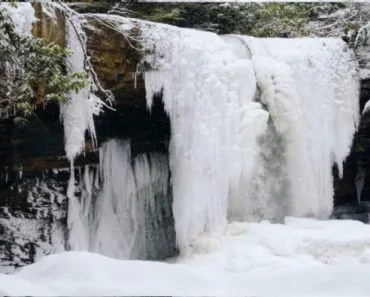
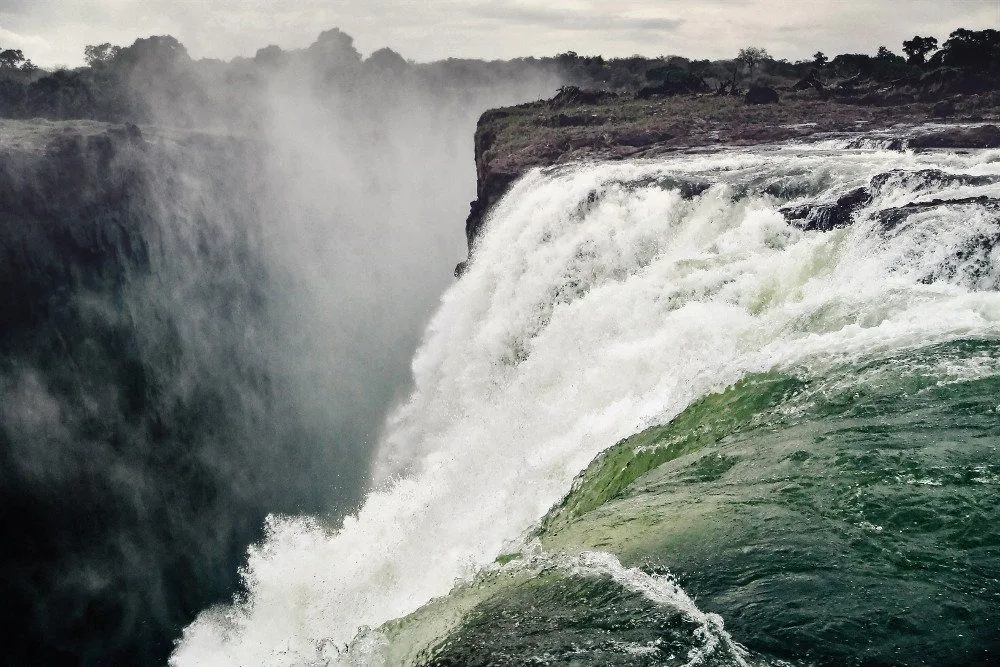
The water appears white while going over a waterfall because the water is moving at a high pace and the trapped air in the water creates bubbles. The bubbles are what make the waterfall look white.
If water is really stirred up, or moving at a high pace (a pace that you can expect from waterfalls), then the trapped air in the water creates bubbles. It is these bubbles (tiny air pockets) that make a waterfall look white.
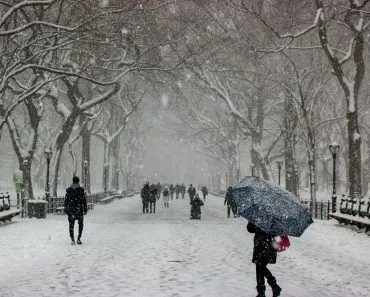
Water is colorless; we all know that, right? Still, snow – which is essentially frozen water – is white. Similarly, water that goes over a waterfall also appears to be white, despite actually being colorless.
What’s going on here?
The answer of this lies in how light interacts with matter, along with aeration.
Water And Dissolved Oxygen
You might already know that water has dissolved oxygen inside of it. It is this dissolved oxygen that helps sustain the lives of aquatic creatures. Normally, you don’t actually see any evidence of oxygen being dissolved in water (apart from the fact that, you know, fish live there). Humans will never understand and appreciate the true value of dissolved oxygen in water bodies (ponds, lakes, rivers etc.) as much as fish do.
Thus, in a still water body, you don’t see much sign of gas at all. But when water tumbles over a cliff like in a waterfall, the churning physically traps a tremendous amount of air inside the water – much more than just the small fraction of oxygen that was dissolved in it.
Aeration
When water is standing still, or moving at a very relaxed, gentle pace, oxygen dissolves in it through diffusion from the surrounding air. However, when water flows rapidly, its flow becomes turbulent. As a result, it offers more surface area for oxygen to diffuse compared to a flat, slow-moving river.
More importantly, the violent churning of a waterfall physically forces air into the water in the form of countless tiny bubbles. Some of this air dissolves, but most of it stays as visible bubbles entrained in the flow, and those bubbles are what give a waterfall its white color.
How Light Reflects Off Water In A Waterfall
If you consider a body of water that’s sitting stationary, then you essentially have one surface from which light can reflect (or even refract). Just like a mirror, due to the even surface of a plain mirror, light rays that fall on it are reflected at a constant angle. However, if you roughen up the mirror surface (by denting, scratching or even breaking it), then light rays would still be reflected off it, but in random directions. That’s why crushed glass also looks whitish.
Similarly, in a water body where the water does not show much movement, light reflects at a constant angle. However, when there’s movement in the water, the reflections you see are no longer as clear. Moreover, if the water is really stirred up, or moving at a high pace (a pace that you can expect from waterfalls), then the trapped air in the water creates bubbles. It is these bubbles (tiny air pockets) that make a waterfall look white.
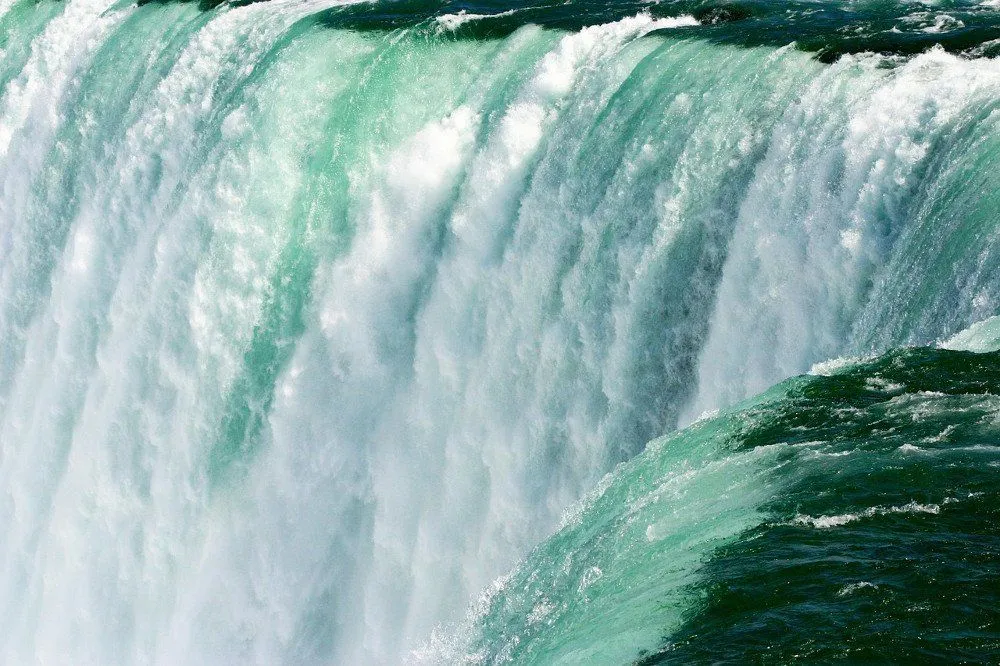
These bubbles have their individual surfaces, all of which reflect some part of the light falling on them. This is why you can see reflections of objects on bubbles if you look really closely. As you can imagine, there are a great deal of bubbles in a waterfall, and all of them are of varying sizes. This is why light gets reflected in so many random directions, and what you eventually see is an evenly white color of the waterfall.
This is the same mechanism that makes clouds look white. It’s just a lot of water droplets suspended in the air, all of which scatter light, resulting in the whitish hue of the cloud.
Why Do Whitewater Rapids, Breaking Waves, And Sea Foam Look White Too?
Once you understand the waterfall, you start spotting the same trick everywhere. Whitewater rapids are the most obvious cousin. When a river’s gradient steepens, the flow becomes turbulent enough to trap air inside the water, and that frothy, aerated current looks opaque and white for exactly the reason a waterfall does: countless air bubbles, each with its own surface, scatter light in every direction.

The crests of breaking ocean waves (whitecaps) work the same way. As a wave topples over, it folds air into the water as a dense cloud of bubbles, and those bubbles scatter all wavelengths of sunlight together, giving the crest its bright white cap. The reason this matters is a point from optics: when the scattering particles are about the same size as (or larger than) the wavelength of visible light, all colors are scattered roughly equally. This is called Mie scattering, and it is the same process that makes clouds appear white rather than blue.
Sea foam adds one more ingredient. Seawater contains surfactants (soap-like molecules) that come from proteins and fats released by decaying marine life. When wind and waves churn the water, those surfactants trap air into long-lasting bubbles, and according to NOAA the foam is built from tiny spheres of surfactant wrapped around air. Whether it is froth at the base of a waterfall or foam riding up a beach, the whiteness comes from the same place: a swarm of bubble walls bouncing every color of light back at you.
Why Do Some Rivers And Lakes Look Blue, Green, Or Brown Instead?
If trapped air turns water white, what gives calm water its color? Several different things, and not one of them is the air bubble.
Start with a surprise: deep, still, perfectly clean water is faintly blue all on its own. As the peer-reviewed paper “Why is water blue?” explains, water molecules selectively absorb light at the red end of the visible spectrum, so the light that survives a long path through water comes out tinted blue. Unusually, this color is born from the vibrations of the O–H bonds in the water molecule, not from the light-bending that paints the daytime sky. (The sky’s blue is a different effect, covered in why the sky is blue; the ocean’s shifting shades are explored in why sea water appears blue.) That same red-absorption is why thick glacier ice and deep snow can glow blue: over a long enough path, the red light is soaked up and mostly blue escapes.
The dazzling turquoise of glacier-fed lakes like Banff’s Moraine Lake comes from a different source. Grinding glaciers crush bedrock into a fine powder called rock flour, which meltwater carries into the lake. According to NASA, these suspended particles absorb the shortest violet wavelengths while the water itself absorbs the reds, leaving blues and greens to scatter back to your eye.

Other colors trace to what is dissolved or suspended in the water. A tea-brown, “blackwater” stream draining a forest or peat bog gets its tint from dissolved organic acids called tannins that leach out of decaying leaves and wood; the USGS notes these give water a tea color. A muddy-brown river after a rainstorm is colored instead by suspended sediment (clay and silt washed off the land), which the USGS measures as turbidity. And green water usually means life: blooms of microscopic phytoplankton packed with chlorophyll, the very pigment that colors land plants, tint the water green where they grow thickly.
The Same Reason Clouds, Snow, And Foam Are White
Here is the satisfying part: the waterfall is just one member of a much larger family. Think about what clouds, fresh snow, beer froth, and a pile of crushed glass have in common. Each one is built from a transparent, colorless material that has been divided into a huge number of tiny pieces, with every piece presenting a surface that bends and bounces light.

Clouds are made of tiny water droplets that, being large compared to the wavelength of light, scatter all colors about equally and so look white. Snow is a packed mass of ice crystals; ice itself is clear, but the many ice grains scatter incoming light, and as the National Snow and Ice Data Center puts it, that light is reflected back “without any particular preference for a single color,” so the surface looks brilliant white. Foam does it with bubble walls: a NASA report notes that the white of shaving cream comes from light scattering at the many water–air interfaces, where the incoming light is thrown in random directions until the foam takes on a milky white appearance.
Caltech physicist Kenneth Libbrecht sums up the principle neatly on his snow crystals site: snow, salt, sugar, and crushed glass are all intrinsically colorless and transparent, yet each pile looks white because countless internal surfaces reflect nearly all the light instead of absorbing it. A waterfall full of air bubbles is simply this same effect rendered in water and air. The water was never white. We just gave it enough surfaces to scatter every color back at once.
References (click to expand)
- Aeration - Aquaculture, Fisheries, & Pond Management. Texas A&M University
- Water's the Matter-- Lesson Presentation: Dissolved Oxygen - peer.tamu.edu:80
- How Does Sea Foam Form? National Oceanic and Atmospheric Administration (NOAA)
- Mie Scattering. Department of Atmospheric Sciences, University of Illinois
- Blue Sky and Rayleigh Scattering. HyperPhysics, Georgia State University
- Durian, D. J., Weitz, D. A. & Pine, D. J. Multiple light-scattering probes of foam structure and dynamics. Science, 1991, 252(5006), 686-688.
- Braun, C. L. & Smirnov, S. N. Why is water blue? Journal of Chemical Education, 1993, 70(8), 612.
- How Glaciers Turn Lakes Turquoise. NASA Earth Observatory
- Water Color. USGS Water Science School
- Turbidity and Water. USGS Water Science School
- Chlorophyll. NASA Earth Observatory
- The Science of Snow. National Snow and Ice Data Center (NSIDC)
- Diffusing Wave Spectroscopy Used to Study Foams. NASA Technical Reports Server
- Why is Snow White? Kenneth Libbrecht, California Institute of Technology