Table of Contents (click to expand)
Blue light is the part of visible light with the shortest wavelength, roughly 380 to 500 nanometers, which gives it the highest energy. It comes mainly from the sun and from screens. Blue light at night suppresses melatonin and disrupts sleep, but there is no good evidence that screen blue light damages the eyes.
For most of us, an action-packed and tiring day ends with a typical wind-down routine. We curl up in bed with the lights off, phones in our hands. The hours before sleep are often spent scrolling through an infinite cesspool of viral memes and cat videos. For others, obviously, reading articles on science blogs is the way to roll.
However, did you know that using your phone, tablet or laptop in the dark is not a very good idea? All screen-bearing electronic devices emit blue light, and a steady stream of it late at night can quietly throw off our sleep cycles. You may also have heard that this same blue light damages the eyes. As we'll see, that part of the story is far shakier than the marketing suggests.
What Is Blue Light?
Blue light is everywhere, as it is emitted both by artificial light sources and by our biggest light source of them all – the sun!
Everything we see is the result of light rays bouncing off objects surfaces and being processed by our eyes. Human eyes are only able to process (“see”) light rays that fall within the visible light spectrum – light rays with wavelengths from 380 to 700 nanometers (nm). The fewer the nanometers, the shorter the wavelength.
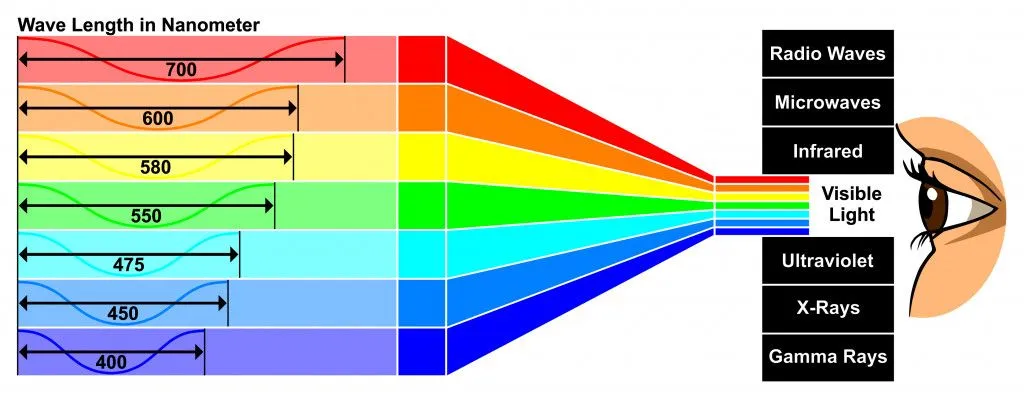
This visible light spectrum can be divided according to wavelength into three categories: short (blue), medium (green), and red (long). Blue light begins at 380 nm and ends at 500 nm.
Light with shorter wavelengths have greater penetrative power. In 1900, Planck discovered the relationship between a photon’s (particle of light) frequency and its energy. Light with shorter wavelengths has higher frequencies, and the greater the frequency of light, the stronger is its energy.
The strong energy of blue light is what allows it to pass easily through the cornea and lens of our eyes, so that, unlike ultraviolet light, most of it reaches the retina. Blue light has the shortest wavelength in the visible spectrum, and therefore also carries the most energy of any light we can see. In laboratory cell cultures and in animals, very intense or prolonged blue light can harm retinal cells. Whether the far weaker blue light from everyday screens does the same to human eyes is a separate question, and one we'll return to below.
Limited exposure to blue light isn’t all that bad. After all, blue light is a part of sunlight. In fact, it is essential for regulating our sleep cycles. One way to get over jet lag is to spend time in direct sunlight. Why? Because the blue light from the sun resets our internal clocks. It is also why we are typically alert and active during the day, but feel drowsy and tired at night.
Blue Light And Its Effect On Our Health
Circadian rhythms are the internal biological clocks that all living organisms possess. It coordinates physiological and behavioral activities of living beings within 24 hr cycles. The Circadian rhythm is influenced by light intensity and the temperature of the living being’s environment.
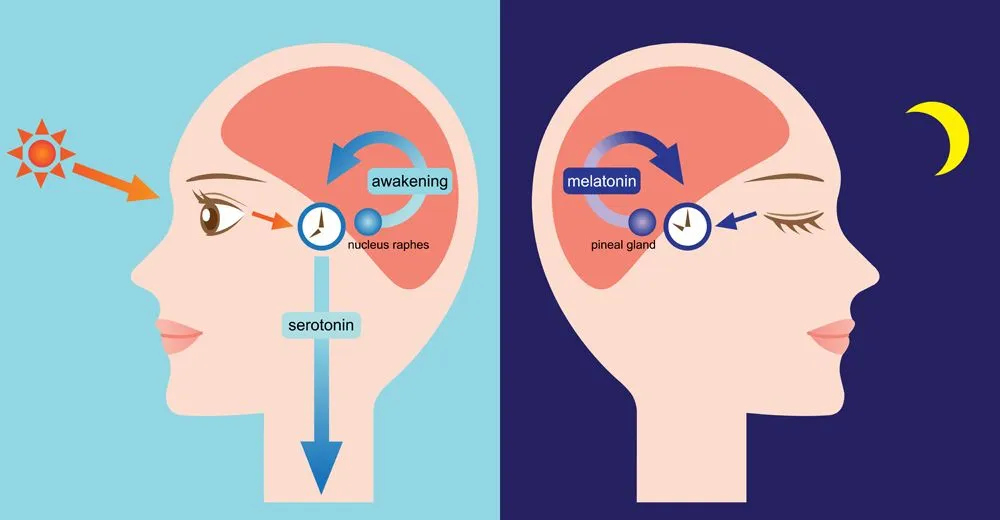
There are two main hormones that regulate our Circadian rhythm: melatonin and serotonin. The former is also called the sleep hormone, while the latter is known as the “happy” or “feel good” brain chemical.
Melatonin secretion is triggered by the absence of light. Blue light from the sun regulates our Circadian rhythm by inhibiting melatonin secretion.
Serotonin secretion, on the other hand, is stimulated by sunlight. Serotonin improves cognitive function and is responsible for an alert and happy state of mind. As exposure to bright light increases (artificial or natural), there is a corresponding increase in serotonin.
Researchers have found that blue light also plays a role in regulating our mood and determining how we manage emotional challenges. Blue light is also shown to strengthen and stimulate connections between various parts of the brain that process language.
The recent problem, however, lies in the bright screen lights we stare at each night. This widespread use is why the harmful effects of blue light are coming into the limelight now, more than ever before. In other words, the problem isn’t exactly exposure to blue light, per se, but rather the extent and the timing of our exposure to it.
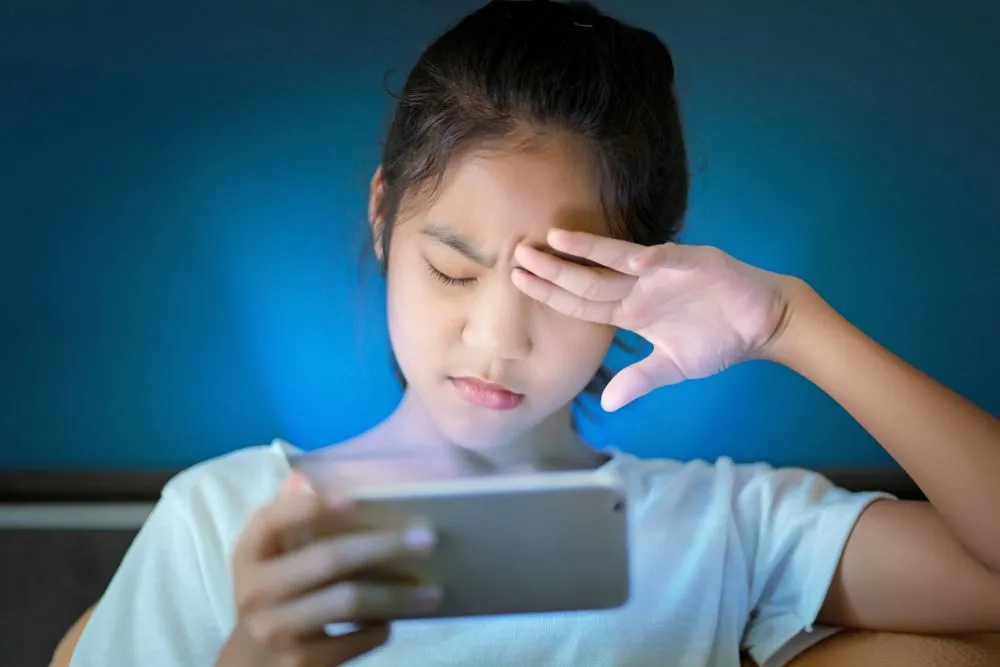
One study compared the difference between reading a physical book versus an e-book before bedtime. They observed that the participants who used an e-reader not only took longer to fall asleep, but were also less alert in the mornings. A likely reason for this is that exposure to the light-emitting reader’s blue light inhibits melatonin production, while increasing mental alertness. This leads to bad quality sleep and consequently lowered alertness the next morning.
So far, we have discussed the effects of blue light on our sleep and body clock, and those are the best-established ones. The effects on the eye itself are murkier. As mentioned before, we humans have, over many millennia, adapted to the blue light in natural sunlight.
How have we evolved to deal with blue light? Our eyes’ natural lenses have certain protective structural proteins, along with specific enzymes, that absorb a high proportion of short wavelength light to protect the retina.
The concern researchers raise is mostly about a lifetime of intense outdoor light. In laboratory studies, blue light can trigger the formation of reactive oxygen molecules (free radicals) in eye cells, and high cumulative exposure to sunlight is one of several suspected risk factors for cataracts and age-related macular degeneration.
Here is the key caveat, though: a screen puts out a tiny fraction of the blue light you would get from a sunny sky. The American Academy of Ophthalmology says there is no scientific evidence that the kind or amount of light coming from screens damages the eyes. If your eyes feel tired and dry after a long day at the laptop, the culprit is usually staring without blinking, not the blue light itself.
Blue Light Filters
So, if the real issue is sleep rather than eye damage, what can we do about it? We can’t all turn into Luddites and stop using electronic devices, surely, which means that the practical answer is blue light filters.
As awareness of blue light’s effect on sleep has grown, tech companies have built filters into their devices that warm up the screen and cut down its blue light emission, especially in the evening.
Laptops now come with the option of a night mode for their screen displays, making them gentler to look at after dark. Samsung Galaxy phones, for instance, have a built-in Eye Comfort Shield that limits the screen’s blue light. Using these modes at nighttime is easier on your eyes and, more importantly, kinder to your sleep cycle.
Apple offers a similar feature called Night Shift on its devices, which uses the location and time of the device to automatically shift the screen toward warmer colors and dial back the blue light in the evening.
If your phone doesn’t have an in-built blue light filter, there are numerous blue light filtering apps available, both free and paid. These apps work by changing the color tone of your device screen.
You have probably also seen ads for blue light-blocking glasses. Here the evidence is clearer, and not in the marketing’s favor. A 2023 Cochrane review of 17 clinical trials found that blue light-filtering lenses probably make no difference to eye strain, sleep quality, or the health of the retina. In other words, they are unlikely to do you any good (or any harm), so there is no need to feel you must buy a pair.
Additionally, to protect the quality of your sleep, avoid electronic screens an hour or two before your bedtime. Switch back to reading a simple paper book before bed, even though that’s easier said than done. If you must use devices before bed, keep a night lamp on and activate the blue light filter on your electronic device.
We’re living in an age where it’s nearly impossible to avoid electronic devices and still function meaningfully in the world, but as is true of everything else in life, balance is key!
References (click to expand)
- (2016) Effects of blue light on the circadian system and eye physiology. The National Center for Biotechnology Information
- Vicente-Tejedor, J., Marchena, M., Ramírez, L., García-Ayuso, D., Gómez-Vicente, V., Sánchez-Ramos, C., … Germain, F. (2018, March 15). Removal of the blue component of light significantly decreases retinal damage after high intensity exposure. (S. Barnes, Ed.), Plos One. Public Library of Science (PLoS).
- AUGUSTIN, A. J. (2008, October). The Physiology Of Scotopic Vision, Contrast Vision, Color Vision, And Circadian Rhythmicity. Retina. Ovid Technologies (Wolters Kluwer Health).
- Gomes, C. C., & Preto, S. (2015). Blue Light: A Blessing or a Curse?. Procedia Manufacturing. Elsevier BV.
- (2018, December 18). Research progress about the effect and prevention of blue light on eyes. International Journal of Ophthalmology. Press of International Journal of Ophthalmology (IJO Press).
- Blue light has a dark side - Harvard Health. Harvard University
- Chang, A.-M., Aeschbach, D., Duffy, J. F., & Czeisler, C. A. (2014, December 22). Evening use of light-emitting eReaders negatively affects sleep, circadian timing, and next-morning alertness. Proceedings of the National Academy of Sciences. Proceedings of the National Academy of Sciences.
- Schreiner, K. (2020, January). Dissecting the Response to Blue Light. Information Display. Wiley.
- Singh, S., et al. (2023). Blue-light filtering spectacle lenses for visual performance, sleep, and macular health in adults. Cochrane Database of Systematic Reviews.
- Are Blue Light-Blocking Glasses Worth It? American Academy of Ophthalmology.
- Blue light. Encyclopaedia Britannica.