Table of Contents (click to expand)
Sunglasses protect your eyes by blocking ultraviolet (UV) rays and cutting down glare and excess visible light. A UV filter built into the lens shields the cornea and retina from sun damage, while tints, polarized filters, and anti-reflective coatings reduce glare and sharpen what you see. For real protection, choose lenses rated to block 100% of UV (UV400).
Sunglasses make you look cool and are one of few fashion statements that never go out of style, but have you ever wondered about the excellent work they do of protecting your eyes? We know that being exposed to a bright source of light can lead to certain eye problems, but what if you had a staring contest with our closest star? Well, the short answer is that you would go blind or invite permanent damage to your eyes. Before we take a look at how sunglasses protect our eyes, let’s consider what would happen without them.
Effect Of The Sun On Our Eyes
The degree of damage that one’s eyes are exposed to is directly proportional to the amount of exposure one has to the potentially harmful rays of the sun. Looking directly at the sun for extended periods of time is a terrible idea, as it causes permanent retinal damage, with blindness being the worst-case scenario. However, even being exposed indirectly to the sun’s rays can have a harmful effect on the eyes. The three types of light that the sun produces are visible, infrared and UV (Ultra Violet).

UV is the most damaging to the structures within the eye, especially if it is reflected off sand, snow, or water. The cells of the cornea (the eye’s clear front surface) are effectively sunburned when exposed to too much UV light. The symptoms of this condition, known as photokeratitis, usually set in 6 to 12 hours after the damage occurs. The signs are excessive tearing, redness and inflammation of the tissue surrounding the eye, light sensitivity, and the feeling that your eyes have been rubbed on a rough surface. The reassuring part is that the symptoms are temporary and usually clear up within 24 to 48 hours as the cornea heals. They can also be avoided altogether by wearing UV-protective eye gear.

More direct or extended exposure to the Sun can also cause damage to the retina, especially the macula. The macula is a tiny substructure on the retina that is responsible for the majority of the detail in a person’s central vision. It is a known fact that the pupil contracts when a bright light is shone directly onto the eye, but the amount of light still entering can be enough to scorch the delicate macular tissue. Staring at the sun can burn this tissue and cause solar retinopathy, leaving a permanent blind spot in the center of your vision. You can relate this to the temporary blindness you experience after a camera flash, but imagine that blindness being permanent! Years of everyday UV exposure also add up: sunlight is a known risk factor for cataracts and age-related macular degeneration, which is exactly why daily sun protection matters.
Use Of Wearing Sunglasses
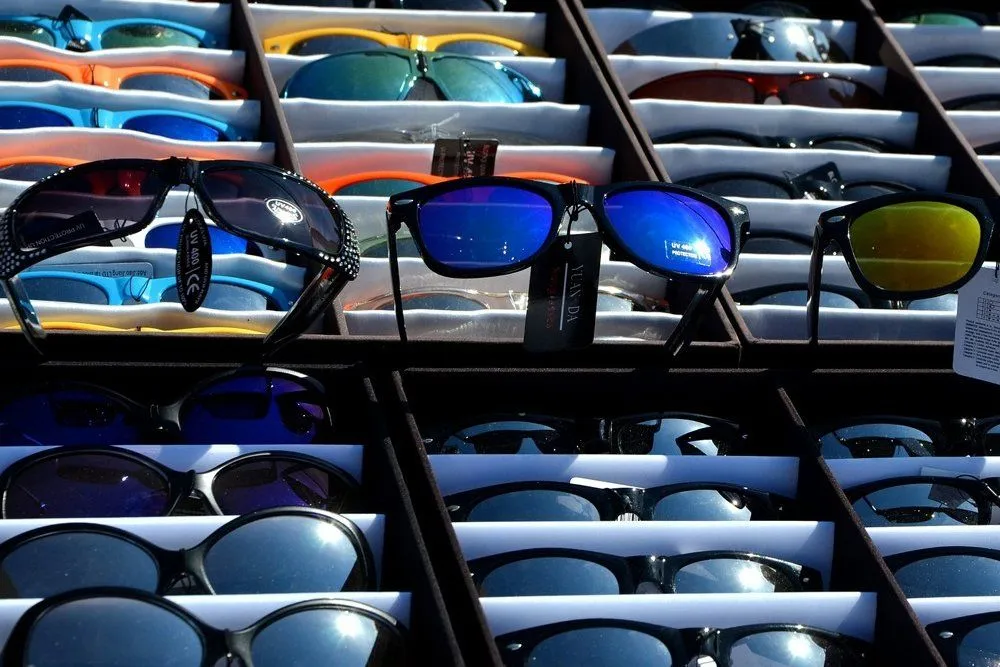
Good sunglasses can be referred to as extremely effective ‘light conditioners.’ They modify the incoming light that reaches your eyes. There are two fundamental ways that we see color. Direct light goes straight from the light source (e.g., the sun) to your eyes. Too much direct light can wash out the details of your surroundings and make it almost painful to try to focus your vision on any one thing. Reflected light, usually in the form of glare, is light that bounces off a reflective object before entering your eyes. Just like direct light, strong reflected light can make it difficult to perceive details or directly view an object. Snow, water, glass, and white sand are all excellent reflectors. The different tint colors serve the following purposes.
- Yellow or gold tints reduce the amount of blue light, while allowing a more significant percentage of other frequencies to pass through. Since blue light tends to bounce and scatter off many things, it can create a kind of glare known as blue haze. The yellow tint virtually eliminates the blue part of the spectrum.
- Amber and brownish tints are also good general-purpose tints. They have the added benefit of reducing glare and contain molecules that absorb higher-frequency light, such as blue, on top of any UV filtering built into the lens. Long-term UV exposure is a well-established risk factor for cataracts, and high-energy blue and violet light is suspected of playing a role too.
- Green tints on lenses filter some blue light and reduce glare. Because green tints offer the highest contrast and greatest visual acuity of any tint, they are very popular.
- Purple and rose tints offer the best contrast of objects against a green or blue background. This is why they are a good choice for hunting or water skiing.
The best sunglasses combine a UV filter, which blocks the direct ultraviolet light that does the real damage, with features that tame reflected light and glare. Sunglasses, surprisingly, have a lot of stuff packed into them to protect your eyes. They will typically contain tinting, polarization, mirroring, scratch-resistant coating and anti-reflective coating.
Polarized filters are commonly made of a chemical film applied to a transparent plastic or glass surface. The chemical compound used will typically be composed of molecules that naturally align in parallel relation to one another. When applied uniformly to the lens, the molecules create a microscopic filter, a little like a set of vertical slats, that absorbs the light waves matching their alignment. Light bouncing off flat surfaces like water, snow, or a road becomes horizontally polarized, so a polarized lens is oriented to soak up exactly that horizontal glare while letting useful vertical light through, which is why these lenses are so popular for driving, boating, and the beach. Photochromic lenses have millions of molecules of different substances, such as silver chloride or silver halide, embedded in them. The molecules are transparent to visible light in the absence of UV light, which is the normal makeup of artificial lighting. However, when exposed to UV rays in sunlight, the molecules undergo a chemical process that causes them to change shape. The new molecular structure absorbs portions of the visible light, causing the lenses to darken. The number of molecules that change shape varies with the intensity of the UV rays.

Reflective sunglasses often have a mirrored look that is called a half-silvered surface. The name “half-silvered” comes from the reflective molecules that coat the glass very sparsely; only about half the molecules needed to make the glass an opaque mirror are applied. At the molecular level, reflective molecules are speckled all over the glass in an even film, but only half of the lens is covered. The half-silvered surface will reflect about half the light that strikes the surface, while letting the other half go straight through. While glass is naturally scratch resistant, most plastics are not. To compensate for this, manufacturers have developed a variety of ways to apply optically clear hard films to the lens. Films are made of materials such as diamond-like carbon (DLC) and polycrystalline diamond. Through a process of ionization, a thin but extremely durable film is created on the surface of the lens.
The purpose of an anti-reflective (AR) element is similar to a scratch-resistant coating. The anti-reflective element is made of a material that has an index of refraction somewhere between air and glass, which causes the intensity of the light reflected from the inner surface and the light reflected from the outer surface of the film to be nearly equal. When applied in a thickness of roughly one-quarter of light’s wavelength, the two reflections from each side of the film cancel each other out through destructive interference, minimizing the glare that you see.

With all that technology in mind, the single most important thing to check before you buy is the UV rating. Tint darkness and price tell you almost nothing about protection: a deeply tinted bargain pair with no UV filter simply dims the scene without shielding your eyes, while a clear lens can block UV completely. Look for a label that reads 100% UV protection or UV400, which means the lens blocks light up to 400 nanometers and stops essentially all UVA and UVB rays. The American Academy of Ophthalmology recommends sunglasses that block 99% to 100% of UVA and UVB, and bigger or wraparound frames help by cutting the light that sneaks in around the edges.
As you can see, those simple shades that you put on all summer are more complicated than “meets the eye”, and now you understand the amount of precise technology that goes into making almost every pair of sunglasses!