Table of Contents (click to expand)
The 10,000-step goal began as a 1960s marketing slogan for a Japanese pedometer, not as a scientific finding. The number itself has no special significance. Recent research shows most of walking's health benefits plateau at around 7,000 steps a day, and what really matters is total energy burned, not hitting a fixed step count.
The famous Greek physician Hippocrates said, “Walking is man’s best medicine”. The fitness trend of walking 10,000 steps a day seems to have taken that advice to heart. With Fitbits, smartwatches and phones, people can now track their steps throughout the day. Some may even pace around aimlessly to meet this seemingly arbitrary goal.
So… is it really that important to walk 10,000 steps a day? What’s so special about 10,000 steps and why is that the standard set by wellness apps? Why not 8,000, 9,000 or even 15,000?
Why 10,000 Steps?
Did we arrive at the number randomly or was it determined through science? Well… neither. It all started in 1965 when a Japanese company, Yamasa Clock, launched a pedometer called the “Manpo-kei”, riding the wave of fitness enthusiasm that followed the 1964 Tokyo Olympics.
This is the Japanese term for a 10,000-step meter, “man” meaning 10,000, “po” meaning steps, and “kei” meaning meter or gauge. They used it as a clever marketing tool and it became their slogan. It was trendy, catchy and easy to remember.
There were theories that the word was used because, in Japanese, the character resembles a person walking, but there is no concrete proof to support that.

As it happened, the product was a success, and people were soon striving to achieve their 10,000-step goal each day. Wellness professionals, sports companies and even the WHO supported this trend.

As the slogan and quantized goal gained popularity, scientists tried to test this claim scientifically. What do you think the results were?
What Does Science Say About Walking 10,000 Steps?
If your guess all along was that the number 10,000 isn’t special, you’re correct. Yes, there was plenty of research that suggested walking 10,000 steps a day is a great thing to do, because covering 10,000 steps (roughly 6.4-8 km, or 4-5 miles) burns about 300-400 kcal, depending on your speed and body type, roughly equivalent to a ninety-minute walk.

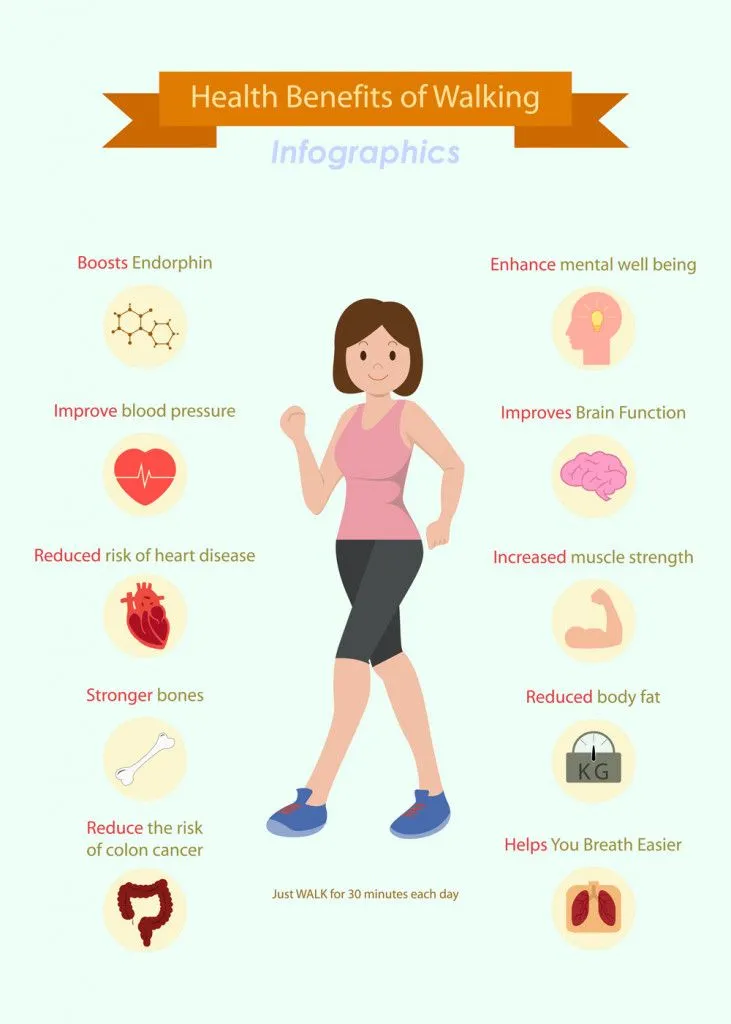
Also, according to international exercise guidelines, it’s recommended to get a minimum of 30 minutes of moderately intense exercise a day. Studies have shown that people who exercised this much have less body fat and lower blood pressure than those who exercised less. Unfortunately, not everyone finds it possible to achieve this daily target, due to our increasingly urban lifestyles.
Walking is considered a great exercise form, and there is ever-growing evidence stating that walking is good for health. It reduces the risk of lifestyle-associated diseases like diabetes, obesity, and cardiovascular problems, but the number 10,000 isn’t special. Instead of walking, running would burn more calories, meaning that you’d burn just as many calories in fewer steps.
Just as the Japanese company Yamasa Clock capitalized on the Olympics to market their pedometer and slogan, so too did public health bodies. International bodies like the WHO used this 10,000 steps/day goal to increase people’s energy expenditure. They used the scientific research backing the benefits of walking and exercise to promote the 10,000 steps/day goal.
Research has found that using this step-based goal was more appealing to the public than telling them to walk 30 minutes each day. People are also then more motivated to buy a pedometer and measure their path to 10,000 steps.
But again, there is no concrete evidence suggesting that meeting 10,000 steps a day is the main aim.
In fact, the studies that have actually measured steps point to a lower sweet spot. A large 2020 study from the US National Institutes of Health followed nearly 4,800 adults and found that people taking 8,000 steps a day had roughly half the risk of dying over the next decade as those taking 4,000, with little extra benefit beyond that point. A 2022 meta-analysis in The Lancet Public Health, pooling data from nearly 50,000 people, found that the longevity benefit leveled off at about 6,000-8,000 steps a day for adults over 60 and roughly 8,000-10,000 for younger adults.
The most thorough look came in 2025, when researchers reviewed 57 studies for The Lancet Public Health. They reported that walking about 7,000 steps a day was linked to a 47% lower risk of dying from any cause compared to walking only 2,000, along with lower rates of heart disease, type 2 diabetes, dementia, and depression. Crucially, the benefits climbed steeply at first and then flattened out, with most of the gains banked by around 5,000-7,000 steps. In other words, you reap the biggest rewards long before you hit 10,000, and chasing that round number isn't necessary for good health.
How Many Steps Should You Walk?
You’re probably wondering how many steps you should walk throughout the day, but there is no correct answer. The steps don’t matter… the intensity does.
Compare two kids who each walk 10,000 steps getting to school and back. One takes a flat, straight path, while the other has to climb a hill on the way there and descend it on the way home. On the trip to school, the kid going uphill burns far more energy than the one on level ground, even though both cover 5,000 steps. On the way home, the situation flips: walking downhill is easier than the flat route. By day's end both have logged 10,000 steps, yet the total energy they spent is very different.
Moderately exercising for 30 minutes a day burns approximately 150 kcal. Walking 10,000 steps a day accomplishes that and more, but it isn’t the only way to do it. If you want a number to aim for, the research points to roughly 7,000 steps a day as a realistic target that delivers most of the health payoff. Anything beyond that is a bonus, not a requirement.
If you’re finding it challenging to meet this numeric goal, that’s perfectly alright. Walk a little less. If it’s too easy for you, then aim higher! Go at the pace you are comfortable with and steadily work your way up. The aim of telling people to walk 10,000 steps a day is purely motivational so that people try to meet the minimum daily exercise requirements and just generally get active!
Conclusion
Don’t be disheartened that your goal of accomplishing 10,000 steps a day came from a marketing gimmick. It wasn’t all for nothing and, after all, you are reaping the benefits! Research has shown that people who completed less than 5,000 steps/day were at greater risk of developing health conditions. The science supports daily walking, though the number 10,000 is debatable.
One issue is whether the goal is sustainable. Not everyone is able to complete this goal and it’s normal to not reach the mark on lazy days.
Another issue is that this number is low for children. With childhood obesity becoming a bigger problem every day, 10,000 steps simply isn’t enough. They need to be walking more. Girls should be covering 11,000 steps/day, while boys should rack up about 13,000 steps/day for at least 5 days a week. This data applies to U.S. children, but may be similar elsewhere.
Research continues on the best way to motivate people worldwide to exercise and keep at it for better overall health. Just remember, it’s burning kcal that matters, not the number of steps you take!
References (click to expand)
- Tudor-Locke, C., & Bassett, D. R., Jr. (2004). How Many Steps/Day Are Enough?. Sports Medicine. Springer Science and Business Media LLC.
- De Cocker, K. A., De Bourdeaudhuij, I. M., Brown, W. J., & Cardon, G. M. (2007, December). Effects of “10,000 Steps Ghent”. American Journal of Preventive Medicine. Elsevier BV.
- Le-Masurier, G. C., Sidman, C. L., & Corbin, C. B. (2003, December). Accumulating 10,000 Steps: Does this Meet Current Physical Activity Guidelines?. Research Quarterly for Exercise and Sport. Informa UK Limited.
- Wattanapisit, A., & Thanamee, S. (2017). Evidence Behind 10,000 Steps Walking. Journal of Health Research, 31, 3.
- Higher Daily Step Count Linked with Lower All-Cause Mortality (Saint-Maurice et al., JAMA, 2020). National Cancer Institute, National Institutes of Health.
- Paluch, A. E., et al. (2022). Daily Steps and All-Cause Mortality: A Meta-Analysis of 15 International Cohorts. The Lancet Public Health.
- Ding, D., et al. (2025). Daily Steps and Health Outcomes in Adults: A Systematic Review and Dose-Response Meta-Analysis. The Lancet Public Health.