Table of Contents (click to expand)
The 4-hour workday is based on the observation that most knowledge workers can sustain deep, deliberate focus for only 4 to 5 hours a day in 90 to 120 minute bursts, after which productivity falls off sharply. Historical examples often cited (Darwin, Poincaré, G.H. Hardy, Alice Munro, John le Carré) and modern 4-day-week trials in Iceland, Microsoft Japan, the UK and Belgium all point to the same conclusion: working fewer focused hours, with proper rest, tends to maintain or even improve output.
Ask yourself, honestly, of the 8 hours that compose your workday, how many hours are you really productive? How many hours are you truly and uncompromisingly focused? Contemplate the number of hours in the last year that you have wasted looking at the monotonous sky, if you’re lucky enough to sit beside a window, or looking at the ceiling, if you’re not. While to your boss you seemed pensive, all you were thinking about was devouring the fruitcake you made the night before.

Or think about how many hours you’ve frittered away in the doldrums of a 9-5 job, either zoning out of meetings or indulging in currently the most common practice to distract oneself – scrolling. Today, we seldom find people who are immune to the seduction.
Why do we inevitably fall into this trap? Is it because, as one study concluded, we always underestimate the time we think we require to complete a task? If this is the case, we might be misled to believe that we can afford to squander some of that excess time on Facebook discovering which Ninja Turtle we might be. Every addiction psychologist knows that an addict, rather than deliberately repressing a craving, should take measures to prevent it from being conceived in the first place — rather than exercising one’s brittle willpower, one mustn’t carry money when heading out the door.
Similarly, to prevent employees from frittering away time and precious, expensive resources, should employers shorten the workday itself? There’s a consensus that the 8-hour proverbial grind is outdated and essentially all we need, regardless of the gamut of disparate domains – from engineering and law to science and art – is just 4 hours.

4 Hour Workday
The 40-hour work week is a relic from the Industrial Revolution. If you think 8 hours is excruciatingly long, prior to its implementation after the notion of 8-hours work, 8-hours recreation, 8-hours rest was propagandized by the Labor Union, workers worked as long as 16 hours every day. The startling discovery was that a reduction in working hours had absolutely no negative effect on productivity. In fact, after Ford Motor Company adopted the eight-hour day in 1914, its annual profits roughly doubled within the next two years (from about $27 million in 1913 to roughly $60 million by 1916). The employees were happier because their work-life balance was restored. This happiness undoubtedly encouraged them to be more fruitful, but it was primarily the pressure to do more in less time.
Perhaps 8 hours sufficed almost a century ago when work – particularly industrial, rather than creative – was solely manual. However, 8 hours seems nonsensical today when manual labor is automated, and work tends to be dominantly cognitive. Ironically, this realization should have saved us time, but instead, people still tend to work as long as even 90 hours a week, probably according to the logic that more hours guarantees more work. This logic is indisputable when applied to machines, but it is high time we realize that human beings do not operate in the same way.

Our mental bandwidth is embarrassingly small and, rather than pushing its limit, we’d be far more efficient if we leveraged it in a period or series of periods as small as possible. In today’s relentlessly competitive culture, Silicon Valley engineers would describe Charles Darwin as lethargic and unambitious for he, instead of working, spent most of his time contemplatively treading gardens and climbing mountains.
Charles Darwin, one of the most influential scientists ever to grace this planet, whiled away most of his time walking and ruminating, but also managed to write 19 books, including the revolutionary but highly controversial Origin of Species and The Descent of Man. Darwin didn’t toil for 16 hours each day; he achieved these glorious feats by working, as you might have guessed, only 4 hours every day. He worked for two 90-minute periods in the morning and then an additional hour later in the day.
The prolific mathematician Henri Poincare wrote 30 books and 500 papers that covered a range of diverse subjects from theoretical physics to philosophy, and he, like Darwin, also worked every day for no more than 4 hours. Every day he lent his elbows to his bench from 10 am to noon and then in the evening from 5 pm to 7 pm. Numerous artists belied the cliché of the obsessed artist: Nobel Prize winner in Literature Alice Munro (2013) and writer John le Carre weren’t glued to their notes-strewn desks until the story materialized; they also chose to work no more or less than 4 hours every day.

And wait, there’s more. The pioneer of capitalism, Adam Smith, wrote: “The man who works so moderately as to be able to work constantly not only preserves his health the longest, but, in the course of the year, executes the greatest quantity of work.” Bear in mind that capitalism is the very principle upon which our economy is based. According to the Bureau of Labor Statistics, the average private-sector workweek in the United States in 2026 was 34.3 hours. Either we have misconstrued Smith’s ideas, which is an innocent, reversible mistake, or the increasingly popular notion that the 90-hour work week is aspirational is a lie proliferated to exploit labor.
One of 20th century Britain’s most eminent mathematicians, G.H. Hardy, began his day with a lavish breakfast and learning cricket scores, followed by work from 9 am to 1 pm. “Four hours creative work a day is about the limit for a mathematician,” he is quoted as saying in C.P. Snow’s foreword to A Mathematician’s Apology. After 1 pm, he would abandon his desk for circuitous, pensive walks and playing tennis. Leonard Woolf, the husband of modernist writer Virginia Woolf, was also fascinated by “how much one can produce in a year, whether of buns or books or pots or pictures, if one works hard and professionally for” – wait for it – “three and a half hours.” What he meant by hard and professional was working with tremendous focus; not mechanically or unconsciously, but wisely.
Focus, Sleep, Repeat
These high-achievers did not work hard, but instead worked smart. They realized that taxing the mind for long hours at a time was counterintuitively unproductive. Rather, they worked when their energy was at its peak or when they felt that they were at their zenith of productivity. Every person experiences this peak; it is in this period when one does truly meaningful, thoughtful work, but every person also knows that it is immensely difficult to stay there.

This is the working principle of the 4-hour workday – tremendous, uncompromising focus during only these peak times. Furthermore, as the psychologist would suggest, rather than resisting enticing distractions, switch off the phone or your data to deny the phone the opportunity to distract you in the first place.
Naturally, these peaks are mentally exacting and therefore cannot last, it seems, more than 90-120 minutes. Also, as finite as this period is, try to dedicate it to conscientiously performing only a single task. In fact, writer of Two Awesome Hours, Josh Davis, has audaciously claimed that one can do more meaningful work in just two hours when fully focused than in two whole days when semi-focused! In other words, leverage every bit of energy you can summon in those two critical hours.
Beyond the 90-minute mark, productivity has been observed to plummet. Coffee and other stimulants, upon which 50 to 90-hour work weeks are helplessly dependent, make it worse. The achievers listed above did not just value focus, but also rest. A lack of sleep beckons stress, one of the potential causes of cancer. According to a 2015 Lancet meta-analysis led by Mika Kivimäki covering 603,838 individuals across multiple cohort studies, those who worked 55 hours or more every week were 33% more likely to suffer a stroke and 13% more likely to develop coronary heart disease than those who worked 35 to 40 hours every week. Of course, coffee mitigates sleep, but this emulates a rubber band effect: the more you stretch, the harder it hits you. Don’t be surprised if, at the end of the day, you’re completely exhausted and as effervescent as a zombie.

The critical importance of the conjugal relationship between tremendous focus and rest was best highlighted by Karl Anders Ericsson, Raif Krampe and Clemens Tesch-Romer. These researchers discovered a pattern in a study examining the lives of students learning the violin at a conservatory in Berlin in the 1980s. The researchers were interested in determining what separated the best from the rest. This was the very study based upon which Malcolm Gladwell stated his 10,000-hour rule in The Outliers, which is now a tenet of athleticism and other realms of achievement.
The researchers found that while every student practiced, the best students practiced deliberately, which required deliberate focus. However, the students never over-practiced. They were aware that excess focus and practice would cause burnout and injuries, so they practiced in regular, short bursts. The total duration of time they practiced every day was calculated to be, of course, 4 hours.
That is, 20 hours a week (excluding the weekends), 80 hours a month and almost 1000 hours a year, or 10,000 hours in a decade, just as The Outliers recommends. However, the rule is incomplete; its counterpart has been overlooked for a decade now. Not only did the best practice more deliberately, but they also rested more deliberately. They rested, on average, an hour more than the others in the study. Basically, squeeze 20-30-minute breaks or power naps between the 90-minute peaks. A brisk walk outside while assimilating the day’s work or listening to music or reading to forget about work for a while is advised.
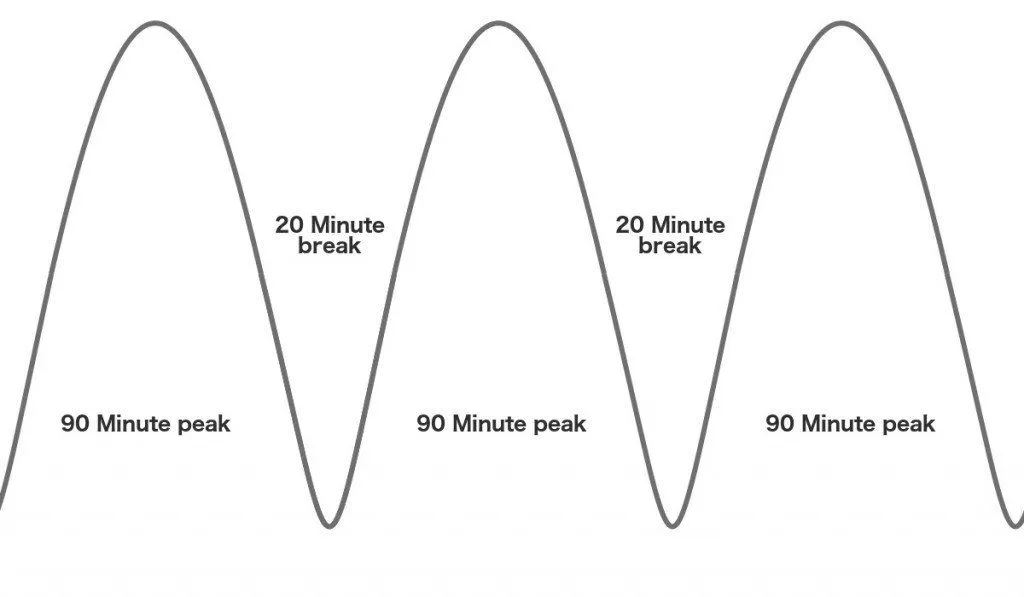
The crux of the argument is that a 4-hour workday makes us much more resourceful. We are able to, as Tony Schwartz advises, manage energy rather than time. Understand this distinction carefully. Becoming resourceful is not easy, as it requires one to make rigorous plans and follow them assiduously, but trust me, it pays off. In one study involving people who designed products, those who tackled the project with a smaller budget were significantly more resourceful and ultimately more successful than those who started with a larger budget. They simply didn’t have a choice. One can then spend the remaining 4 hours with family, with oneself, fulfilling passions and devouring fruitcakes. It is high time we begin to value work over presence.
Where Did the Eight-Hour Workday Come From?
If 4 hours is the sweet spot, why did the world settle on 8? The number is not a law of nature, and it is a good deal younger than the grind it describes. Its clean, three-way split traces back to Robert Owen, the Welsh industrialist who ran the New Lanark cotton mills in Scotland. By 1817, agitating against the punishing 12 to 14 hour shifts that defined British industry, Owen had landed on a tidy formula for the day: eight hours' labour, eight hours' recreation, eight hours' rest. It was less a scientific finding than a rallying cry, but the arithmetic was seductive: split the 24-hour day into three equal, humane parts.

Owen's idea did not catch on in Europe overnight, but it crossed the Atlantic and became the organizing demand of the American labor movement. In 1866 the International Workingmen's Association, meeting in Geneva, proposed eight hours as the legal limit of the working day. Then, at its 1884 Chicago convention, the Federation of Organized Trades and Labor Unions resolved that eight hours shall constitute a legal day's labour from and after May 1, 1886. When that date arrived, roughly 350,000 workers walked off the job at around 1,200 factories across the country, with about 80,000 marching in Chicago alone. The Chicago protests spiraled into the deadly Haymarket affair a few days later, but the eight-hour day had become a permanent fixture of the labor agenda.
The slogan most people still recognize was not Owen's original wording but the chorus of a protest song. "Eight Hours," with words by I.G. Blanchard and music by the minister Jesse Henry Jones, was published in 1878, and its refrain, eight hours for work, eight hours for rest, eight hours for what we will, became one of the anthems of the 1886 strikes. So the workday we treat as timeless was really a nineteenth-century compromise between exhausted mill hands and their employers. It was a vast improvement on 14-hour days, but nobody ever claimed those middle 8 hours were the number that squeezes the most good work out of a human brain.
The Modern 4-Day Week Experiments
The arguments above are not just historical curiosities. Over the past decade, several real-world trials have tested what happens when you actually cut the working week, and the results have largely supported what Darwin and Hardy figured out on intuition.
The biggest natural experiment ran in Iceland between 2015 and 2019, where roughly 2,500 public-sector workers (about 1.3% of the country’s working population) had their weeks cut from 40 hours to 35 or 36 with no loss of pay. Productivity stayed flat or improved across most workplaces, and worker wellbeing rose sharply. The trial was judged such a success that the unions then negotiated permanent reductions, and today around 86% of Iceland’s workforce has either moved to a shorter week or has the contractual right to do so.
Microsoft Japan ran a smaller but more eye-catching trial in August 2019 called the "Work Life Choice Challenge." Closing offices every Friday for a month produced a roughly 40% jump in productivity per employee, alongside 23% lower electricity usage and 59% less paper printed.
The most rigorous evidence to date comes from the UK 4 Day Week pilot coordinated by 4 Day Week Global, Autonomy, the University of Cambridge and Boston College, which ran from June to December 2022. Sixty-one companies and nearly 2,900 workers tried a 100-80-100 model (100% of pay, 80% of hours, in exchange for delivering 100% of output). Burnout dropped by 71%, sick days by 65%, attrition by 57%, and revenue across the reporting subset actually edged up by 1.4%. Ninety-two percent of the participating companies chose to continue the 4-day week after the pilot ended.
Belgium became the first European country to formally legislate a right to request a 4-day week, in 2022, although the law compresses the same total hours into four longer days rather than cutting them. Spain followed with a government-subsidised pilot for small and medium-sized businesses. None of these are a full-blown 4-hour workday yet, but they are pushing the conversation in the right direction.
References (click to expand)
- Kivimäki M et al. Long working hours and risk of coronary heart disease and stroke: a systematic review and meta-analysis. The Lancet, 2015. PubMed.
- Ericsson KA, Krampe RT, Tesch-Römer C. The role of deliberate practice in the acquisition of expert performance. Psychological Review, 1993.
- Results of the UK 4-day working week pilot. University of Cambridge Department of Sociology, 2023.
- The Results Are In: The UK’s Four-Day Week Pilot. Autonomy / 4 Day Week Global.
- Microsoft Japan’s 4-day work week saw productivity rise 40%. World Economic Forum.
- Average hours and earnings of all employees on private nonfarm payrolls (Table B-2). U.S. Bureau of Labor Statistics.
- Davis J. (2015). Two Awesome Hours: Science-Based Strategies to Harness Your Best Time and Get Your Most Important Work Done. HarperCollins.
- Smith A. An Inquiry into the Nature and Causes of the Wealth of Nations, Book I, Chapter 8.
- Eight-hour day movement (Robert Owen's 1817 formula; the 1884 Federation resolution; the May 1, 1886 general strike). Wikipedia.
- Eight Hours: the 1878 protest song by I.G. Blanchard and Jesse Henry Jones whose chorus became the 1886 eight-hour-day slogan. Encyclopedia.com.