Table of Contents (click to expand)
IQ (intelligence quotient) measures cognitive ability, such as reasoning, logic and problem-solving, while EQ (emotional quotient) measures emotional intelligence, the ability to perceive, understand and manage emotions. In Daniel Goleman’s popular model, EQ spans five traits: self-awareness, self-regulation, empathy, social skills and motivation. Neither is inherently “more” important, and both can be developed.
Self-improvement is a natural desire for human beings, but to improve ourselves, we must first understand our limitations and our potential. For many years, regarding the study of the mind, intelligence was thought to be the most important element that guided our lives.
In the beginning of the 20th century, a formal means of measuring intelligence was developed – the IQ (Intelligence Quotient) test. However, in recent years, a new theory has been proposed, focusing on people’s EQ (Emotional Quotient). There is a great deal of debate surrounding the relationship, similarities, differences, and strengths of EQ and IQ, and if we’re ever going to learn what truly makes us tick, we should all understand these two concepts a bit better.
IQ – Intelligence Quotient
The term “intelligence quotient” dates to 1912, when the German psychologist William Stern proposed dividing a child’s mental age by their chronological age (Lewis Terman later multiplied the result by 100 for the 1916 Stanford-Binet scale). That original “ratio IQ” of mental age to chronological age worked for children but broke down for adults, so modern tests instead use a “deviation IQ” that scores you against your own age group on a bell curve, with the average set at 100 and a standard deviation of 15. Eventually, the belief emerged that IQ measured a person’s fundamental intelligence and would not change throughout a person’s lifetime. This has since been shown to be incorrect (check out this article for the details), but IQ tests became widely trusted and very popular.
Due to their universal popularity, specific knowledge and facts are included to a very limited degree on IQ tests. Instead, an IQ measures your problem-solving skills, intuition, pattern recognition, reasoning, logic, mathematics, and a number of other fundamental skills that aren’t necessarily determined by what facts you’ve memorized. Essentially, IQ tests measure how someone learns, understands, and applies information in different settings.
This is critical to everything in our lives, including our careers, our fundamental behaviors, driving a car, reading a book, and everything in between. Clearly, having a higher IQ can help progress your academic and professional career, and perform the necessary tasks of daily life. However, that isn’t the whole story….
EQ – Emotional Quotient
While many people have the misconception that EQ and IQ are opposed, they are actually just different. Whereas IQ measures how people learn, understand and apply information, EQ measures how individuals learn, understand, and apply emotional knowledge. More specifically, an EQ (Emotional Quotient) score reflects how well a person can understand their own and other’s emotions, to differentiate between them, and to use that knowledge to guide your actions and behaviors. This emotional intelligence (EI) is extremely important for human beings, namely because we are emotional beings!
The term “emotional intelligence” first appeared in the mid-1980s, but the concept took off in 1990, when psychologists Peter Salovey and John Mayer published the first scientific definition, framing EI as a genuine mental ability to perceive, use, understand and manage emotions. Daniel Goleman’s 1995 bestseller Emotional Intelligence then carried the idea to a mass audience, and his popular model is the one most people picture today. Goleman described EI as five broad traits: self-awareness, self-regulation, empathy, social skills and motivation. Working on these traits can raise your EQ, since EQ, unlike IQ, is widely considered more flexible and improvable through concerted and conscious effort at self-improvement.
The ability to understand, control, and utilize your emotions is crucial to success in work, relationships, family matters, and personal health (physical and mental). Now, let’s take a slightly closer look at the five facets of EI.
Self-awareness: Argued by many to be the most important aspect of EI, the ability to “know thyself” and honestly appraise strengths, weaknesses, mistakes, and intentions.
Self-Regulation: Understanding your emotions is one thing, but keeping them under control and using rationality to guide your behavior, instead of instinct, is also very important.
Empathy: Recognizing emotional needs in others and effectively supporting them in the way that they require is a key to interpersonal relationships. This is the ability to see other people as humans, full of faults and insecurities, just like you.
Social Skills: Interacting with others in normal, acceptable ways, and engaging them both socially and intellectually, is a great way to create relationships and be a great leader. Doing this with respect and compassion is the sign of high EI.
Motivation: Chasing your dreams, setting long-term goals, and driving yourself forward to success is the sign of someone with high EI.
As you can see, these skills are incredibly important for success in every aspect of life, yet they have nothing to do with problem-solving, reasoning, math puzzles, or pattern recognition (in the classic sense of these skills). Obviously, EQ must be considered when analyzing a person’s potential to succeed. So… IQ or EQ? Which one is actually more important?
IQ Vs. EQ?
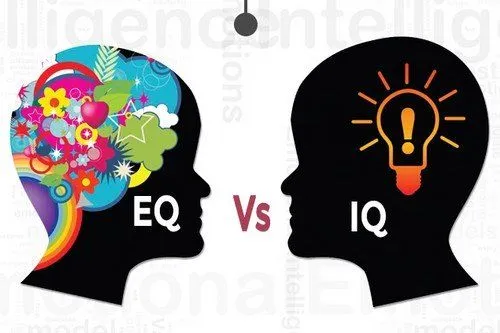
The short answer… neither is “more” important or “less” important. There are those researchers who suggest that EQ forms the foundation for all of your interactions and impulses, including the learning process, thus affecting your IQ and cognitive development. However, others posit that EQ is overrated and has a limited effect on your overall success in life. Consider it this way, having a high IQ might be a good predictor of a career path or industry, but your EQ score will determine how well you will function in that position (e.g. teamwork, leadership, etc.).
In the professional world, EQ has gained a great deal of popularity, and meta-analyses do link higher emotional intelligence to better job performance, even after accounting for IQ. That said, the effect is modest. Some popular books oversell it (Daniel Goleman’s often-quoted line that emotional factors account for most of what separates star performers was challenged at the time as having little hard data behind it), so it is fair to say EQ matters in the workplace without claiming it simply outweighs IQ.
IQ will always have a significant place, because it has proven its reliability for nearly a century. Also, an IQ test is relatively objective, whereas many EQ tests rely on self-report and are therefore easier to game (people try to score well, and thus may not answer honestly). Ability-based measures such as the Mayer-Salovey-Caruso Emotional Intelligence Test (MSCEIT) try to fix this by scoring emotional problem-solving against expert answers, but EQ remains harder to quantify than IQ across the general population.
The prevailing theory is that EQ and IQ do not work in opposition to one another, but are instead complementary aspects of an individual that often overlap and work together.
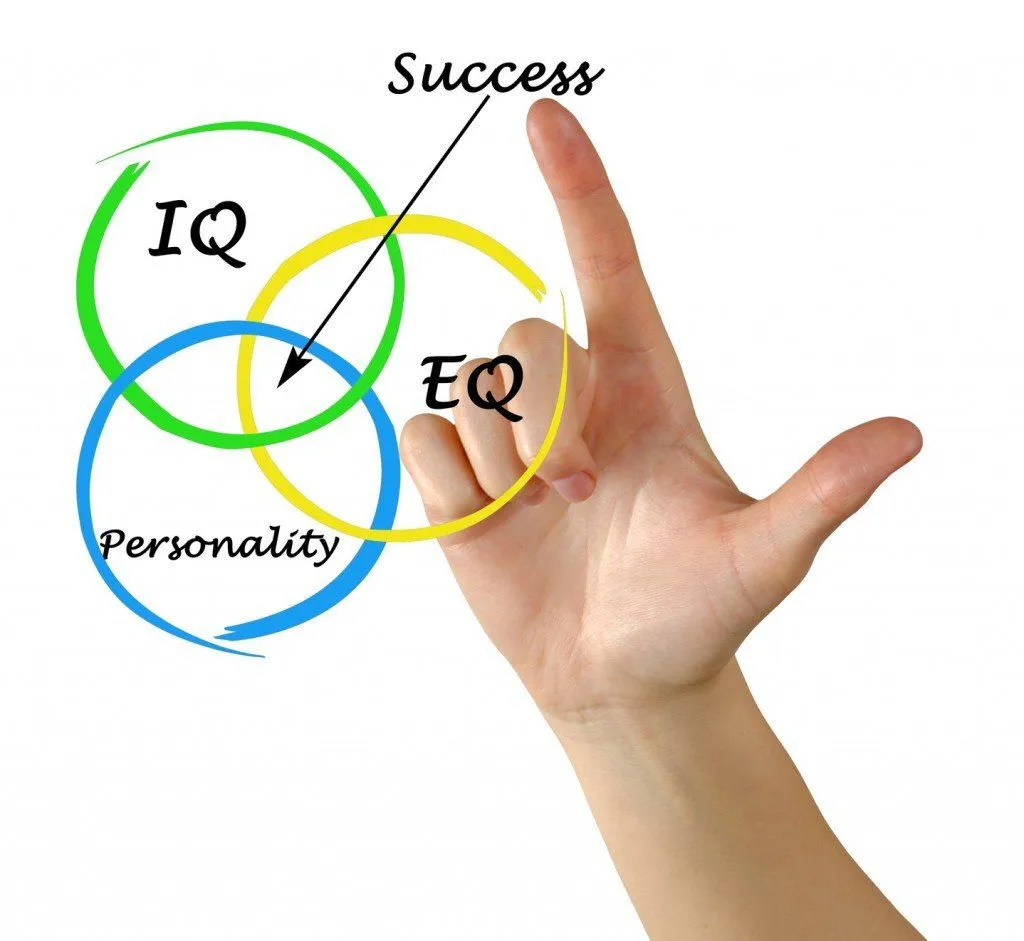
Instead of thinking about EQ and IQ as battling it out in an endless personality duel, recognize the value of both skill sets, improve them whenever possible, and enjoy the benefits that a powerful EQ/IQ combination can bring!