Table of Contents (click to expand)
Tanker trucks are cylindrical (or elliptical) because curved walls distribute internal pressure as uniform hoop stress in tension (something steel handles efficiently), while rectangular tanks concentrate stress at their corners. Cylinders also have a lower, more uniform centre of gravity, drain completely without trapped pockets, and accept baffles to dampen liquid surge.
While driving around the city, you have surely seen oil/water tankers hundreds of times. Although tankers come in different sizes, have you noticed the rather interesting thing that’s common in almost all tankers? All liquid-carrying tankers are cylindrical in shape.
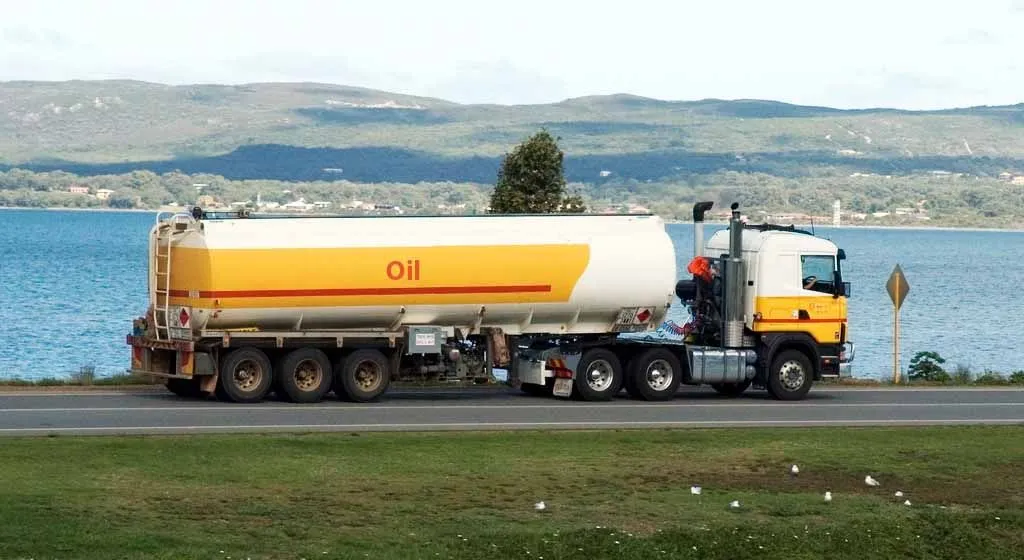
Wouldn’t a rectangular tank be able to carry more volume than a cylindrical one? Also, it seems like a rectangle-shaped tanker would be easier to manufacture on a large scale. With that in mind, why do these trucks carry cylindrical (or elliptical) tankers?
Tank Trucks
A vehicle that’s specially designed to carry liquefied loads, such as water, oil or gases is referred to as a tank truck (or tanker truck). Some of these tank trucks, especially the pretty large ones, are quite similar to railroad tank cars that you’ve likely seen chugging along on railway lines.
There are many variants of tank trucks, depending on the type of liquid that needs to be transported. Tank trucks can be large or small, pressurized or non-pressurized, insulated or non-insulated and so on.
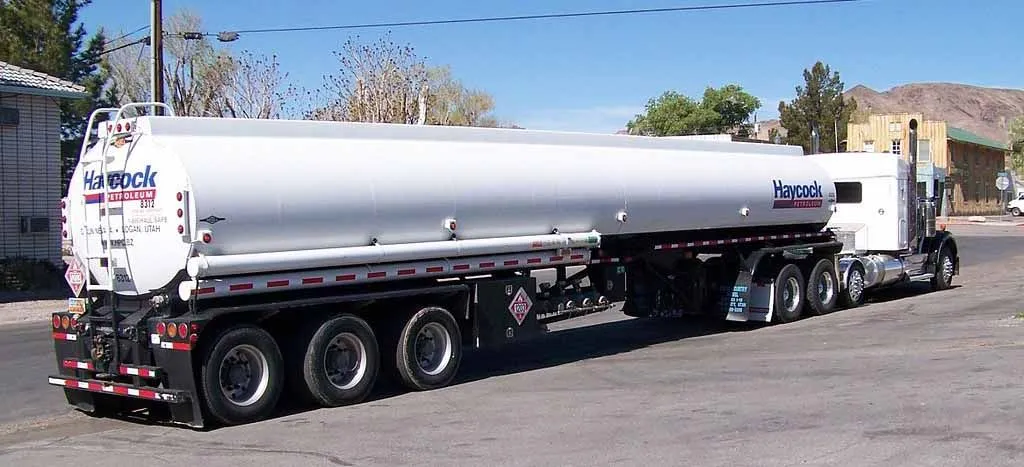
Most, if not all, tank trucks that carry liquids are of a cylindrical/elliptical shape. Why is that?
Reasons For The Cylindrical Shape Of Oil/liquid Tankers
No Weak Spots
Firstly, a cylindrical container doesn’t have “weak spots” that need reinforcing. When liquid (or gas) pushes outward against the wall of a tank, a curved surface converts that pressure into uniform hoop stress, a tensile load that steel is excellent at carrying. A flat side, by contrast, wants to bulge outward like a balloon, and the corners act as stress concentrators. A rectangular tank therefore needs heavy internal bracing or thick walls to handle the same pressure a thinner-walled cylinder shrugs off, using more material and adding more weight.
That’s the same reason why windows in commercial airplanes have rounded corners, rather than being perfectly rectangular or square-shaped. The early de Havilland Comet jetliners used near-square windows, and those sharp corners acted as stress raisers that seeded fatigue cracks under repeated cabin pressurization; later aircraft switched to rounded windows to spread that stress out.

Spherical shapes are the best for housing liquids, as a sphere lets you store the maximum volume for a given surface area. However, spheres are not easy to transport, so the next best choice becomes a ‘long’ sphere, i.e., a cylinder or ellipse.
Stability
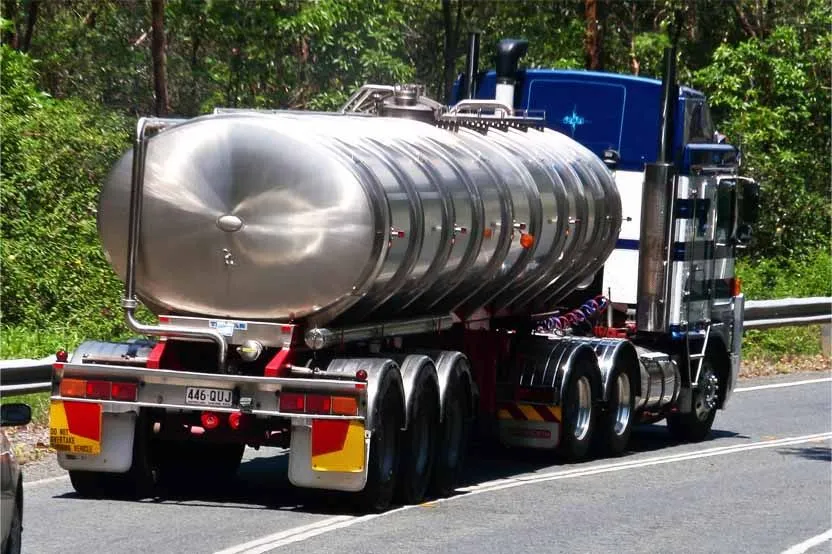
The stability of the vehicle, especially one carrying liquids like oils and liquefied flammable gases, is paramount. You want a shape whose centre of gravity sits as low as possible. This is why fuel tankers are often elliptical rather than perfectly circular in cross-section. The squat oval is wider and shorter than a round cylinder of the same volume, lowering the CG and improving cornering. Either curved profile beats a tall rectangular tank, which would put a much heavier mass higher off the road.
Sloshing Liquid
There’s also the problem of sloshing of the liquid. You see, when a truck accelerates/slows down, the liquid in the tanker is bound to slosh around (i.e., move to and fro) within the tanker in accordance with the law of inertia, i.e., an object at rest stays at rest and an object in motion keeps moving until acted upon by an unbalanced external force.
This sloshing effect is called surge in industry lingo. To minimise it, most tankers have internal partitions: baffles (with holes that let fluid flow through slowly) or bulkheads (full dividers that split the tank into separate compartments). These break the long body of liquid into smaller masses that can’t build up as much momentum. This is one of the reasons good tanker drivers brake and turn gently: a fully loaded tanker without effective baffling can shove the truck forward several feet after the brakes have stopped the cab.
Although a sphere is the best shape to counter surging, as we discussed, that’s not an easy shape to transport. Thus, cylindrical – the next best – is preferred.
Liquid Extraction And Maintenance
A cylinder, as you can imagine, is more favorable when it comes to extracting the liquid contents of the tanker, as it lets the liquid funnel down to the bottom of the tank.
A rectangle, on other hand, wouldn’t be a great choice in this regard. This is the same reason why most bathroom sinks are NOT rectangular.
Lastly, rectangular tankers would be more difficult to clean than cylindrical ones, as traces of liquid would get stuck in the corners, making them harder to sanitize. Cylindrical/elliptical tankers present no such cleaning or sanitary problems.
How Much Does A Tanker Truck Hold?
Once you’ve noticed how many of these tankers are on the road, the obvious next question is: just how much liquid is sloshing around inside one? The answer is governed less by the size of the cylinder than by a number you might not expect, the weight limit on the road itself.

In the United States, a fully loaded truck on the Interstate System is capped at a gross weight of 80,000 pounds (about 36,300 kg), with no single axle carrying more than 20,000 lb (about 9,070 kg) and no tandem axle more than 34,000 lb (about 15,400 kg). Once you subtract the weight of the tractor, the trailer and the empty tank, that ceiling, not the geometry of the cylinder, is what really decides how much fuel you can pour in. Because a liquid like gasoline weighs roughly 6 lb per US gallon (about 0.72 kg per litre), a typical road fuel tanker fills out at somewhere around 9,000 US gallons (roughly 34,000 litres) before it hits that weight wall, which is why most highway tankers cluster in the same size range rather than simply being built ever larger.
The fuel tanker you see at a filling station is usually built to the U.S. federal DOT 406 specification (the standard that replaced the older MC 306 design). These are low-pressure tanks: the rules require a maximum allowable working pressure of just 2.65 to 4 pounds per square inch (psig), so the cargo is essentially carried at atmospheric pressure rather than squeezed in under high pressure. The tank is split into separate compartments, often three to five of them, each with its own hatch, which is how a single truck can drop regular gasoline at one stop and diesel or premium at the next without mixing the loads. Those compartment walls double as bulkheads that keep the surging mass of liquid broken up, the same anti-slosh idea we met earlier. So a tanker’s “size” is really a balancing act between a curved shell that handles pressure cheaply, a low centre of gravity for stability, and a hard legal limit on what the axles are allowed to press onto the road.
References (click to expand)
- Only in 3D are spheres the worst packers | New Scientist. New Scientist
- Crude Oil Transport: Risks and Impacts - Green Choices. Cornell University
- Oil Loading and Unloading Procedures - www.uhcl.edu
- AV Perelmuter. Analysis of the Stressed State of Cylindrical Tanks with .... CiteSeerX
- Bridge Formula Weights. Federal Highway Administration (FHWA), U.S. Department of Transportation
- 49 CFR 178.346-1 - General requirements (Specification DOT 406 cargo tank). Legal Information Institute, Cornell Law School
- Celestial Body (de Havilland Comet window fatigue). Smithsonian Air & Space Magazine