Manholes are round because a circular cover is the simplest shape that cannot fall through its own opening at any angle. A round cover also distributes traffic loads evenly with no weak corners, can be rolled rather than lifted by a single worker, and drops into place without having to be aligned with the rim.
I didn’t know how popular this question actually was, but once I started to do some research about it online, I realised that it’s actually a very common question to be asked during job interviews for corporate positions (most of which are not even distantly related to architecture or civil engineering!). You’ve also seen countless manhole covers while strolling along the street, but have you ever asked yourself why they are that shape?
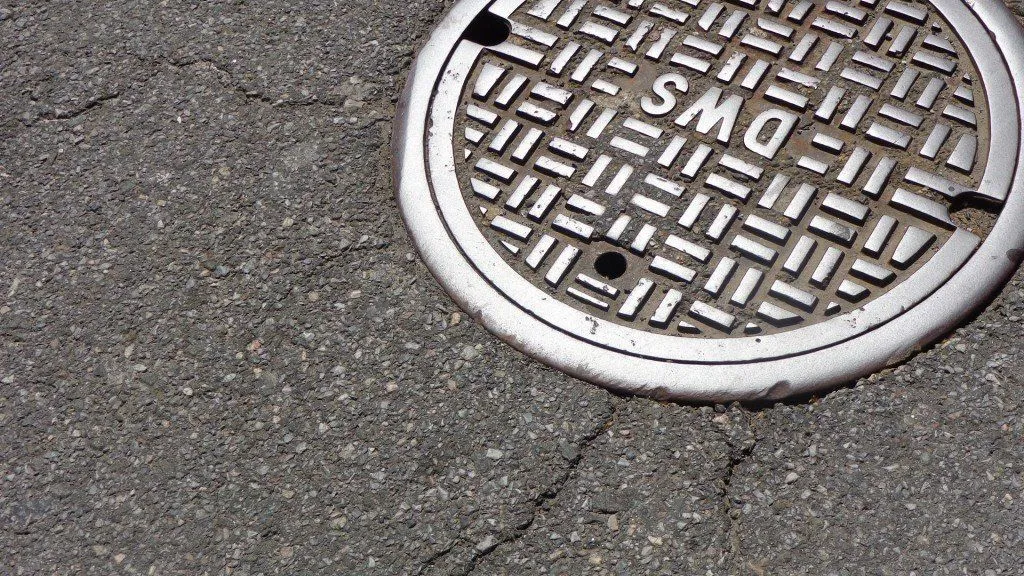
What’s the reason behind this innocuous detail underfoot in our daily lives? Why aren’t manhole covers some other shape, like a triangle, a rectangle or even a square? Squares are a popular choice for lids and covers elsewhere, so why wouldn’t they work in this situation?
What’s A Manhole?
Unless you’ve have been living under a rock for years, you already know what a manhole is. Also known as a maintenance hole, utility hole, inspection chamber or sewer hole, it’s an opening to an underground space (usually a confined one) that’s used for a variety of purposes, including inspections, making repairs and connections and performing maintenance operations.
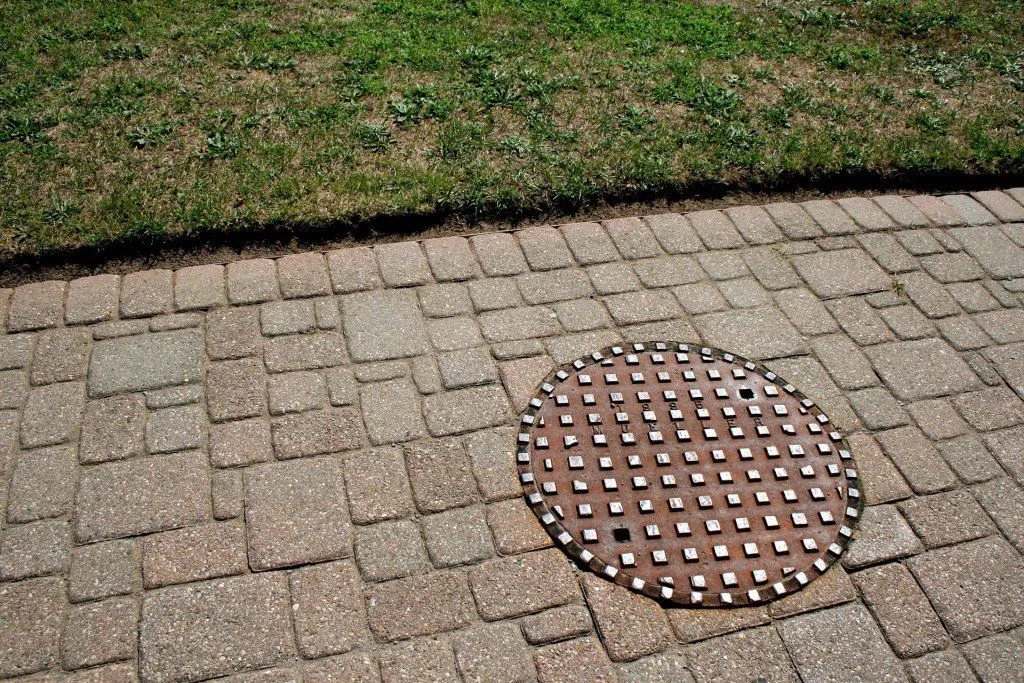
Some of the most common areas where you might find a manhole are underground public utilities, such as sewer, telephone, water, electricity, etc.
Manhole Covers
As mentioned earlier, manholes are openings to underground spaces (that are usually confined or shut off from the outside world); it goes without saying that they need to be properly covered/closed to prevent any unauthorized access (you must have seen your fair share of those in movies) and to avoid freak accidents, like people falling through them and injuring themselves.
Covers are typically made of cast iron, ductile iron or concrete (or some combination of these), which makes them durable, inexpensive and quite heavy. In recent years, composite covers made from fiber-reinforced plastic (FRP/GRP) have actually become the largest single product category sold worldwide, because they’re much lighter, don’t rust and aren’t worth much to metal thieves.

Another important thing to know about manhole covers is that they’re put on top of a metal base that has a smaller inset rim, which is why the cover fits perfectly.
Why Are Manholes Usually Circular?
Circular Covers Won’t Fall Through The Opening On Which They Sit!
The most commonly cited reason is that the circular shape of the cover ensures that the cover doesn’t fall through the opening itself. This actually makes sense, since rectangular/square covers would fall through the opening if inserted diagonally into the hole (Source).
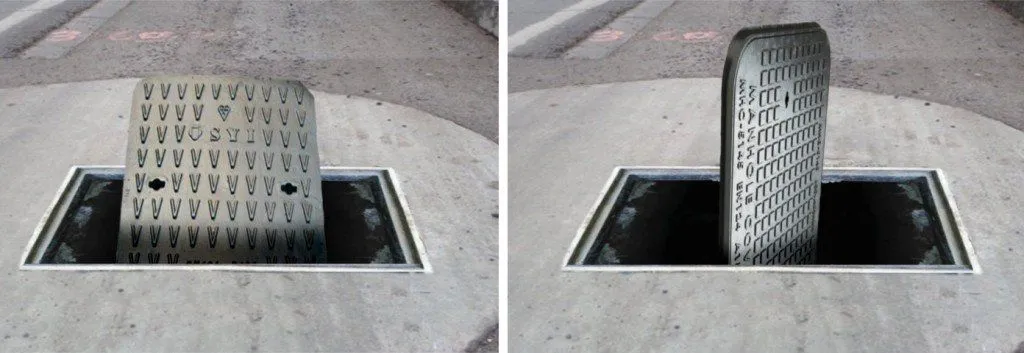 Rectangular manhole covers would be a bad choice.
Having said that, circular ones are not the ‘only’ covers that wouldn’t fall through the openings they protect; a curve of constant width or a Reuleaux triangle would also serve the purpose. But they would be much more complicated to manufacture on a large scale than simple, circular covers.
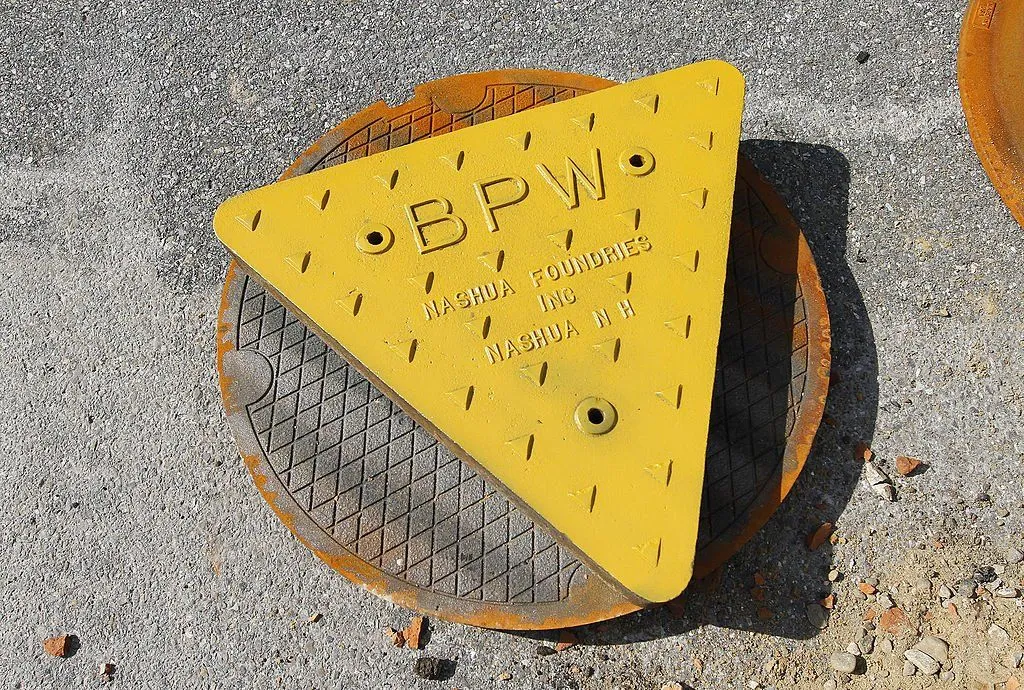
Portability
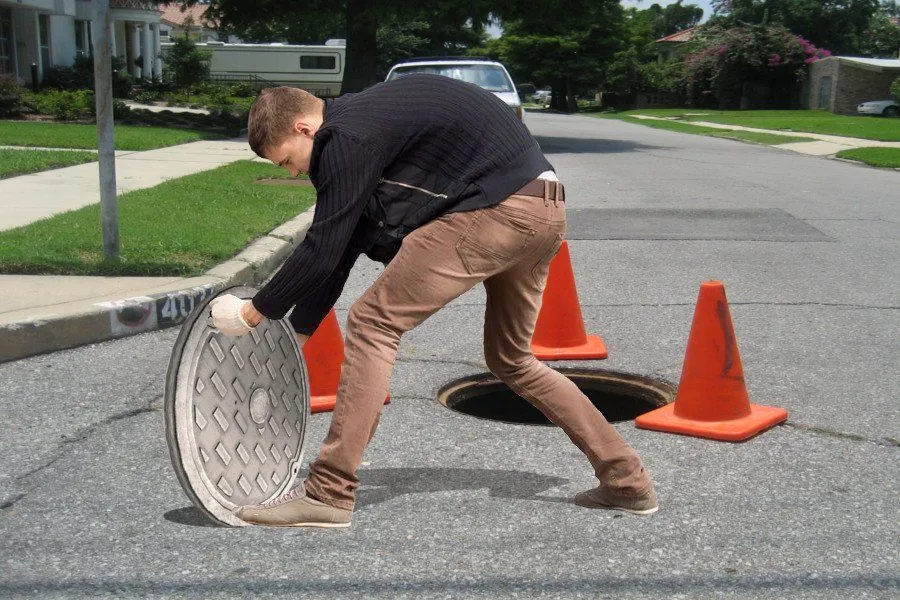
Imagine working on a manhole and you want to move a cover to another hole a few dozen meters away. Since a typical cover weighs upwards of 50 kg (about 110 pounds), carrying it all the way would be quite a workout (one that you don’t particularly need while working on the streets!). A circular cover is ideal in such scenarios, as it can simply be rolled to reach the destination much faster, while applying relatively little effort.
Aren’t we supposed to learn from the legacy of our ancient forefathers who first discovered the wheel?
Best shape to resist compression
A round cover also spreads the weight of trucks and traffic evenly across its rim, with no corners where stress can pile up and crack the casting. That’s the same reason arches and domes are curved, and it makes circular covers the most material-efficient choice for the load.
Easy To Fit
A circular manhole can easily be fit into the hole by simply sliding it over the top, whereas with other shapes, you would have to properly align the cover with the edges and angles of the hole to fit it into place.
Not Very Easy To Unlock
In some countries, like France, they ‘lock’ these round covers in place by making a quarter turn after slipping it into place. This makes it more difficult for anyone without a special tool to just lift it and go exploring.
Why Can’t A Circle Fall Through Itself? (The Math)
Here’s the bit that turns a street-level curiosity into a neat piece of geometry. A circle has the same width no matter which way you measure across it. That width is just the diameter, and it never changes as you rotate the cover. So however you tilt or turn a round lid above its hole, the gap it has to squeeze through is always narrower than the cover itself, and it simply cannot slip in. A square cover fails this test: its diagonal (corner to corner) is about 1.41 times its side, so stand it on edge and that long diagonal will drop straight through the shorter side of the opening.
Mathematicians call any shape with this property a curve of constant width, defined as one where the separation of every pair of parallel supporting lines is the same, regardless of their orientation. The circle is the obvious example, but it isn’t the only one. The famous alternative is the Reuleaux triangle, a curved triangle built by drawing three circular arcs, each one centered on one corner of an equilateral triangle and sweeping between the other two. Because it also has constant width, a Reuleaux-triangle cover can’t fall through its opening either. If you’ve ever wondered how a drill can bore a (nearly) square hole, that same shape is the trick behind it. (We have a whole piece on what the Reuleaux triangle is if you want to go down that rabbit hole.)

So the honest answer to “what shape stops a cover falling in?” isn’t only a circle. It’s any shape of constant width. The circle just happens to be the cheapest and simplest one to cast, roll and drop into place, which is why it wins in practice.
Manhole Covers And The Famous Interview Question
If this question feels oddly familiar, that’s because for years it was a staple of tech job interviews, most notoriously at Microsoft, with Google and plenty of others borrowing it too. It became shorthand for the “lateral thinking” brain-teaser: a problem with no single right answer that’s meant to reveal how a candidate reasons rather than what they’ve memorized.
Tellingly, one Microsoft interviewer who used the question wrote that it “probably isn’t an official interview question” at all, but simply a way “to help loosen up the interviewer and have some fun” while seeing whether someone could think on their feet. The answers he collected over the years ranged from the sensible (“it won’t fall into the hole” and it’s “easier to roll the cover some distance than carry it”) to the cheeky (“because the hole is round”). Crucially, he also noted that a cover not falling in is true “for an equilateral triangle” too, which is exactly the constant-width point above. The exercise rewards spotting that there are several valid reasons (load, rolling, fitting, geometry) and being able to argue them, not parroting one textbook line.
So if you ever get asked, the gold-standard reply ties it together: a round cover can’t fall through its own opening because a circle has constant width, it spreads load with no weak corners, it can be rolled instead of lugged, and it drops in without lining up edges. That this homely object became a hiring legend is a small reminder that good science questions hide in plain sight.
The Manhole Cover That May Have Beaten A Rocket Into Space
No manhole article would be complete without the wildest story attached to one. In August 1957, during the United States’ Operation Plumbbob nuclear tests in Nevada, physicist Dr. Robert Brownlee ran an experiment nicknamed Pascal-B to see whether an underground blast could be contained. A nuclear device sat at the bottom of a deep shaft, and the top was sealed with a heavy steel cap, four inches (about 10 cm) thick, that Brownlee himself described as having “appreciable mass from a man-handling point of view.”

When the bomb went off, a high-speed camera filming one frame per millisecond caught the cap in just a single frame before it vanished. From that, Brownlee later calculated a speed of roughly “six times the escape velocity from the Earth.” The tale is often retold as the fastest human-made object ever, supposedly blasted clear into space. Brownlee himself was far more cautious: he stressed that his figure came from a simplified calculation and called it “meaningless” for predicting the cap’s real fate. The plate was never found, and the likeliest outcome is that air resistance and compression heating vaporized it within the atmosphere. So the cover almost certainly did not reach space, but as the punchline to a question about a humble street fixture, it’s hard to beat.
There you have it. It’s not like someone woke up one morning and decided that manhole covers would only be circular; there are plenty of logical reasons behind the choice.
References (click to expand)
- Manhole cover - Wikipedia
- Reuleaux triangle (curve of constant width) - Wikipedia
- The Reuleaux Triangle and Curves of Constant Width - Cleve Moler, MathWorks
- Rolling with Reuleaux - Science News
- Why are Manhole Covers Round? - Middle School Math and Science, Ohio State University (archived)
- Reuleaux Triangle - Wolfram MathWorld
- Why is a manhole cover round? A Microsoft interview question - Microsoft Learn (archived blog)
- Operation Plumbbob - Wikipedia
- Learning to Contain Underground Nuclear Explosions - Robert R. Brownlee