Table of Contents (click to expand)
- Presumptive Tests
- What Is Luminescence?
- Chemiluminescence: Detecting Blood
- Why Does Semen Fluoresce Under UV Light?
- What Color Does Semen Glow Under UV Light?
- Which Body Fluids Glow Under a Black Light?
- Can a Black Light Detect Old or Washed-Out Stains?
- Do Bodily Fluids Glow in the Dark on Their Own?
- A Final Word
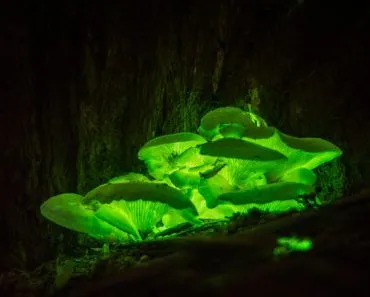
Crime dramas show us shining splatters of blood and semen at certain crime scenes. The scientific reason behind these glow-in-the-dark splatters is due to a chemical phenomenon called luminescence.
Every crime drama fan knows that body fluids are important forms of evidence. However, they aren’t always clearly visible. The blood may have been wiped away, or the semen may have dried up, leaving only an indistinct stain behind. To detect these, the forensic experts will shine a special light in a dark room and voila, the bright lights will reveal bodily fluids.
But is that accurate? How and why do bodily stains “light up”?
Presumptive Tests
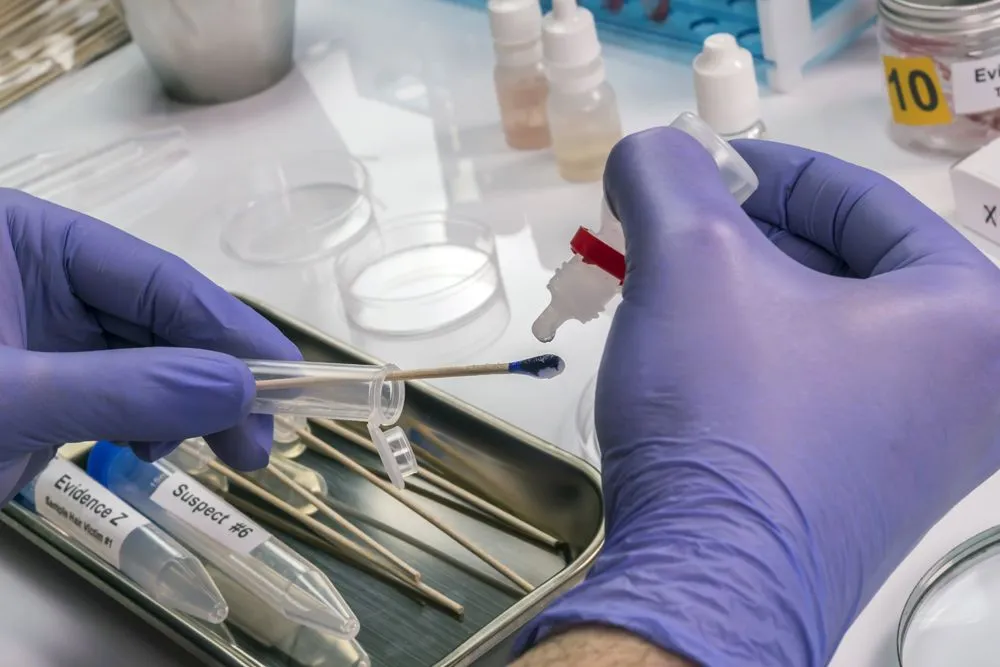
Despite the name, these tests are real. When forensic experts need to check if certain fluids are present at a crime scene, they will perform presumptive tests. The tests help strengthen the assumption that bodily fluid is present. False positives have been found, as certain other substances react similarly to these tests.
To confirm, forensic experts will then usually perform more rigorous tests.
From among the arsenal of presumptive tests up a forensic expert’s sleeve, one is called an alternate light source. These tests are where an expert shines a light on a bodily fluid, and if the fluid is present, it lights up.
The next question, of course, is how do they light up? Through a phenomenon called luminescence.
What Is Luminescence?
Luminescence is a phenomenon where a chemical substance emits light without being heated. This can happen in two broad ways, chemiluminescence and photoluminescence.
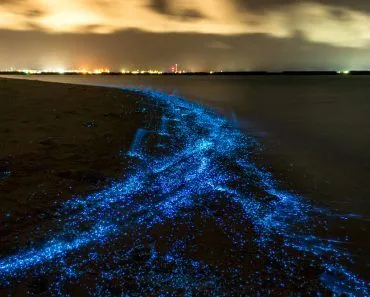
Chemiluminescence, as the name suggests, occurs via a chemical reaction. A subset of chemiluminescence is bioluminescence, in which life, through certain metabolic reactions, creates light. One of the best examples of this is fireflies.
Photoluminescence is when light causes a chemical to in turn release light. There are two types of photoluminescence: fluorescence and phosphorescence. For this article, we’re only interested in fluorescence.
Fluorescence works like this. One would shine light with high energy (light with short wavelengths) on a chemical that can fluoresce, called a fluorophore. That chemical will absorb the energy in the light. The energy will cause the electrons in that chemical to get excited. Excited electrons, though, are unstable. So, they release the extra energy as vibrational energy (they vibrate a lot) and light energy. The emitted light has less energy (and therefore a longer wavelength) than the initial light source, as some energy was given out through vibrating.
Many of our bodily fluids are either chemiluminescent or fluoresce.
Chemiluminescence: Detecting Blood
Blood is readily visible; newer stains are red, and older ones are brown. Despite being visible, such stains can be cleaned away. Luckily for investigators, blood leaves traces behind.
Several tests help reveal blood stains, but only one works through luminescence.
A chemical called luminol (for the fellow nerds, the IUPAC name is 5-Amino-2,3-dihydrophthalazine-1,4-dione) is frequently used to detect blood stains at a crime scene.
Luminol In Action.
When luminol is mixed with a little hydrogen peroxide and contacts hemoglobin (the molecule in RBCs that transports oxygen and gives your blood a red color), or rather, the heme in the hemoglobin, a blue hue is generated.
The best conditions to see this blue hue is in the dark because the light is quite faint. The light is emitted as long as the chemicals react, so multiple sprays of luminol may be required.
Luminol is a good detector of blood. According to one estimate, it can help detect 1 microliter of blood in 1 liter of a solution! For comparison, a single drop of blood is 50 microliters!
Why Does Semen Fluoresce Under UV Light?
Bodily fluids like saliva, semen, and vaginal fluid do not require a chemical agent to make them emit light. Instead, they fluoresce when exposed to the right (short) wavelength of light.
In 1919, physicist Robert Wood found that UV-A light, what he called “black light,” could be useful in detecting certain bodily fluids. The technique caught on, and since then, the light has been known as Wood’s light or Wood’s lamp.
Semen is excited by short-wavelength light in roughly the 300-450 nm range (ultraviolet into violet) and emits a faint blue-white fluorescence. The invisible (to us) UV rays don’t interfere with that emitted light, so forensic experts can pick out the stains. In practice, though, a plain UV “black light” is unreliable on its own: one study found that none of 29 semen samples actually fluoresced under a Wood’s lamp, whether wet or dry, which is why modern teams favor a tunable blue/blue-green light source instead. This technique can also mislead, as skin, hair, and cloth fluoresce under the same wavelengths.
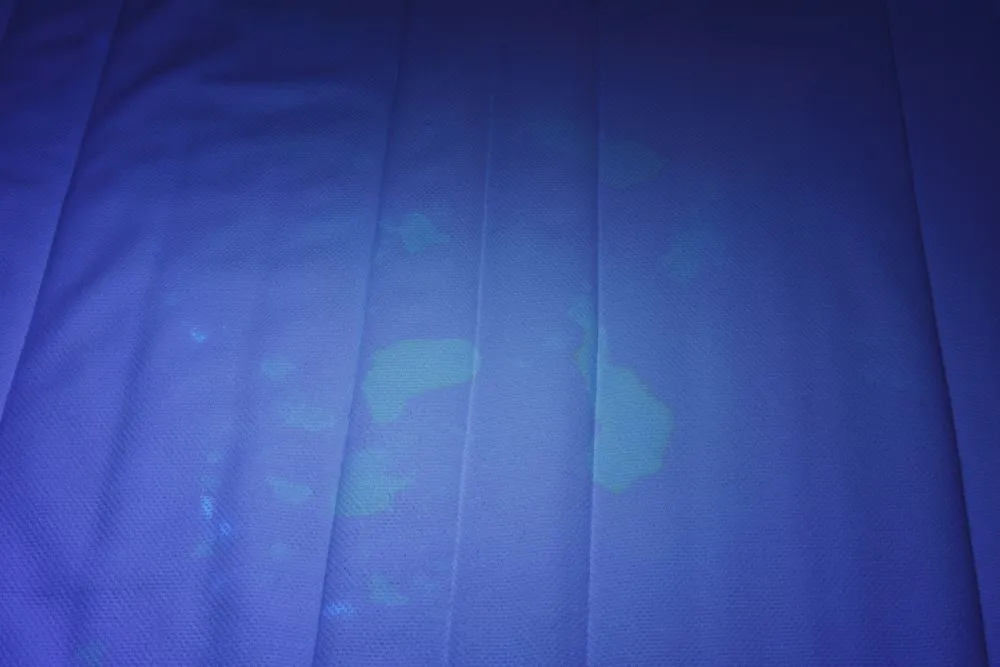
When semen is exposed to wavelengths between 430-470 nm (within the visible spectrum), it generates an orange fluorescence. This can be visualized by using a light filter to filter out all other wavelengths of light besides the fluorescing light. This prevents interference from other sources.
Saliva, urine, and vaginal fluid fluoresce for the same reasons as semen: the chemicals, primarily the proteins and lipids (fats), present within them.
What Color Does Semen Glow Under UV Light?
If you have ever seen a forensic scene on television, you might expect semen to flash an unmistakable neon blue. The reality is more muted. Under a true ultraviolet "black light," semen tends to give off a faint blue-white glow, and it is often surprisingly hard to spot. The faint light comes from natural fluorophores in the fluid, mainly proteins rich in the amino acid tryptophan, along with flavins and oxidation products that build up as the stain ages.
The exact color you see depends heavily on the light you use. Forensic teams rarely rely on a plain UV lamp. Instead they use a tunable alternate light source and shine blue or blue-green light (roughly 415 to 490 nm) at the surface, then view it through an orange or yellow filter. Under those conditions a semen stain can appear to fluoresce a brighter blue-white or even a yellow-orange against the darkened background. There is no single "official" color, which is exactly why a glow alone is never treated as proof. Dried semen, saliva, and urine can all look broadly similar, so the color is a clue, not a verdict.
Which Body Fluids Glow Under a Black Light?
Semen is the fluid people ask about most, but it is far from the only one that lights up. The body fluids that fluoresce on their own, without any chemical spray, are the ones loaded with fluorescent molecules such as tryptophan, flavins, and the breakdown products of vitamins. In forensic and laboratory studies, the fluids that fluoresce under the right light include:
- Semen – a faint blue-white fluorescence, brightest under blue/blue-green light.
- Saliva – fluoresces thanks to tryptophan in the enzyme amylase.
- Urine – often one of the brighter fluids, driven by flavins, pterins, and porphyrins.
- Sweat and vaginal fluid – fluoresce for the same reason, through their proteins and other organic compounds.

The famous exception is blood. Blood does not glow under a black light. The hemoglobin in red blood cells absorbs light rather than re-emitting it, so a bloodstain actually looks darker, not brighter, under UV. That is precisely why blood needs a different trick entirely. Investigators reach for luminol, which produces its own glow through a chemical reaction (chemiluminescence) rather than fluorescence. A handy rule of thumb: if a fluid is rich in proteins and waste products, it tends to fluoresce; if it is rich in iron-bearing hemoglobin, it tends to absorb.
Can a Black Light Detect Old or Washed-Out Stains?
This is where the myth of the all-seeing black light starts to crack. Fluorescence is not permanent. Heat, humidity, sunlight, bacteria, and mold all chip away at the fluorescent molecules in a stain over time, so an old mark can fade and grow harder to see. Counterintuitively, an aging semen stain can also shift the way it fluoresces. Researchers have used that gradual change to roughly estimate a stain's age, but only over a window of a couple of weeks, not months or years.
Washing complicates things further. A run through the laundry can dramatically weaken or wipe out the visible glow, especially because many detergents contain "optical brighteners" that themselves fluoresce and can swamp the real stain in background light. Yet laundering does not always erase the underlying evidence. Studies have recovered the chemical and DNA traces of semen from fabric even after it was washed, which is why forensic teams treat the black light as a first-pass screening tool only. The glow points to where to look. Laboratory tests then decide what is actually there.
Do Bodily Fluids Glow in the Dark on Their Own?
A common search, and a common worry, is whether semen or other fluids glow on their own in a dark room, or light up at a club or rave. The short answer is no. Fluorescence is not the same as glow-in-the-dark. A fluorescent material only emits light while it is being hit by an outside source of short-wavelength light, such as a UV lamp. The instant you switch that light off, the glow vanishes, because the excited electrons drop back to their resting state in well under a millionth of a second.

Tonic water is the easy demonstration: the quinine in it fluoresces a vivid blue under the UV lamps at a club, then looks ordinary the moment you carry it back into normal light. True "glow-in-the-dark" materials are a different phenomenon called phosphorescence, where a substance keeps releasing stored light for seconds or minutes after the source is gone. Body fluids do not do this. So no, they will not glow on a pitch-black dance floor; they only reveal themselves when a UV or alternate light source is actively shining on them.
A Final Word
These tests are crucial first steps in identifying evidence that could connect a victim to a suspect. However, since they are only presumptive tests, they are liable for inaccuracy. One study found that doctors misidentified other substances, such as hand cream, soaps, and antibiotic creams, as semen, even when they used Wood’s lamp.
A similar case exists for blood. Other substances, particularly those with copper and iron, also give out a similar chemiluminescence with luminol.
DNA testing and checking for specific proteins are much stronger and are far more accurate. Forensic scientists test a liquid to detect a group of proteins called protamines that are present only in semen. These biomarkers are more reliable than a blacklight.
References (click to expand)
- Khan, P., Idrees, D., Moxley, M. A., Corbett, J. A., Ahmad, F., von Figura, G., … Hassan, M. I. (2014, April 22). Luminol-Based Chemiluminescent Signals: Clinical and Non-clinical Application and Future Uses. Applied Biochemistry and Biotechnology. Springer Science and Business Media LLC.
- Webb, J. L., Creamer, J. I., & Quickenden, T. I. (2006, April 27). A comparison of the presumptive luminol test for blood with four non‐chemiluminescent forensic techniques. Luminescence. Wiley.
- Stoilovic, M. (1991, October). Detection of semen and blood stains using polilight as a light source. Forensic Science International. Elsevier BV.
- Santucci, K. A., et al. (1999). Wood's Lamp Utility in the Identification of Semen. Pediatrics, 104(6), 1342-1344. (American Academy of Pediatrics)
- Specific fluorescent signatures for body fluid identification using fluorescence spectroscopy. Scientific Reports (Nature), 2023. PubMed Central.
- Towards Onsite Age Estimation of Semen Stains Using Fluorescence Spectroscopy. Sensors (Basel), 2023. PubMed Central.