Table of Contents (click to expand)
TV and video games hook the brain because they deliver fast, frequent rewards that release dopamine in the brain’s reward system, which makes you crave more. Studying offers the same brain little instant payoff, so it never fires that loop as strongly. The real difference is the timing of the reward, not the activity itself.
Most children start learning to read somewhere around 5 to 7 years of age. However, the age at which kids start to watch TV and play video games differs greatly from one family to the next.
Personally, I started watching TV when I was 7-8 years old, and started playing video games when I was in third grade. I can also assure you that I have spent a reasonable part of my life being engaged in any of these three activities – reading/studying, watching TV and playing video games.
However, here’s an interesting observation – I never enjoyed studying as much as I like watching TV or playing video games.

There’s something about playing video games that easily gets you hooked, something that’s not present with studying. Note: Throughout this article, when the word ‘study’ is used, it should be inferred that I am only referring to the kind of studying that’s purely academic in nature. This obviously doesn’t include ‘light reading’ or the kind of reading that you take up on your own.
I’m fairly certain that most people, especially youngsters, can relate to this ‘condition’ of enjoying TV and video games more than they enjoy dedicated academic learning.
However, have you ever thought why that is the case? Wouldn’t it be awesome if we could get addicted to studying as quickly and badly as we get hooked on a TV series or a new video game?

The answer to this question obviously lies with the brain!
Brain’s Reward System
The brain has a so-called reward system. Essentially, it makes you happy when you have/do certain things, and then makes you want it even more. If you don’t have/do more of that thing, then it throws a tantrum and makes you cranky and irritated, or even angry, at times. It can only be pacified once it has what it craves. That’s basically how the brain’s reward system works.

More specifically, the reward system is a group of neural structures that are responsible for associative learning (primarily classical conditioning and positive reinforcement), as well as positive emotions, especially those that have ‘pleasure’ at their core. In other words, the reward system is a number of components in the brain that are activated by ‘rewarding’ stimuli.
Role Of Dopamine In Addiction
When exposed to a rewarding stimulus, the brain responds by increasing its release of a neurotransmitter known as dopamine. Dopamine is the one neurotransmitter that’s the primary ‘culprit’ behind all kinds of addiction – be it addiction to video games, watching too much TV, drinking too much alcohol, doing drugs or even eating junk food.
The structures associated with the brain’s reward system are found along the major dopamine pathways in the brain. The following image will help you visualize this better:
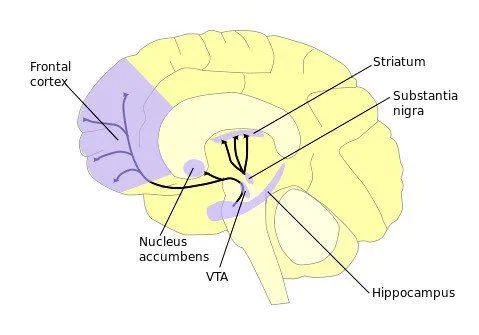
Whenever you do something that makes you feel good (e.g., doing something fun, watching a movie, or even finishing a task), the reward system is flooded with dopamine. This is what makes you really ‘enjoy’ things and want to do them again (so you get more of that enjoyment).
If the brain is flooded with such chemicals in a very short span of time, it takes time for the brain to ‘adjust’ itself and return to its normal state.
Why Is Playing Video Games So Much Fun?
Watching TV, playing video games, gambling… these are certain activities that are specifically designed to force your body to release these chemicals. When the effects of these chemicals begin wearing off, we tend to feel ‘bad’ and try to seek the same stimulus again to feel good all over again.

Over a brief period of time, this cycle of instant gratification often leads to dependency, wherein the individual has trouble staying ‘normal’ without that stimulus. This is what slowly turns into an addiction of the same stimulus.
Activities like studying or learning something academic are typically not instantly gratifying, nor do they hand you the kind of excitement or ‘high’ that a good game does. That’s the absolute opposite of playing video games.
To be clear, studying does reward your brain. Solving a tough problem or finally understanding a concept absolutely releases dopamine too. The catch is when, and how reliably, that reward arrives. The payoff from studying is delayed and uncertain (you might ace the exam in three weeks, or you might not), while a game pays you back in seconds, again and again.
In fact, video games are often designed to keep giving you ‘hits’ of those chemicals. These hits are aptly called ‘dopamine hits’, and game studios pour real research into figuring out how to keep them coming. A landmark brain-imaging study by Koepp and colleagues, published in Nature in 1998, used PET scans to actually watch dopamine flood the striatum (a core part of the reward system) while people played a video game, with the biggest surge in the ventral striatum.
There’s another trick at work: the rewards in games are unpredictable. You don’t know whether the next loot box, level, or kill will pay off, and that uncertainty is precisely what psychologists call a variable-ratio reward schedule, the same pattern that makes slot machines and social media so hard to put down. Predictable rewards are easy to ignore; uncertain ones keep you chasing. Watching TV works in a related way; the next twist or cliffhanger is its own instant reward (unlike studying).
That’s why it’s so much easier to get hooked on TV and video games than studying.
References (click to expand)
- Zastrow, M. (2017, April 25). Is video game addiction really an addiction?. Proceedings of the National Academy of Sciences (PNAS).
- Koepp, M. J., et al. (1998). Evidence for striatal dopamine release during a video game. Nature, 393, 266-268.
- WHO gaming addiction classification an important step for .... Iowa State University of Science and Technology
- Drugs, Brains, and Behavior: The Science of Addiction - Drugs and the Brain. National Institute on Drug Abuse (NIDA).
- Sharma, M. K. (2016, March). Video Game Addiction and Life Style Changes: Implications for Caregivers Burden. Indian Journal of Psychological Medicine. SAGE Publications.