The decimal system is favored because we have ten fingers. However, the dozenal system would fare much better. It is more divisible, which makes it easier to divide goods or money. It is also more versatile. The only downside is that it would require rewriting a majority of math textbooks.
The decimal system is widely favored for the simple reason that we have ten fingers. Each abstract quantity from 0-9 can be counted on each of our long fingers. Had our primate ancestors evolved with twelve fingers, perhaps humans would have adopted the duodecimal or Base-12 system for counting. However, this inadequacy in no way stopped us from exploring the option, as well as higher numerical systems.
Ancient peoples, including the Sumerians and Egyptians, counted not on their ten fingers, but on the twelve finger segments (phalanges) of one hand, using the thumb as a pointer. It is a pity that entire institutions are based on the decimal system, that we still use for our daily, mundane computations, such as counting money when, as mathematicians suggest, Base-12 or the dozenal system would fare much better.
Where Did Base-12 Come From?
Long before anyone debated which base was "better," ordinary hands were already counting in twelves. Each of your four fingers (setting the thumb aside) has three bones, or phalanges. Using the thumb of the same hand as a pointer, you can tick off all twelve of those finger segments in a single sweep, which gives you a built-in tally that runs to a dozen rather than to ten. This finger-joint method is no historical curiosity: it is still used as an everyday counting trick across parts of the Middle East, South Asia and beyond.

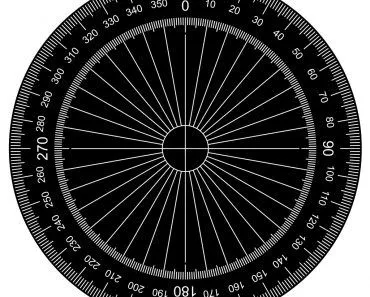
That twelve-on-one-hand habit may be the hidden ancestor of one of the oldest number systems on record. Historians of mathematics have suggested that the Sumerian Base-60 (sexagesimal) system was born when two peoples merged, one counting in twelves on the finger bones of one hand and the other counting in fives on the fingers of the other; point at each of the twelve segments with each of the five fingers and you reach sixty. The Babylonians inherited that system, and its fingerprints are still all over the clock face and the 360° circle.
Base-12 also left a permanent mark on our units. The Romans split the pound and the foot into twelve parts they called the uncia ("a twelfth"), and that single Latin word is the direct ancestor of both the inch and the ounce. We still buy eggs by the dozen (12) and stock by the gross (12 × 12 = 144), reckon 12 months in a year and (twice) 12 hours on a clock, and split a foot into 12 inches. None of this was planned as a coherent "Base-12 movement," yet the dozen keeps surfacing precisely because it divides so cleanly.
Higher Divisibility
The twelve symbols in the dozenal system are 0, 1, 2, 3, 4, 5, 6, 7, 8, 9, plus two additional digits for ten and eleven. The Dozenal Society of America uses turned digits ↊ (pronounced ‘dek’) for ten and ↋ (pronounced ‘el’) for eleven, though X and E are also common in plain text. The number twelve in the system is written as 10 and pronounced ‘doh’. The next twelve numbers are listed with the prefix ‘doh’ in this way: doh-1 (11), doh-2 (12), doh-3 (13), and so on up to doh-dek (1↊) and doh-el (1↋). The number twenty-four is therefore called 2-doh, and subsequent numbers follow the same pattern.
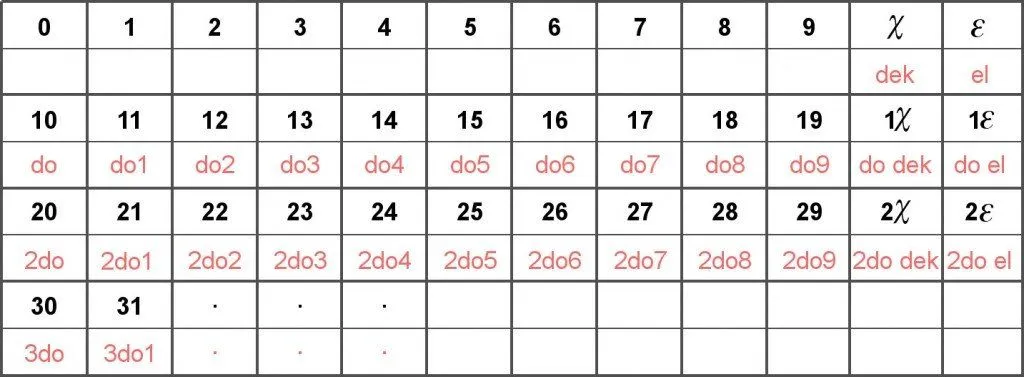
Of course, the system seems bewildering at first, but so does the decimal system or the alphabet to a child encountering it for the very first time. Once we become accustomed to the system, however, we begin to realize that its benefits are worth the trouble. For instance, children will find that learning multiplication tables in Base-12 is much easier than in Base-10. Consider the multiplication tables of three, four and six in Base-12.
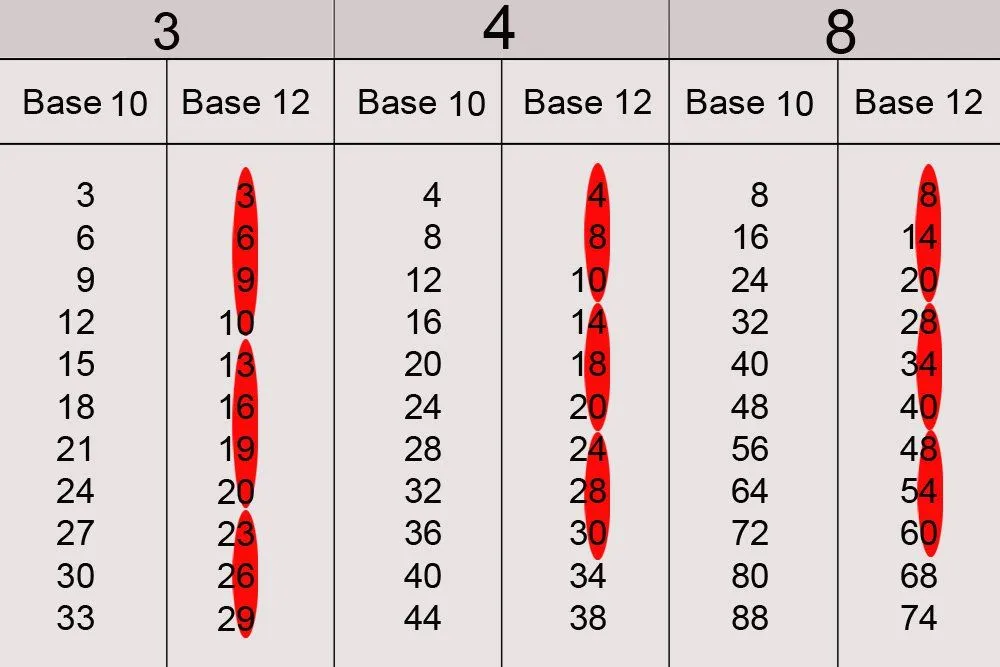
The transformation shows that a distinct, recurrent pattern emerges within each table, rendering them easier to learn.
However, mathematicians don’t admire the system for its aptitude for multiplication, but rather for its aptitude for division. An excellent number system is one that is divisible by more numbers. For instance, while 10 is only divisible by 1,2, 5 and 10 itself, 12 is divisible by 1,2,3,4,6 and 12 itself. This makes for easier opportunities to divide say, goods or the money you buy them with.
Consider dividing $100 or 100 goods into three equal parts. Each part will consist of $33.3333.. or 33.3333.. goods each, a fraction that is universally frowned upon. Now, let’s divide the same number in the dozenal system. Now, 1/3 is the same as dividing 4/12, however, 12 in the dozenal system is 10, so, the division now becomes 4/10, which is equal to 0.4, a perfectly rigid fraction.
Or consider dividing $100 into 2/3 parts. Each part must acquire $0.6666.., again, a number that perturbs us. Now, let’s perform the division in Base-12. The fraction can be written as 8/12, which in the dozenal system transforms to 8/10 or 0.8, a number not so perturbing.
How Do You Count And Convert Between Base-12 And Base-10?
Counting in Base-12 looks strange for exactly one stretch: the run-up to twelve. You count 0, 1, 2, 3, 4, 5, 6, 7, 8, 9, then keep going with the two extra symbols, ↊ (dek, for ten) and ↋ (el, for eleven). Only after eleven do you roll over and write 10, which here means one dozen, not ten. So the dozenal sequence reads 8, 9, ↊, ↋, 10, 11, 12 (decimal twelve, thirteen, fourteen), all the way up to 1↋ (twenty-three) and then 20 (two dozen). If the symbols ↊ and ↋ are awkward to type, you will often see A and B used in their place, the same letters hexadecimal borrows.
Converting a Base-12 number to our everyday Base-10 is just bookkeeping with place values. Each position is a power of twelve instead of ten: reading right to left the columns are worth 120 (1), 121 (12), 122 (144), 123 (1,728), and so on. Multiply each digit by its column value and add the results. For the two-digit number 1↊12, that is (1 × 12) + (10 × 1) = 22 in decimal. For 2↊312, it is (2 × 144) + (10 × 12) + (3 × 1) = 288 + 120 + 3 = 411.
Going the other way, from Base-10 to Base-12, you repeatedly divide by twelve and read the remainders from last to first. Take decimal 100: 100 ÷ 12 = 8 remainder 4, and 8 ÷ 12 = 0 remainder 8, so 100 in decimal is written 84 in dozenal (8 × 12 + 4 = 100, as a check). The fractions are where the system shows off: a third of a dozen is simply 0.4 and two-thirds is 0.8, both clean and terminating, whereas the same fractions become the messy 0.333... and 0.666... in Base-10.
The Most Versatile System
However, one can argue that if divisibility is the virtue of an excellent system, shouldn’t we adopt an even larger system, such as Base-200? The logic is indisputable; 200 is divisible by far more numbers than 10 or 12 is. Also, the space complexity is drastically reduced, as it allows us to represent larger numbers with smaller units. However, to use the system effectively, one must remember a mammoth 200 symbols! On the other extreme, there is Base-2 or the binary system, which consists of merely two symbols (1 and 0) but requires a number as small as 50 to be represented by a long string of bits: 110010. Let’s not forget that it also exhibits the poorest divisibility.
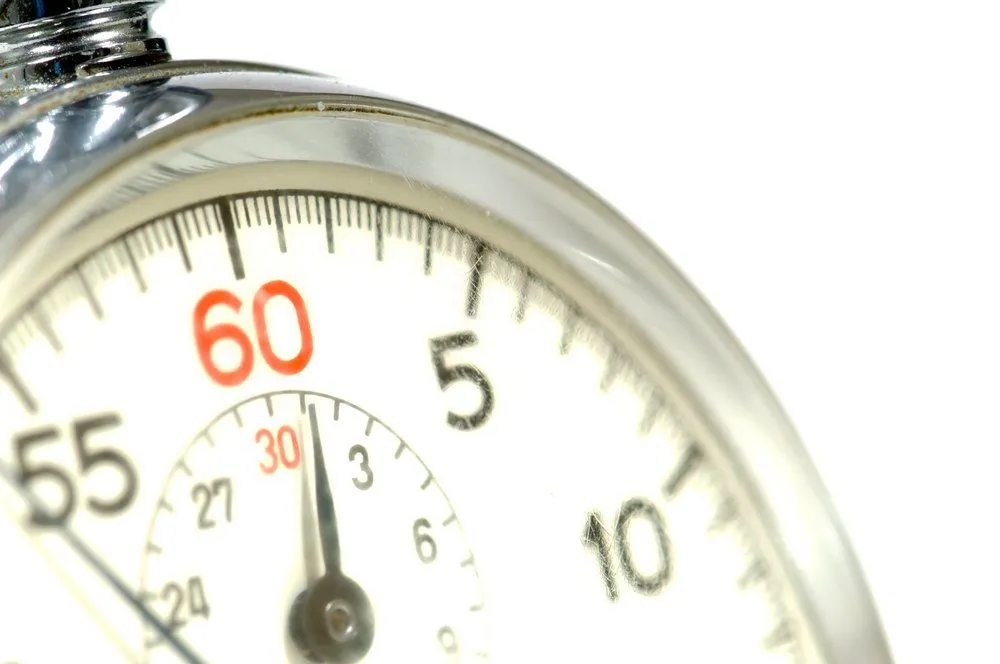
A compromise must be made between the three aspects: symbol size, space complexity and higher divisibility. The ancient Sumerians were the first people to develop Base-60 or the sexagesimal system, later inherited by the Babylonians, which was nothing less than genius. The system consists of fewer symbols than the symbols in Base-200 and exhibits less space complexity than the binary system. However, its most valuable characteristic is that not only does it have the same number of factors as 200 (12), but unlike 200, it is trichotomous (divisible by 3). This has rendered it the most convenient and therefore most ubiquitous system to keep time and, since being inherited by the Greeks, to study angles.
The dozenal system enjoys the same advantage. Systems like Base-12 or Base-60 are therefore wonderfully versatile number systems. Yes, 12 has fewer factors and higher space complexity than 60, but it is still trichotomous and the number of symbols in Base-12 is far less than in Base-60. There are only two more symbols than are found in the religiously followed Base-10 system, so learning the extra two symbols is not too high an obstacle to surmount. In this nature, Base-12 is truly profound: of all the versatile number systems, it is the easiest to learn.
Our use of the decimal system is purely based on habit. One is not even required to unlearn the entire decimal system; you must simply incorporate two additional symbols into the existing order. But… is it too late? The revolution will come at the maddening cost of rewriting a majority of math textbooks ever published. As of now, this is, no doubt, highly implausible.
Decimal’s Failed Stint
Neither the addition of two months to the original ten-month calendar, nor the notion of a 12-hour day and night was accepted in view of 12’s virtues, but the fortuitous effect is evident nonetheless. What was accepted in view of its virtues were the units of lengths and weights: 12 inches still make up a foot. However, everything was reshuffled when the decimal system was revived, and a majority of the units were metricized. In fact, for a brief period, even time was decimalized.
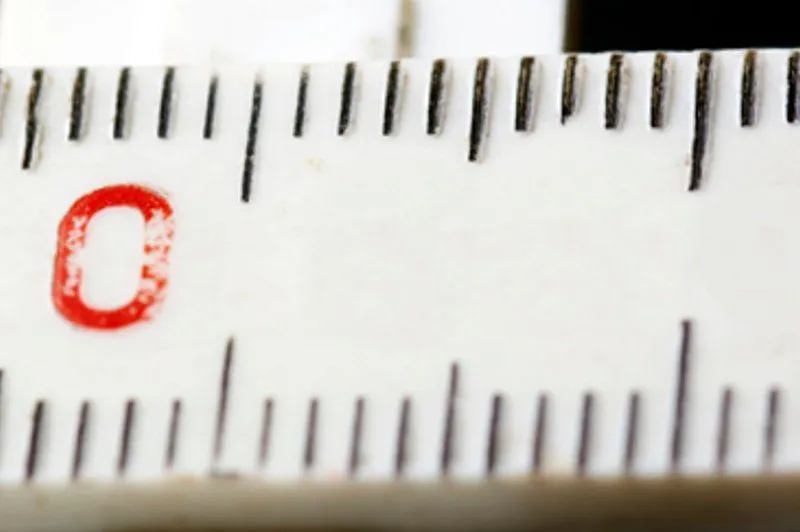
The French were enamored, or rather obsessed, with the Base-10 system, to the extent of inventing and following a calendar charting not seven, but ten-day weeks. The month was then not divided into four weeks but three decades. What’s worse is that they even decimalized the days! The day was legally divided into ten hours instead of twenty-four, whereby each hour comprised one hundred minutes, each of which comprised one hundred seconds. Each day was then 100,000 decimal seconds long, as compared to the 86,400 seconds it is in a standard 24-hour-60-minute-60-second day.
The citizens were required to work for not six, but nine marginally longer days every week! This was, as you would imagine, frightening. They followed this quirky, decimalized calendar for about 12 years after the French Revolution, until Napoleon abolished it in 1806 and restored the Gregorian calendar.
References (click to expand)
- Fundamental Operations in the Duodecimal System. dozenal.org
- Dozenal Society of America | Main Page | Experiment. dozenal.org
- Duodecimal - Wikipedia. Wikipedia
- Babylonian numerals. MacTutor History of Mathematics Archive, University of St Andrews
- Ounce (and inch) from Latin uncia, a twelfth part. Online Etymology Dictionary