Table of Contents (click to expand)
Yes, under tightly controlled conditions a dark-adapted human eye can detect a single photon, just above the level of random chance. Consciously “seeing” a flash takes more, roughly 5 to 9 photons. A lone photon isn’t like seeing an object; it’s a brief sensation, a cursory feeling that you’ve seen something.
Yes, under tightly controlled conditions a dark-adapted human eye can detect a single photon, just above the level of random chance. Consciously “seeing” a flash takes more, roughly 5 to 9 photons. A lone photon isn’t like seeing an object; it’s a brief sensation, a cursory feeling that you’ve seen something.
Human eyes are one of the greatest wonders of the human body. They enable us to see millions of colors in a variety of lighting conditions. However, we’ve always tried to determine their true potential, the farthest they could see an object, the faintest changes in hue they could register and the dimmest light they could perceive.
We had a pretty decent idea about the first two; it’s the third one that kept scientists guessing for years.
The Human Eye
Our eyes are responsible for equipping us with the sense of vision. They react to light and pressure, and help send signals to the brain, which processes the images and finally helps us ‘see’ things as they are.
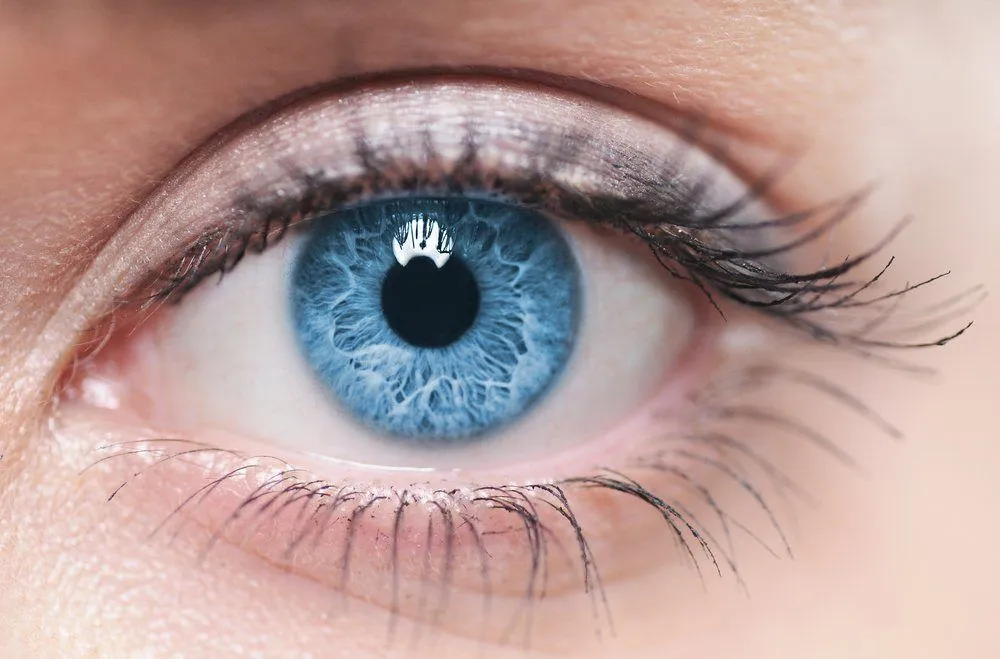
As one can imagine, the human eye consists of a number of smaller components that work together to help us see. For the scope of this article, we are interested in the two main types of sensors that enable us to detect light and distinguish between different colors.
In the retina (a light-sensitive screen at the back of the eyes), there are two types of photoreceptors: cones and rods. Cones are the photoreceptors that allow humans to see colors. They are activated in high lighting conditions, which is why we have trouble seeing color when it’s too dark around us.
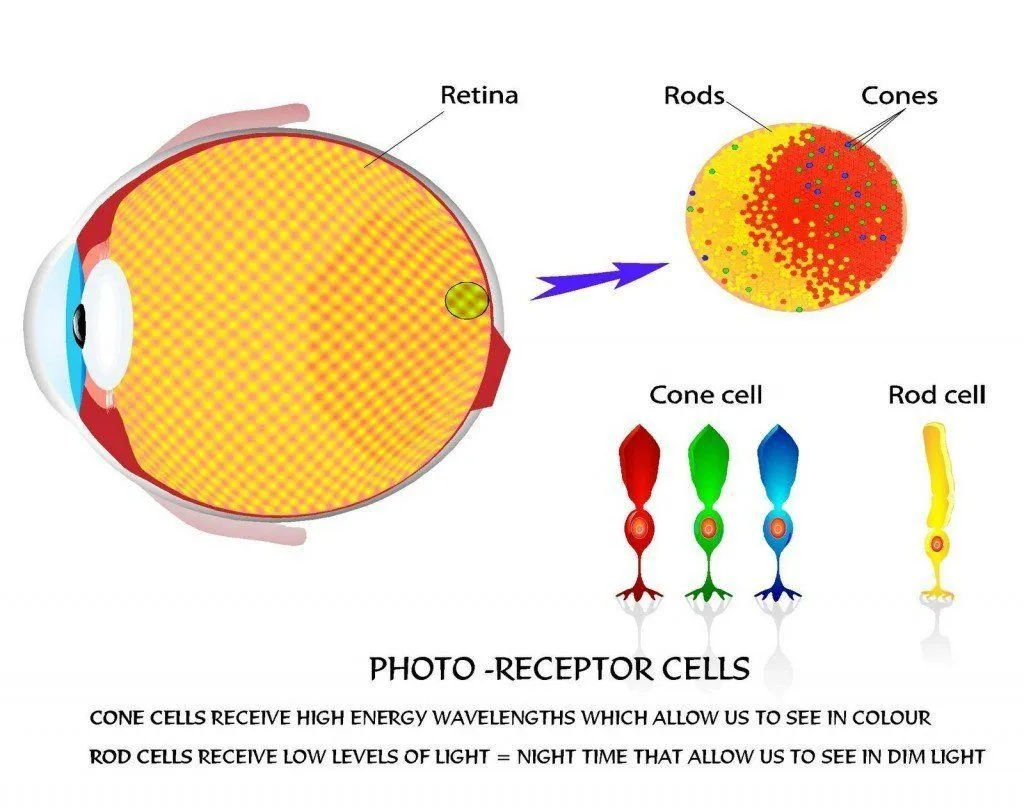 Rods, on the other hand, are extremely sensitive to light, and they should be, considering that they are responsible for one’s vision in low lighting conditions. The higher the number of rods, the better one can see in the dark. Quite predictably, therefore, certain nocturnal animals (e.g., cats, owls etc.) have a huge number of rods in their eyes, which equips them with brilliant night vision.
Photons: The Particles That ‘Carry’ Light
We see something when light falls on it, bounces off its surface and then reaches our eyes. However, when we say that light ‘reaches our eyes’, what is really happening?
In one word: photons.
A photon is the fundamental particle of visible light, or any electromagnetic radiation whatsoever. It has zero rest mass, and travels at the speed of light in a vacuum. In simple words, it’s the particle that ‘carries’ light.

These photons are what fall on our eyes and allow us to see things.
What’s The Minimum Number Of Photons That Our Eyes Can Detect?
Until a few years ago, scientists believed that the human eye could only register a flash once roughly 5 to 9 photons arrived. However, a landmark study published in July 2016 showed that the human eye can, in fact, detect a single photon.
Eminent scientists Hecht, Shlaer and Pirenne first tested the visual sensitivity of the human eye in 1942 by carrying out groundbreaking experiments using a very dim source of light in a dark room.
Looking at their experimental data, they concluded that rods in the human eye can respond to a single photon under low light conditions (Source).
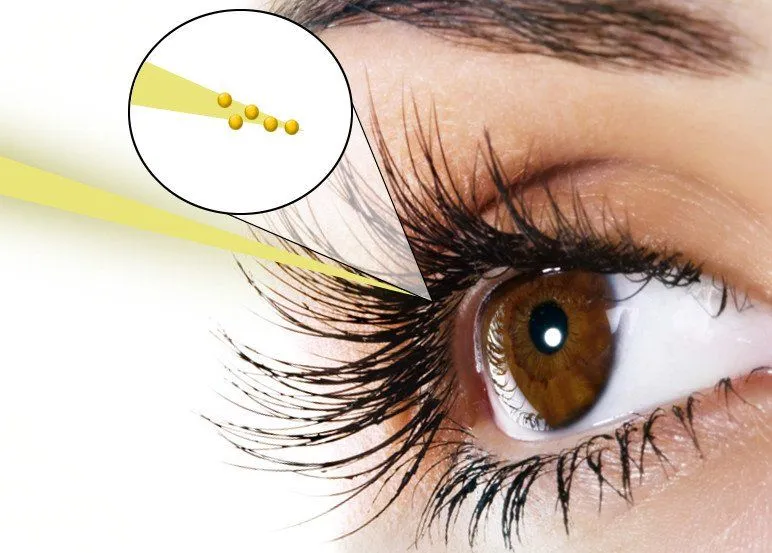
Hecht and colleagues correctly hypothesized, around 75 years ago, that the eye could detect even a single photon. However, the required technology to test that hypothesis had been lacking.
Fast-forward to 2016, when a team led by Alipasha Vaziri (then splitting his lab between The Rockefeller University in New York and the Research Institute of Molecular Pathology in Vienna), with Jonathan Tinsley as the lead author, actually built a quantum optical setup that could fire a single photon at the eye. The trick was a process called spontaneous parametric down-conversion, in which a crystal splits one photon into a pair: one photon was sent to the subject’s eye, while its twin tripped a detector and confirmed that exactly one photon had been delivered. They ran 30,767 trials with three male participants in their 20s (you can find the link to their published study at the bottom of the article).
From the results obtained in the trials, the probability of a human correctly detecting a single photon came out to about 51.6%, just over the 50% you’d expect from pure guessing. That sounds like a coin toss, and on its own the margin was borderline. However, when the researchers looked only at the trials where subjects felt most confident, the success rate climbed to about 60%, a result the team reports as statistically significant.
That said, there’s quite a bit of difference between detecting versus actually seeing something.

Researchers say that a single photon is not even like a very dim source of light; it’s actually far different. “It’s more of a feeling of seeing something, rather than really seeing it.” says Alipasha Vaziri, the study’s senior author. “If you’ve ever looked at a faint star in the night sky and one second you see it, but the next second you don’t… it’s kind of like that.”
References (click to expand)
- Tinsley, J. N., Molodtsov, M. I., Prevedel, R., Wartmann, D., Espigulé-Pons, J., Lauwers, M., & Vaziri, A. (2016, July 19). Direct detection of a single photon by humans. Nature Communications. Springer Science and Business Media LLC.
- Hecht, S., Shlaer, S., & Pirenne, M. H. (1942, July 20). Energy, Quanta, And Vision. Journal of General Physiology. Rockefeller University Press.
- Can a Human See a Single Photon? - UCR Math. The University of California, Riverside
- Single-photon detection by rod cells of the retina - www.cns.nyu.edu