Table of Contents (click to expand)
- What Are Feedback Mechanisms?
- Positive Feedback Mechanism
- Example Of Positive Feedback
- More Examples Of Positive Feedback Loops In The Body
- Negative Feedback Mechanism
- Example Of Negative Feedback
- More Examples Of Negative Feedback Loops In The Body
- Positive vs Negative Feedback: What’s The Difference?
- The Two Mechanisms Work To Establish Homeostasis
A positive feedback mechanism is one where the body uses the effect of a particular action/task to perform more of the same behavior. A negative feedback mechanism is one where the body uses the effect of a particular action/task to stop that behavior.
The body uses feedback mechanisms to monitor and maintain our physiological activities. There are 2 types of feedback mechanisms – positive and negative. Positive feedback is like praising a person for a task they do. Negative feedback is like reprimanding a person. It discourages them from performing the said task.
The human body is like any other system. It carries out a myriad of functions, and like any functioning entity, it needs a way of maintaining balance. This balance is called homeostasis. Our body employs certain methods with which it keeps a measure of how well our systems are functioning. Any imbalance is corrected as soon as possible so the system is returned to a balanced state.
What Are Feedback Mechanisms?
Our body uses the feedback it receives from a particular process to monitor how well it is functioning. Based on the outcome, it decides whether it should continue performing a specific action, or if it should stop the action. This is called a feedback mechanism.
The body uses feedback mechanisms to monitor and maintain our physiological activities. There are 2 types of feedback mechanisms – positive and negative.
Positive Feedback Mechanism
Positive feedback is like praising a person for a task they do. This praise encourages them to do more of that particular activity. On the other hand, negative feedback is like reprimanding a person. It discourages them from performing the said task, and they do the opposite instead. In the end, however, it all leads to homeostasis – maintaining a balance within the body. After all, it’s not as easy as snapping your fingers!

In positive feedback, the body uses the effect of a particular action/task to perform more of the same behavior. One such example is the regulation of the hormone Oxytocin.
Example Of Positive Feedback
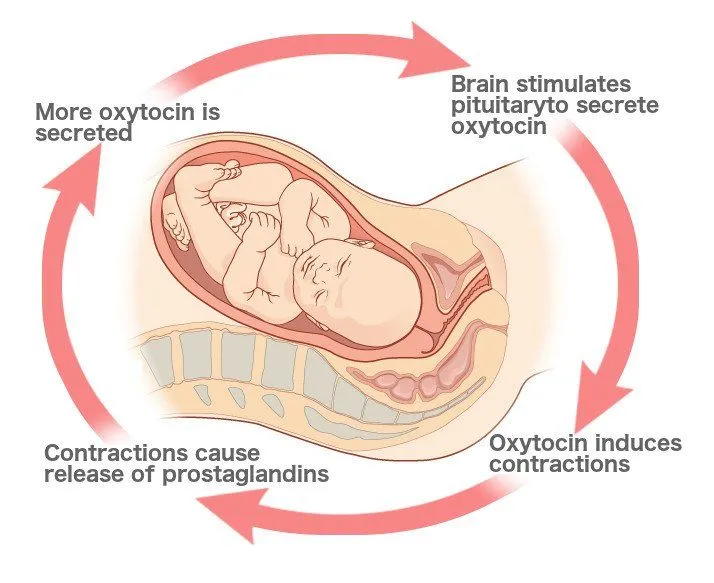
Oxytocin is produced in the hypothalamus and secreted by the posterior part of the pituitary gland. It is responsible for inducing contractions in the uterine wall during labor.
When labor begins, the pituitary gland secretes oxytocin. This helps in inducing contractions. The contractions that are induced trigger the release of prostaglandins, which in turn trigger the release of more oxytocin. Thus, more oxytocin is secreted and the cycle continues until parturition (childbirth).
More Examples Of Positive Feedback Loops In The Body
Childbirth is the textbook example, but positive feedback loops show up all over human physiology. Whenever the body needs to push a process to completion fast — instead of gently nudging it back to a setpoint — it tends to reach for a positive feedback loop. Here are a few more that biology classes love to test on.
1. Blood Clotting (The Clotting Cascade)
Cut your finger and a remarkable chain reaction begins. Damaged tissue releases chemical signals that attract platelets, the small cell fragments that initiate clotting. The first platelets to arrive release more signaling chemicals (ADP, thromboxane A2), which recruit even more platelets to the site, which in turn release more signals. Each platelet that joins the plug recruits the next. This snowballing continues until the wound is sealed and the cascade naturally terminates — but during the event, it’s pure positive feedback. Without this amplification, even a small cut could lead to dangerous blood loss.
2. Lactation And The Milk Letdown Reflex
When a baby suckles at the breast, sensory nerves send a signal to the hypothalamus, which triggers the posterior pituitary to release oxytocin (the same hormone responsible for labor contractions). Oxytocin causes the muscles around the milk-producing alveoli in the breast to contract, ejecting milk — the so-called “letdown” reflex. The infant’s continued suckling causes more oxytocin release, which causes more letdown, which encourages more suckling. The loop sustains itself for as long as feeding continues, and ends only when the baby stops nursing.
3. Nerve Cell Action Potentials
When a neuron fires, a tiny voltage change opens a few voltage-gated sodium channels in the cell membrane. Sodium ions rush in, which depolarizes the membrane further, which opens more sodium channels, which lets in even more sodium. This is a textbook positive feedback loop, completed in about a millisecond — it’s what creates the sharp, all-or-nothing “spike” of an action potential. The loop is shut down almost immediately by the slower opening of potassium channels (a negative feedback brake), which is why a neuron can fire repeatedly without locking into a permanent “on” state.
4. The LH Surge Before Ovulation
For most of the menstrual cycle, rising estrogen suppresses the release of luteinizing hormone (LH) — that’s standard negative feedback. But just before ovulation, the relationship flips. When estrogen crosses a critical threshold, it begins to stimulate LH release instead of suppressing it. The rising LH triggers the ovary to release more estrogen, which triggers more LH, and so on. The result is the dramatic “LH surge” that triggers the ovary to release an egg roughly 36 hours later. Once ovulation occurs, the loop breaks.
5. Stomach Acid Secretion During A Meal
The presence of partially-digested protein in the stomach stimulates G-cells in the stomach lining to release gastrin, a hormone that signals the stomach to secrete more hydrochloric acid. More acid means more protein digestion, which means more protein fragments stimulating more gastrin release. The loop drives stomach acid production up to a steady high level during a meal — and is shut off when the meal moves on into the small intestine.
A useful pattern is hiding in all of these: positive feedback loops are self-amplifying, but they almost always have a built-in termination signal. Childbirth ends with delivery. Clotting ends when the wound is sealed. Action potentials end with potassium efflux. Biology rarely lets a positive feedback loop run unchecked — when it does, the result is usually pathological (a runaway fever, a tumour, a heart-attack cascade).
This brings us back to homeostasis. Positive feedback isn’t the opposite of homeostasis; it is a tool the body uses to achieve a new homeostatic state quickly, by overshooting and then locking in.
Negative Feedback Mechanism
The term “negative” doesn’t refer to a “bad” effect, so to speak. It simply implies that the current state of an activity is not beneficial, so the body then brings about the opposite effect. The negative feedback loop signals that it is now time to stop an activity, like the secretion of certain hormones, in order to maintain a healthy balance.
Example Of Negative Feedback
Let’s consider the case of our blood sugar level. Our blood sugar levels are mainly controlled by 2 hormones – insulin and glucagon. These are secreted by the pancreas through special cells known as the Islets of Langerhans. Insulin signals cells to take up glucose from the blood and triggers the liver to store it as glycogen, while glucagon does the opposite — it tells the liver to break glycogen back down into glucose and release it.
When the sugar concentration in our blood increases — after a meal, for example — it is detected by the beta cells of the pancreas, which secrete insulin. Insulin then drives muscle and fat cells to absorb the excess glucose and prompts the liver to package it as glycogen for storage. Thus, the sugar concentration in our blood is brought back to normal.
Conversely, when blood sugar drops, the alpha cells of the pancreatic islets respond by releasing glucagon while insulin secretion is suppressed. Glucagon signals the liver to break down its stored glycogen and release glucose back into the bloodstream, raising the blood sugar concentration.
In this way, the body relies on the increasing or decreasing sugar level in the blood to determine which hormone shall be secreted and which shall be stopped.
More Examples Of Negative Feedback Loops In The Body
Blood sugar is the classic example, but it is far from the only one. Negative feedback is the body’s default control strategy: the great majority of physiological variables we keep steady are held there by a negative feedback loop. Whenever a value drifts away from a comfortable target, the body reads the change and triggers a response that pushes the value back the other way. Here are three more loops that biology classes love to test on.

1. Body Temperature (Thermoregulation)
A healthy core temperature sits at about 37 °C (98.6 °F), give or take half a degree. The hypothalamus acts as the body’s thermostat: thermoreceptors in the skin and deep tissues report the current temperature, and the preoptic area of the hypothalamus compares it to that target. If you get too hot, the body dissipates heat by sweating and by widening the skin’s blood vessels (vasodilation) so warmth radiates away. If you get too cold, it does the opposite, narrowing those vessels (vasoconstriction), triggering shivering to generate heat, and raising goosebumps. Either way, the response always opposes the drift and steers your temperature back toward 37 °C.
2. Blood Pressure (The Baroreceptor Reflex)
Stretch-sensitive nerve endings called baroreceptors, packed into the walls of the carotid sinus (in the neck) and the aortic arch, monitor blood pressure moment to moment. When pressure rises, these receptors fire faster. The brainstem responds by dialing down sympathetic (“fight-or-flight”) output, which relaxes the blood vessels and slows the heart, so pressure drops back down. When pressure falls, perhaps when you stand up quickly, the baroreceptors fire less, the brainstem ramps sympathetic activity back up, the vessels tighten and the heart speeds, and pressure climbs again. It is a tug-of-war that keeps your blood pressure within a narrow band.
3. Thyroid Hormone (The HPT Axis)
Your metabolic thermostat runs on a three-part hormonal chain called the hypothalamic-pituitary-thyroid axis. The hypothalamus releases thyrotropin-releasing hormone (TRH), which prompts the pituitary to release thyroid-stimulating hormone (TSH), which in turn tells the thyroid gland to pump out the hormones thyroxine (T4) and triiodothyronine (T3). Here is the feedback part: once levels of T3 and T4 climb high enough, they loop back and suppress the release of both TRH and TSH, throttling their own production. If thyroid hormone levels fall, that brake is released and TSH rises again. The result is a self-correcting loop that keeps thyroid hormone, and your metabolic rate, remarkably stable.
Notice the common thread: in every case the body senses a deviation and answers with the opposite action. That “opposite” response is exactly what makes the feedback “negative,” and it is why negative feedback is the workhorse of homeostasis.
Positive vs Negative Feedback: What’s The Difference?
It is easy to mix the two up, so here is a side-by-side way to keep them straight. The single most important difference is the direction of the body’s response relative to the original change.
- Direction of the response: Negative feedback pushes against the change and reverses it. Positive feedback pushes with the change and amplifies it.
- Goal: Negative feedback aims to hold a variable steady at a set point (stability). Positive feedback aims to drive a process rapidly to completion (change).
- End state: Negative feedback returns the system to its starting balance. Positive feedback escalates until an outside event ends it, such as the birth of a baby or the sealing of a wound.
- How common it is: Negative feedback runs the vast majority of the body’s control systems, from temperature to blood sugar to blood pressure. Positive feedback is reserved for the relatively few situations where the body actually wants a runaway, all-or-nothing result.
A handy mental shortcut: if a loop calms things down and restores balance, it is negative feedback; if it builds on itself and races toward a finish line, it is positive feedback. And remember that “positive” and “negative” describe the direction of the response, not whether it is good or bad for you.
The Two Mechanisms Work To Establish Homeostasis
These are just some examples of positive and negative feedback systems in the body. Negative feedback mechanisms tend to bring the body from a disturbed state to a balanced state, i.e., it favors balance. Conversely, positive feedback mechanisms tend to favor extreme conditions, rather than establish a balance. The majority of the systems in the body follow the negative feedback mechanism, as the body prefers a balanced environment. However, there are some activities, such as labor contractions or lactation, that rely on a positive feedback mechanism. It is important to remember that the terms “positive” and “negative” don’t indicate the nature of the effect, i.e. whether it is harmful or not. Instead, they indicate the type of feedback mechanism that is being followed.
References (click to expand)
- Mitrophanov, A. Y., & Groisman, E. A. (2008, May 13). Positive feedback in cellular control systems. BioEssays. Wiley.
- Positive and Negative Feedback Loops in Biology.
- 14.3 Homeostasis – Concepts of Biology.
- Physiology, Platelet Activation. StatPearls. NCBI Bookshelf.
- Physiology, Thromboxane A2. StatPearls. NCBI Bookshelf.
- Physiology, Lactation. StatPearls. NCBI Bookshelf.
- Neuroanatomy, Neuron Action Potential. StatPearls. NCBI Bookshelf.
- Neuroendocrine mechanisms underlying estrogen positive feedback and the LH surge. Frontiers in Neuroscience (2022). PMC.
- Physiology, Gastrin. StatPearls. NCBI Bookshelf.
- Physiology, Temperature Regulation. StatPearls. NCBI Bookshelf.
- Physiology, Baroreceptors. StatPearls. NCBI Bookshelf.
- Physiology, Thyroid Stimulating Hormone. StatPearls. NCBI Bookshelf.
- Physiology, Homeostasis. StatPearls. NCBI Bookshelf.