HBO’s Chernobyl (2019) is broadly accurate — it gets the timeline, the people (Legasov, Dyatlov, Akimov, Toptunov, Ignatenko), and the core physics right: the RBMK reactor’s positive void coefficient, the graphite-tipped control rods, and the AZ-5 shutdown that triggered the explosion. It overdramatises a few things: radiation isn’t contagious like a virus, ARS doesn’t kill instantly, and a few characters (notably Ulyana Khomyuk) are composites invented for the screen.
HBO’s 2019 series Chernobyl received critical acclaim for its accurate portrayal of the 1986 nuclear disaster at the Chernobyl power plant. The show provided a detailed look into the history, politics, and science behind the tragedy, with meticulous attention given to its production and writing.
While some creative liberties were taken for the sake of storytelling, most of the changes were justifiable. For instance, the addition of a fictional scientist named Ulyana Khomyuk, played by Emily Watson, represented the numerous scientists who contributed to the investigation.

However, at times, the creators added elements solely for dramatic effect. As a result, many viewers were left feeling anxious after binge-watching the series, fearing that their local reactors could pose a danger. It is important to note that this is not the case.
While some aspects of the science behind Chernobyl were simplified, and others were exaggerated, overall, the show’s scientific accuracy was impressive. The series accurately portrayed certain scientific aspects, while other parts fell short. This article will examine what technical aspects of Chernobyl were correct and which were not.
The science side of Chernobyl does suffer a bit, being simplified in some points and blown out of proportion in others. Some parts of the show are incredibly scientifically accurate, and some fall short. With that in mind, let’s look at what technical aspects Chernobyl got right and what it got wrong.
How Dangerous Is The Radiation?
One Forbes article writes, “Chernobyl runs across the line into sensational in the first episode and never looks back.” This might seem at odds with what creator Craig Mazin says about the show. Mazin told Variety that while writing the show, he “always defaulted to the less dramatic because the things that we know for sure happened are so inherently dramatic.” However, putting the show under some level of scrutiny is hard to believe.
The portrayal of the dangers of radiation and nuclear energy was exaggerated to a ludicrous extent in certain parts of the show.
For instance, the story of firefighter Vasily Ignatenko and his pregnant wife, Lyudmilla, is true. Still, the show’s heavy implication that Lyudmilla’s unborn child died simply because radiation was “absorbed” out of Vasily’s body is overstated. That is not how external radiation poisoning works — although hospitals do limit pregnant women’s contact with internally contaminated patients, since their body fluids and breath can carry radioactive particles.
Radiation is not a virus that can spread through contact. Showing it in that way is preposterous and even problematic. After Vasily has been stripped and cleaned, there is no reason that his body would hold enough radioactive contamination to cause any distress to Lyudmilla, let alone affect an unborn fetus.
Radiation is also not like a ‘bullet,’ as it is so dramatically described in the show.
Radiation is all around us at all times… it’s not something that only comes from nuclear reactor failures. We would be unable to go about our day-to-day lives in peace if bullets were shooting us at all times from all sides, now would we?
The series also shows workers dying instantly after being exposed to radiation…another exaggeration. First responders were indeed diagnosed with acute radiation syndrome (ARS), and among those affected, some died, but their tragic deaths were months later. Most of the others, in fact, lived out the rest of their lives. The civilian population around Chernobyl was also not affected by ARS, as the show would have us believe.
Can An RBMK Reactor Explode?
Many fans were also left with much scientific curiosity after the series concluded. Some were intrigued by how one of the central (though not particularly liked) characters, Anatoly Dyatlov, insisted that an RBMK REACTOR CANNOT EXPLODE. Even when it becomes painfully obvious that it did, in fact, explode.
So… why was he so firm in his insistence? Was it just that he was terrified of admitting that the unthinkable had happened on his watch, or was the scientific reasoning behind his thought process solid?
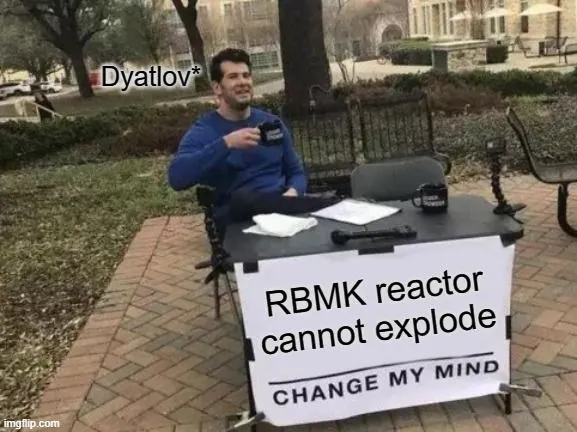
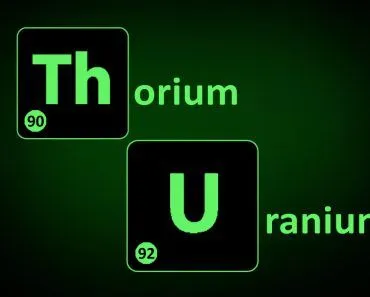
He was correct in saying that an RBMK reactor cannot explode. At least, not in the way you imagine an explosion to happen. When thinking about nuclear explosions, nuclear bombs are what comes to mind. However, reactor failures work differently from the runaway chain reactions of nuclear bombs. Nuclear fuel in reactors does not have sufficiently high concentrations of fissionable Uranium to explode like a bomb.
Valery Legasov explains how the Chernobyl disaster happened in the final courtroom scene. The first part of his speech explained how the reactor works, how the different components controlling the reactions work together, and hence why Dyatlov thought an explosion was impossible.
Yet the impossible—the explosion in Chernobyl—did happen. Why? It was caused by a unique set of circumstances, which combined human error, a broken political system, misinformation, design flaws in the reactor, and a bit of bad luck that led to many poor choices.
In other words, unfortunately, RBMK reactors can explode, but they need a lot of help!
Simplifying The Reactor Explosion
It was a tough job for the creators to delve into the complex physics behind the Chernobyl disaster without losing the audience’s interest. Thus, they watered down some parts when explaining what happened.
A more accurate look into what happened is shown in this video.
RBMK (which, FYI, stands for Reaktor Bolshoy Moshchnosti Kanalniy, or ‘high-power channel reactor’) has the unusual feature of using graphite as the moderator and water as the coolant. Because that water is also a mild neutron absorber, the reactor has a positive void coefficient. This is that big word thrown around liberally by our man Legasov during the trial.
The void coefficient describes how the reactor’s reactivity changes when the cooling water boils into steam (a “void” in the water). Most modern reactors have a negative void coefficient — more steam means fewer slow neutrons in the right places, which damps the reaction. In RBMK reactors, however, water is itself a mild neutron absorber, so losing water to steam increases reactivity — a dangerous positive feedback loop.
Basically, the two flaws in the design of RBMK reactors that allowed for the Chernobyl disaster to happen are the design of the control rods and the positive void coefficient.
As the show says, the control rods weren’t actually Boron tipped with graphite. The design is more accurately represented in this image-
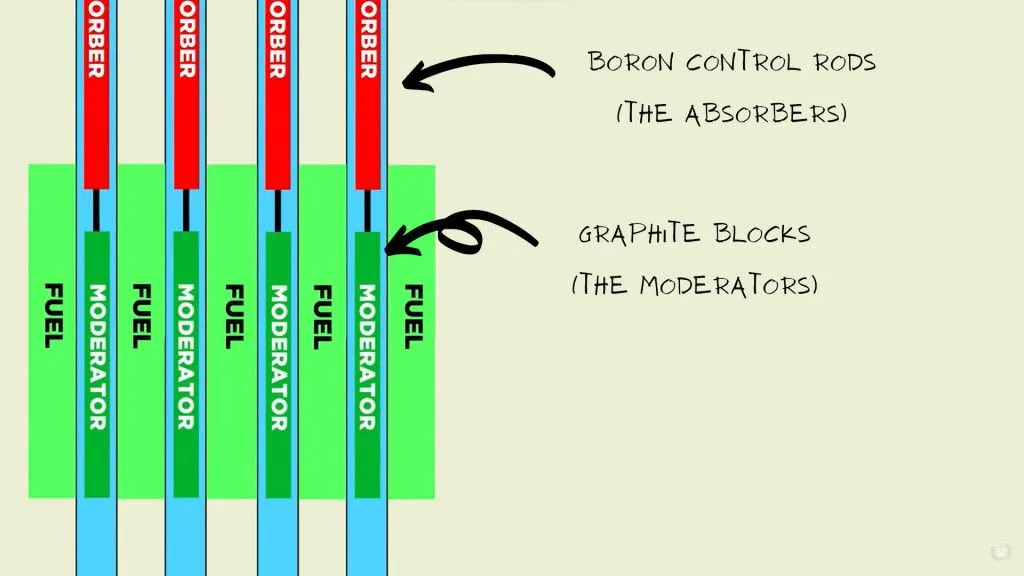
So, while taking out the control rods (which slow down the reaction), they are simultaneously putting in the moderators (which speed up the reaction). This design ultimately caused the final straw that led to the disaster truly going off the rails.
The chain of events is described pretty well in the show, staying true to the facts while giving viewers a visceral taste of building tension and danger. The safety test happened. The reactor power got too low and was brought up too fast, and then, the now-infamous AZ-5.
As for the explosion itself, the show’s explanation simplifies things quite a bit. When the control rods were reinserted all at once, and the moderators shifted, there were way too many neutrons at the base of the reactor. The reaction spiked to a level that it simply could not handle. Combined with all the other unfavorable elements in play, this spike in neutron flux caused the explosion.
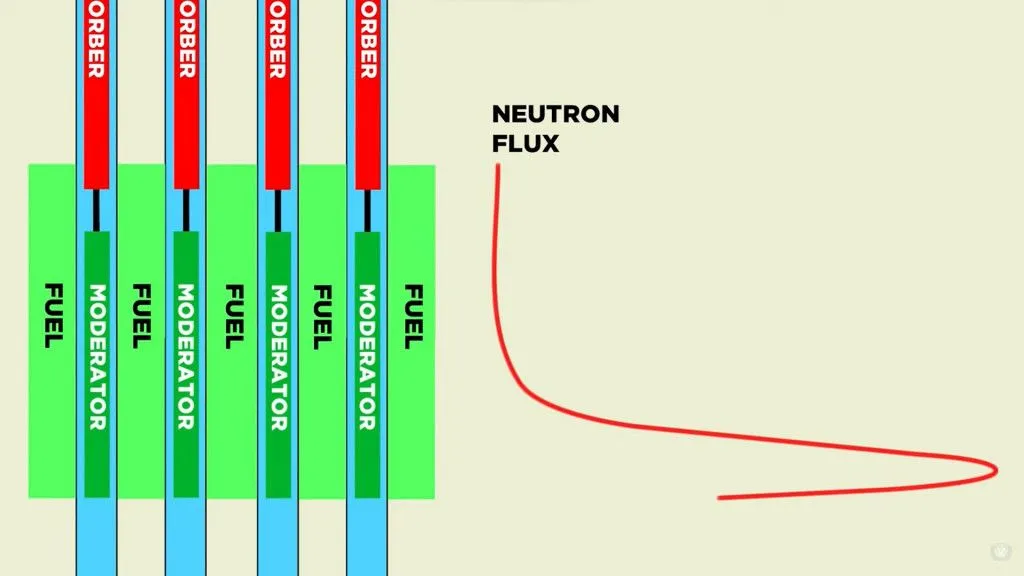
Nothing was left at the reactor’s base to absorb neutrons and control the reactions when the control rods were being reinserted at this particular position. This is what tipped the reactor over the point of no return.
Did Everyone On The “Bridge Of Death” Really Die?
One of the most haunting moments in episode 1 shows the residents of Pripyat strolling onto a railway bridge to watch the reactor burn, while flecks of glowing ash drift down on the children below. The closing text of the final episode drives the dread home, claiming that of the people who watched from that bridge, it has been reported that none survived. It is a chilling line. It is also almost certainly a myth.

Journalist Adam Higginbotham, who spent over a decade interviewing survivors and combing through documents for his book Midnight in Chernobyl, went looking for proof of the so-called “Bridge of Death” and came up empty. As he put it, he “could find no evidence of that.” He even tracked down a man who, as a boy of seven or eight, had cycled out to the bridge to gawk at the reactor only three kilometers (about 1.9 miles) away. Far from being dead, the man is alive and, by all accounts, perfectly healthy.
There is a simpler reason to doubt the tale, too. The reactor blew at 1:23 a.m., when nearly all of Pripyat was fast asleep. The image of a crowd gathering on the overpass that night does not square with the testimony of people who were actually there. The bridge is real, and a handful of curious residents may well have wandered over, but the legend that every last one of them was doomed appears to be exactly that, a legend.
Could A Second Explosion Have Wiped Out Half Of Europe?
In episode 2, the scientists deliver a terrifying warning. If the molten core burned down into the water-filled tanks beneath the nuclear reactor, the result would be a steam explosion of 2 to 4 megatons, enough to flatten everything for kilometers around and smear radioactive fallout across Kiev, Minsk, and much of Eastern Europe. To prevent it, three plant workers, Alexei Ananenko, Valeri Bespalov, and Boris Baranov, waded through flooded, pitch-black basement corridors to open the valves and drain the water.

The mission was real and genuinely dangerous, but the apocalyptic math was dialed up for television. Nuclear experts have called the 2-to-4-megaton figure a wild exaggeration. As Greenpeace nuclear specialist Jan Haverkamp has pointed out, molten reactor fuel (corium) does not melt downward as one neat, synchronized blob, so the notion of a single, lake-boiling, megaton-scale steam blast is closer to science fiction than physics. A nasty steam release was plausible; a blast that could erase a chunk of a continent was not.
The show also leaves you assuming the three “divers” marched off to certain death. They did not. All three survived. Ananenko and Bespalov are still alive, while Baranov lived until 2005, when he died of heart failure, not radiation. In 2018, the three were finally honored with Ukraine’s Order For Courage. Far from a doomed suicide squad, they were experienced staff who treated the task as something that simply had to be done.
Was The Helicopter Crash Caused By Radiation?
Episode 2 also serves up a gut-punch of a scene. A helicopter clatters over the gaping reactor, seems to falter in the invisible haze rising from the core, and drops out of the sky in a ball of flame. The implication is hard to miss: that the radiation itself reached up and swatted the aircraft down.

A helicopter really did crash at Chernobyl, but not like this and not then. The accident took place on 2 October 1986, months after the disaster, while a Mil Mi-8 was helping to build the concrete sarcophagus over the ruined reactor. As it maneuvered, its rotor blades clipped the steel cable of a tall construction crane, and the machine plunged to the ground, killing all four crew members. It was a grim but ordinary aviation accident, a collision with a cable, not radiation frying the controls.
Series creator Craig Mazin has openly acknowledged shifting the crash earlier in the timeline for dramatic effect, saying he wanted viewers to feel the hazards the pilots faced. It is a defensible storytelling choice, but it is worth knowing that radiation, for all its menace, does not knock helicopters out of the air.
A Final Word
In conclusion, Chernobyl gets some things right and some things very wrong. In short, radiation does not spread like COVID-19, and RBMK reactors do explode. Although the show offered a pretty great explanation for the reactor failure, there are some other technicalities behind it all, for those who are curious!
However, compared to all the sci-fi mishaps out there, the technical inconsistencies of Chernobyl can be forgiven to some extent. Although perhaps not for all of it, like the radiation stories scaring the pants off the audience. The important thing is to remember that the series is still a dramatization of real events, no matter how accurate it may be.
Last Updated By: Ashish Tiwari
References (click to expand)
- RBMK Reactors – Appendix to Nuclear Power Reactors.
- Chernobyl Accident 1986.
- Sequence of Events – Chernobyl Accident Appendix 1.
- Afanasieva, A. A., Burlakov, E. V., Krayushkin, A. V., & Kubarev, A. V. (1993, July). The Characteristics of the RBMK Core. Nuclear Technology. Informa UK Limited.
- Saenko, V., Ivanov, V., Tsyb, A., Bogdanova, T., Tronko, M., Demidchik, Y., & Yamashita, S. (2011, May). The Chernobyl Accident and its Consequences. Clinical Oncology. Elsevier BV.
- The Chernobyl Accident — An Epidemiological Perspective.
- The human drama of Chernobyl. Bulletin of the Atomic Scientists.
- What HBO’s Chernobyl Gets Right (And Wrong) About The Accident. ScienceAlert.
- Individual involvement in the Chernobyl disaster. Wikipedia.
- Chernobyl Mi-8 helicopter crash. Wikipedia.