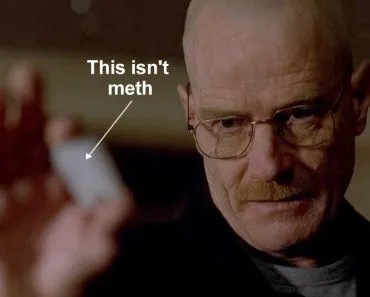
The answer to this is both yes and no! The scene is a good blend of both fact and fiction.
If you’re a science geek or TV buff, you have to admit that Breaking Bad is as good as it gets, a perfect example of an amazing union of entertainment and science.

About Breaking Bad
The show traces the life of a high school chemistry teacher turned drug kingpin named Walter White, who, upon being diagnosed with stage-three lung cancer, leaves his seemingly complacent and unrewarding life behind to produce the purest methamphetamine the streets of Albuquerque, New Mexico, have ever seen.
Pairing up with his former high school student and now delinquent, Jesse Pinkman, a small-time meth dealer and distributor, Walt paved his pathway from a simple educator to the infamous Heisenberg.

Based on some mind-boggling science facts, this show taught a lot of cool chemistry stuff to viewers around the world.
Unlike other crime lords who would get knocked out quick without a gun in hand, Walter could always conjure up something in a jiffy, ensuring that no one knew what hit them.
But how much of what we saw was actually fact and not fiction?
For the sake of caution, I should add a disclaimer NOT to take this as a sign to try any of this out at home. Just sit back and marvel at the scenes happening on the TV screen instead.

But How Real Was The Show?
Apart from piquing curiosity among kids and adults alike, the science behind the show is astonishingly factually correct and, in most cases, practical. Nonetheless, in some ways, it falls short of reality. One such example is the makeshift battery Walt and Jesse make in the episode “4 days out”.
Before getting access to the meth super lab in the seasons ahead, Walt and Jesse had a mobile meth lab (an RV) that they took far out in the desert for their wildly successful cooks. Their plan worked out magnificently for them, with bundles of cash piling up, until the end of one such cook, when they find that Jesse left the keys in the ignition for a couple days, leaving the RV’s battery dead, stranding them in the desert with no cellphone reception or access to the outside world.
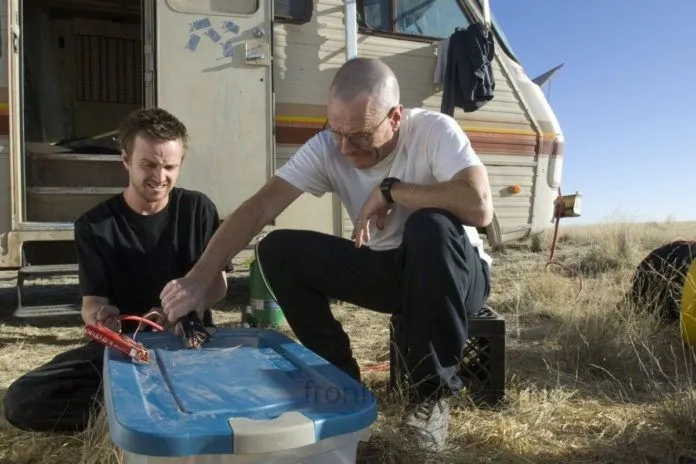
Walt (after his initial meltdowns and routine bashing of Jesse) comes up with the ingenious plan to build a mercury battery to jump-start the RV.

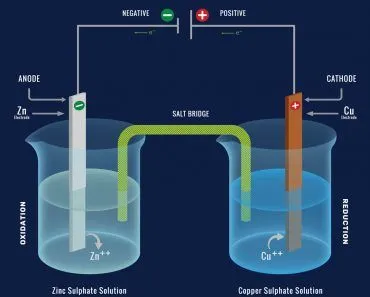
Structure Of A Battery
Looking at what a battery is generally composed of, the basic functional parts include:
- Anode: the negative electrode that holds charged ions and gives up electrons;
- Cathode: the positive electrode that contains the discharged ions and absorbs electrons;
- Electrolyte: the solution that allows ions to move from the anode to the cathode, generally composed of salt water or acid;
- Conductor: it carries the electrons and is usually a metal wire
A battery both generates and stores electrical energy through chemical reactions. Suppose you put two different metals (anode and cathode) in an acid or electrolyte solution.
In such a case, the difference in the chemical reactivities of the metals produces a flow of current between them, which forms a basic electrochemical cell. A series of these cells is put together to form a battery.
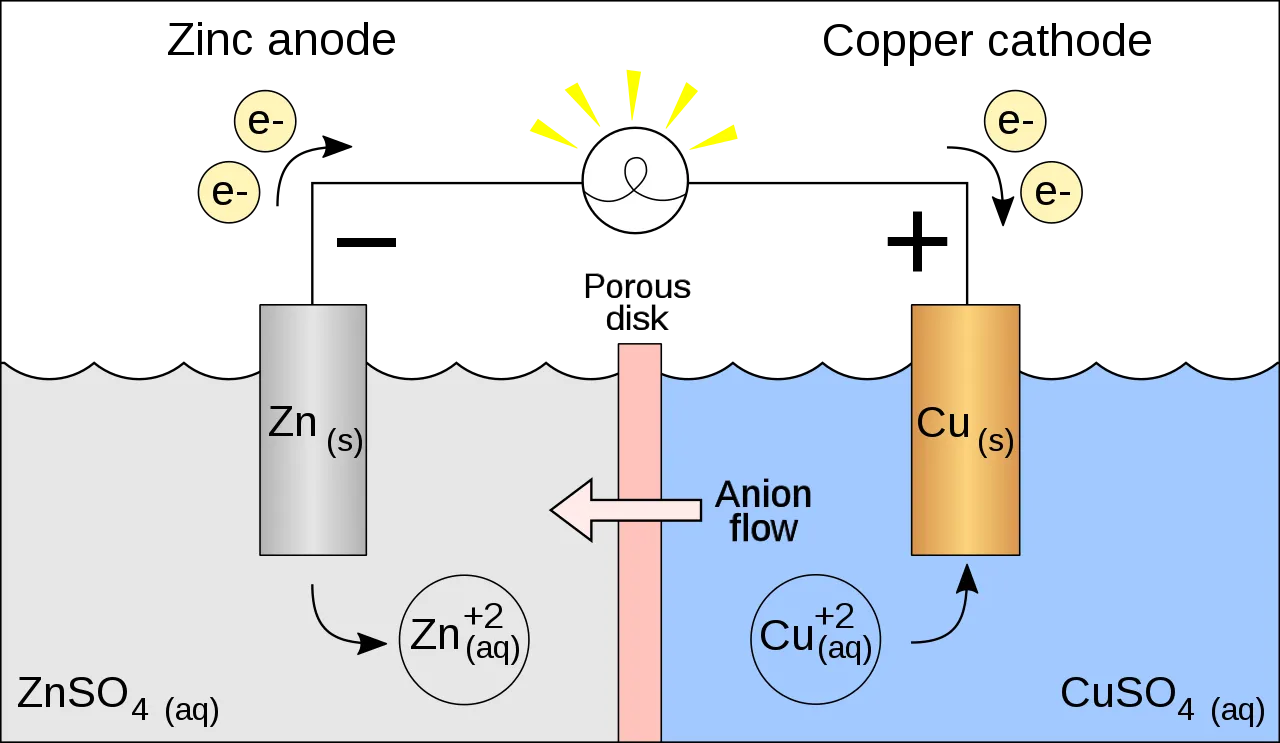
Walter White’s Version Of The Battery
Following the basic design, this is how Walter made his battery:
- He found coins, nuts, bolts, and any other pieces of metal from the RV that contained zinc for the anode, where the electron loss would happen;
- He took the RV’s brake pads, which in the show are said to contain mercuric oxide and graphite, to make the cathode (note: real brake pads do not actually contain mercuric oxide, this is a creative liberty taken by the show);
- The leftover potassium hydroxide from the meth-making was the electrolyte;
- The copper wire was the conductor.
He separated the anode and cathode with sponges absorbing the electrolyte (if the anode and cathode touch each other, the current flow stops). He put six of these electrochemical cells together, and voila! The RV trudged them away from their near-fatal cookout.
However, despite the solid structural design, such a simple battery would only provide a fraction of the power actually required to turn over an engine. It’s highly unlikely that this battery would have actually ever worked in reality, but it did make for a great episode!
Would Walt’s Battery Actually Start The RV?
Here’s where the chemistry runs into the physics. The design is real, but the numbers simply don’t add up. A single zinc–copper cell, the kind Walt built, has a standard cell voltage of only about 1.10 volts. That figure comes straight from the two metals’ standard reduction potentials: zinc sits at −0.76 V and copper at +0.34 V, and the gap between them (0.34 − (−0.76) = 1.10 V) is all the push a single cell can deliver. Stack six of these cells in series, exactly as Walt did, and you get roughly 6.6 volts on a good day. An RV’s electrical system runs on a 12-volt battery, so right off the bat the makeshift pile is short by half.

Voltage is only half the story, though. The real dealbreaker is current. Turning over an engine is brutally demanding work: a starter motor typically pulls somewhere between 150 and 250 amps for the second or two it spins the engine, and in cold weather that figure climbs higher still. One college physics text works the example of a starter drawing 200 A from a 12-volt battery, and even then the battery’s terminal voltage sags to about 10 V under that load. A handful of coins, nuts, and brake-pad shavings soaked in caustic potash can trickle out a few milliamps to maybe an amp or two before its voltage collapses, because a galvanic pile of that size has enormous internal resistance. In other words, Walt’s battery is off by a factor of hundreds, not a rounding error. It could light a small bulb or beep a buzzer; it could never crank a starter motor. (If you want the underlying electrochemistry, we break it down in our explainer on galvanic cells, and the reason real batteries sag under heavy load in our piece on a battery’s internal resistance.)
How Did The RV Battery Die In The First Place?
The whole crisis kicks off because Jesse left the key in the ignition for two days. So was that enough to flatten the battery? Surprisingly, yes, this part is grounded in reality. With the key turned to the accessory or “on” position, plenty of circuits stay live (the radio, interior lights, the fan, dashboard electronics) even though the engine isn’t running. Crucially, the engine being off means the alternator isn’t spinning, so nothing is topping the battery back up. Every milliamp those accessories sip comes straight out of the battery with no way to replenish it.

Even with everything switched off and the key removed, a parked car still loses a little charge to what mechanics call parasitic draw, the tiny standby current that clocks, alarms, and memory chips draw around the clock, usually a modest 50 to 85 milliamps in a newer car (and under 50 in older ones). Leave loads running for a couple of days, though, and the drain is far heavier. Over 48 hours that is more than enough to leave a battery too weak to swing a starter, which is exactly the dead-RV predicament Walt and Jesse wake up to. The show got the setup right; it’s only the fix that takes creative liberties.
The show is quite accurate in most of its scientific endeavors, making it a fascinating blend of reality mixed with a little imagination. Fanning the flame of curiosity in young science enthusiasts, Walter White will teach you to “simply respect the chemistry”, and he’s not a man with whom you want to argue!
References (click to expand)
- Components of Cells and Batteries. The University of Washington
- A Battery from Household Chemicals - Clean Energy Institute. The Clean Energy Institute
- How a battery works - Curious - Australian Academy of Science. The Australian Academy of Science
- Galvanic Cells (zinc–copper standard cell potential of 1.10 V). Chemistry LibreTexts
- Electromotive Force: Terminal Voltage (starter-motor current draw and terminal-voltage sag). College Physics, University of Hawaii
- What Is Parasitic Battery Drain and How To Test Parasitic Draw. Universal Technical Institute