Table of Contents (click to expand)
- Would Shooting A Nuclear Missile Cause A Nuclear Explosion?
- Nuclear Weapon Mechanisms
- Delivering A Nuclear Weapon
- Is A Missile The Same Thing As A Bomb?
- Can A Nuclear Missile Actually Be Shot Down?
- Do Regular Missiles Explode When They Are Shot Down?
- What If You Shot A Nuclear Bomb With A Gun?
- Closing Remarks
Shooting down a nuclear missile is theoretically possible but extremely difficult in practice: sophisticated warheads come wrapped in decoys and countermeasures that make interception anything but guaranteed. And even if you do hit one, the warhead almost certainly will not detonate. The most likely outcome is a fizzle that scatters radioactive material across the impact area.
Poison defeats poison, or so goes the saying. That’s great if one were to restrict their risks to consumable potions, but does this logic extend to nuclear weapons?
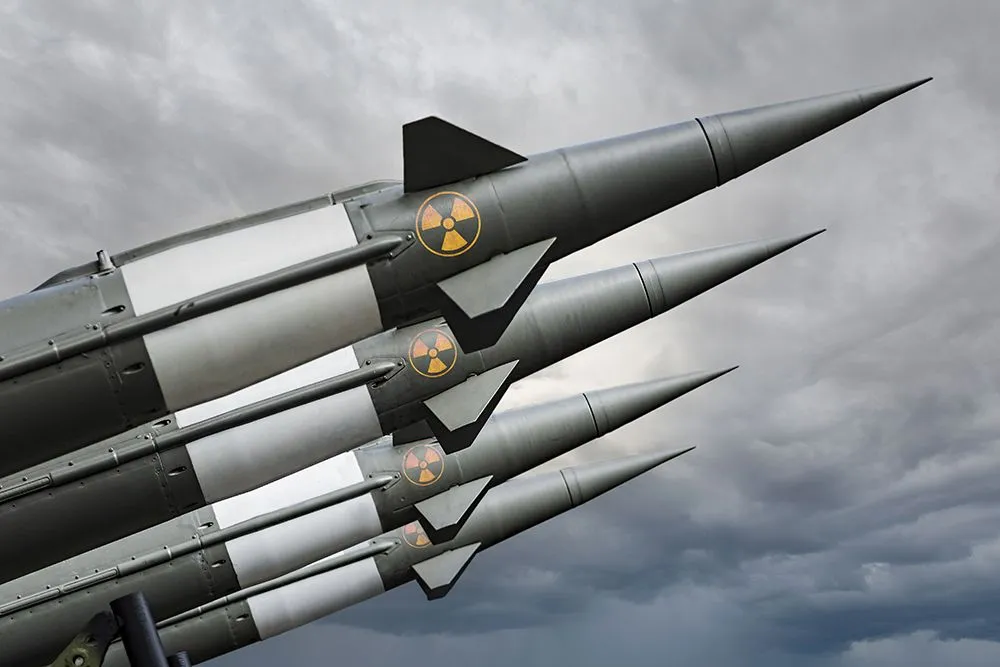
Growing up, we’ve all seen numerous fantasy visuals of weapons colliding in mid-air, only to vanquish each other in futile attempts at war. However, consider the case of nuclear weapons. With even more dangerous terms like critical mass and chain reaction perpetually accompanying them, the chances of the ‘poison defeating poison’ seem bleak.
Basically, can a nuke be shot down without it going off? Let’s find out!
Would Shooting A Nuclear Missile Cause A Nuclear Explosion?
Theoretically, yes. Statistically (and realistically), no.
In most of our minds, nuclear weapons are akin to cranky but delicate children that must be handled with extreme care, lest they release a loud and uncontrollable tantrum. Nuclear weapons are extremely precise instruments that require a very specific series of events to go off, long before the weapon actually hits the ground.
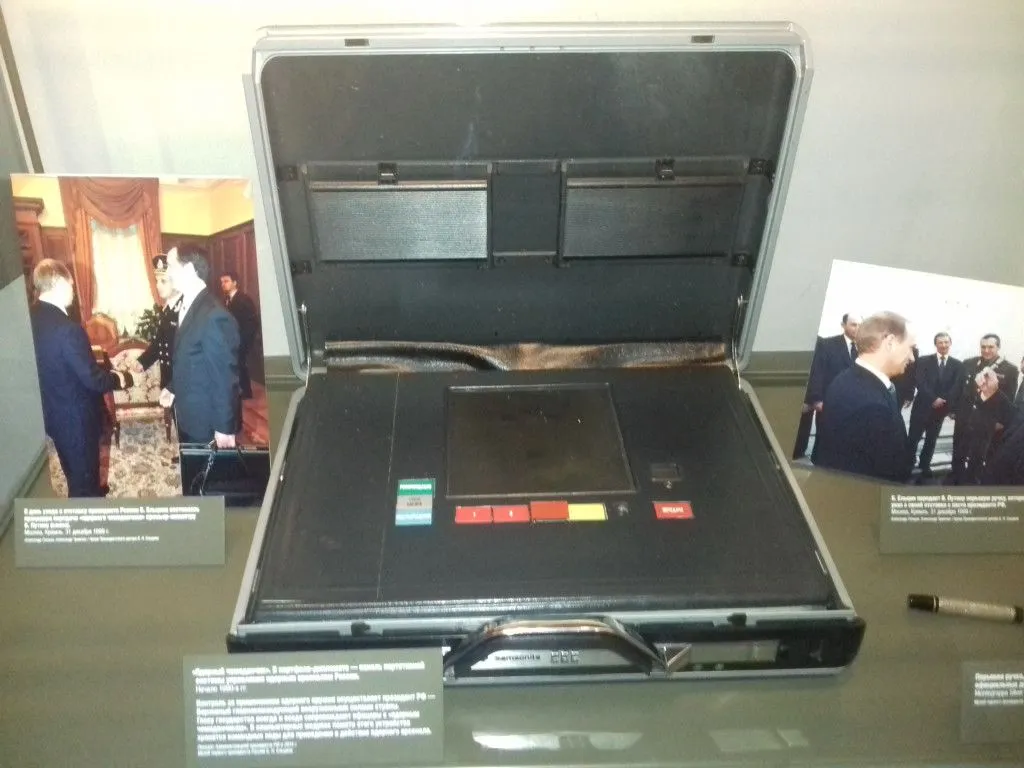
Even slight deviations from procedure prevent these weapons from detonating. This is certainly to humankind’s advantage, as it significantly reduces (if not eliminates) the destruction that could ensue.
Nuclear Weapon Mechanisms
The idea behind a nuclear weapon is pretty simple: to utilize the energy resulting from the splitting of atoms (nuclear fission), or the fusing of atoms (nuclear fusion).
A Note On Nuclear Fusion And Fission
Heavier elements in the periodic table are willing to break apart their single heavier nucleus into smaller, lighter and consequently more stable nuclei. This is accompanied by a tremendous release of energy, a process known as fission.
Nuclear fission can be catalyzed by bombarding a heavy nucleus with neutrons. These neutrons get absorbed into the nucleus, resulting in an unstable core, which breaks down to release energy.
Additionally, these neutrons also displace existing neutrons, which then invade the nuclei of neighboring atoms, resulting in a chain reaction.
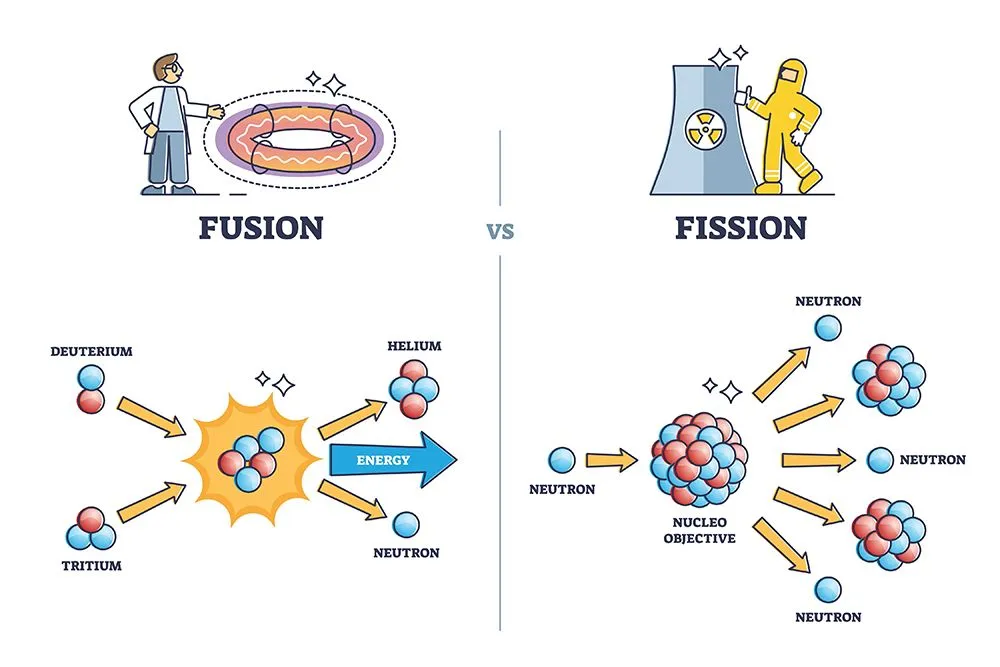
On the flip side, when exposed to extremely high temperatures and pressures, two lighter nuclei can fuse to form a single, heavier nucleus, while also releasing energy in the process. This is known as fusion.
To sustain a chain reaction, a minimum amount of the element in question must be present, an amount known as the critical mass.
Achieving Critical Mass
All nuclear weapons begin with heavy elements (primarily isotopes of uranium and plutonium) as nuclear fuel. To prevent unintentional discharge, the nuclear fuel is kept at a ‘subcritical’ state. When the weapon is armed or activated, the subcritical states are brought to a critical mass state, which allows a chain reaction to be sustained.
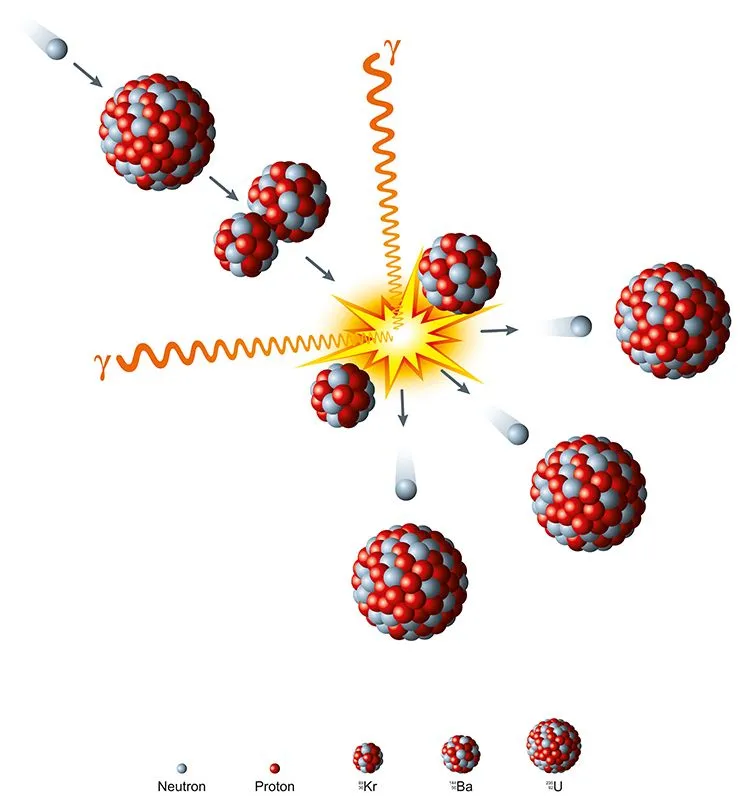
For fission-based reactions, achieving critical mass can be as simple as bringing two subcritical masses together. Fusion, on the other hand, does not require critical mass.
Modern nuclear weapons employ a combination of fusion and fission reactions, rather than relying solely on one methodology. To improve the yield of the nuclear weapon, fusion and fission are incorporated as multiple stages. These combinatory designs result in what are known as thermonuclear weapons.
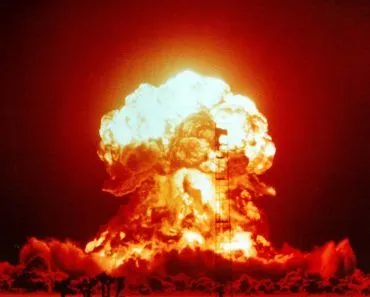
Operation Castle, conducted in 1954, is one of the first and most notable use cases of thermonuclear weapons that yielded a very high-energy output. It was also the harbinger of dry nuclear ‘fuel’, which would allow nuclear weapons to become truly portable and even more compact. Despite being a test, the explosions resulting from it resulted in fatalities and long-term impacts on survivors in the vicinity of the area where it was conducted. (Source)
Geometrical Considerations
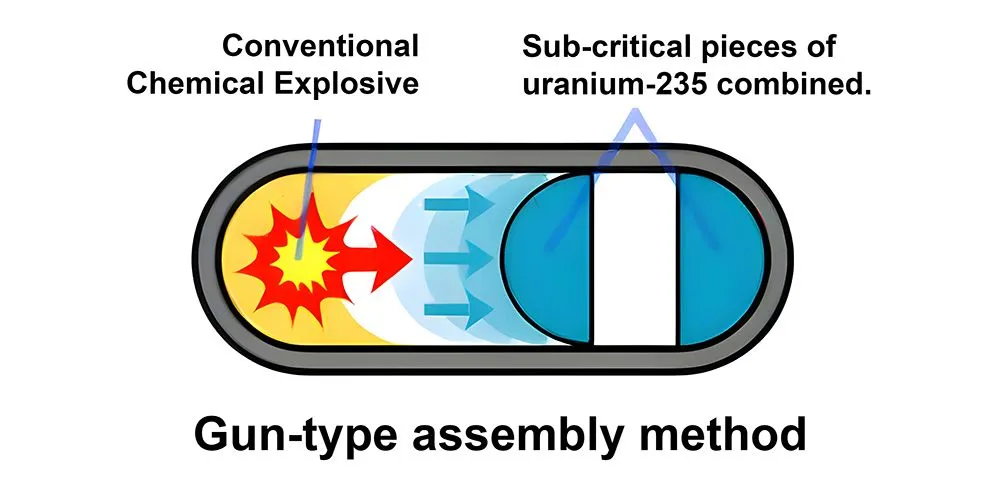
To set off any nuclear explosion, the geometry of the subcritical masses that form the core of the weapon is an important consideration. Originally, for fission reactions, a plug-and-socket type design was used.
In this model, the subcritical masses were machined such that one would perfectly fit into the other. The smaller of the two pieces, similar to a plug, would be propelled by an explosion to fit into the socket, thereby reaching critical mass. However, other geometries that place subcritical cores in close proximity are also used.
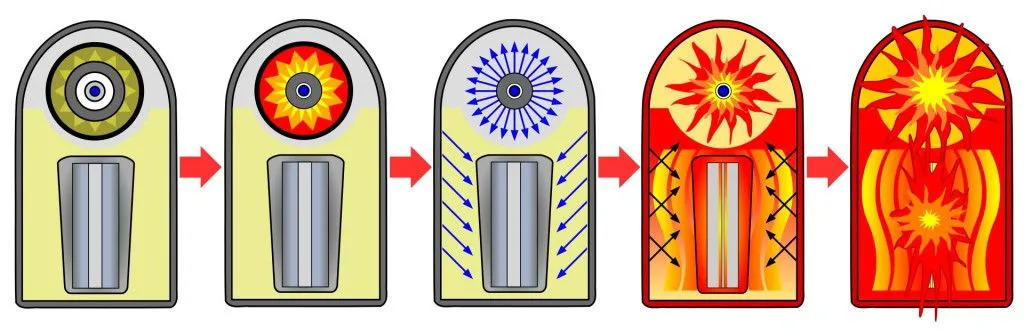
However, such a design was quite unreliable, and was replaced by an implosion-type design, which brings about criticality by compressing the core using immense heat and pressure. To achieve this, the core is machined as a sphere, and then covered by a layer of conventional chemical explosives. This layer is itself wired by switches that must go off concurrently, to ensure symmetric compression of the core.
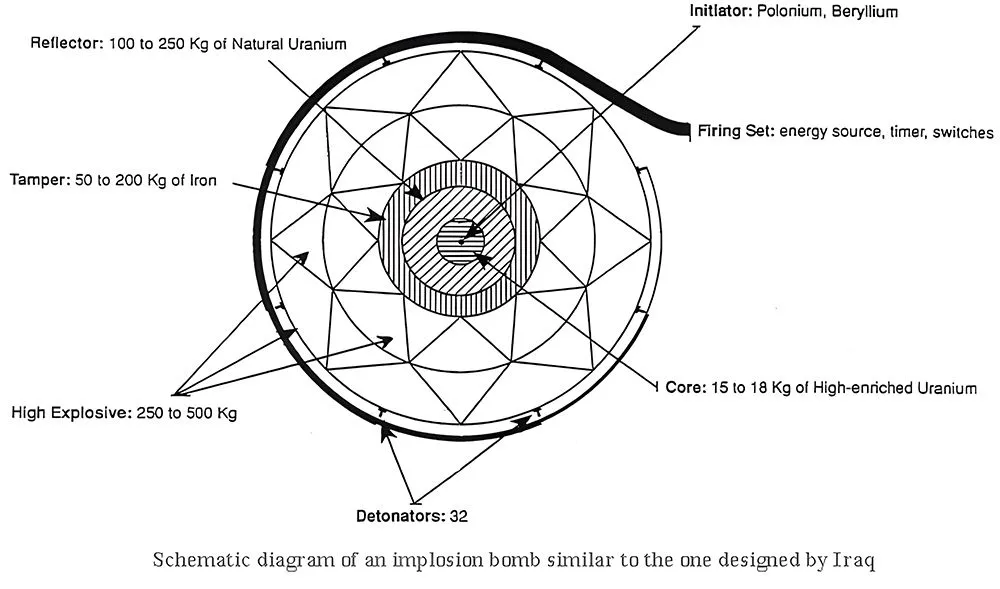
When the core becomes critical, neutrons begin to escape from it, but they are bounced back into the core using a surrounding shell of dense material (typically natural uranium or tungsten carbide) known as a tamper or neutron reflector. (The shaped chemical charges on the outside of the device are called ‘explosive lenses’; the metallic shell that reflects neutrons is a separate component.)
Unlike conventional explosives, the sanctity of this arrangement plays a major role in the success of the nuclear explosion.
Delivering A Nuclear Weapon
Original nuclear bombs were standalone devices, delivered to intended locations in aircraft. Modern nuclear weapons are compact and more lethal, and their delivery is unmanned. They are incorporated as ‘warheads’ into the tips of missiles (intercontinental ballistic missiles, or ICBMs, to be precise).
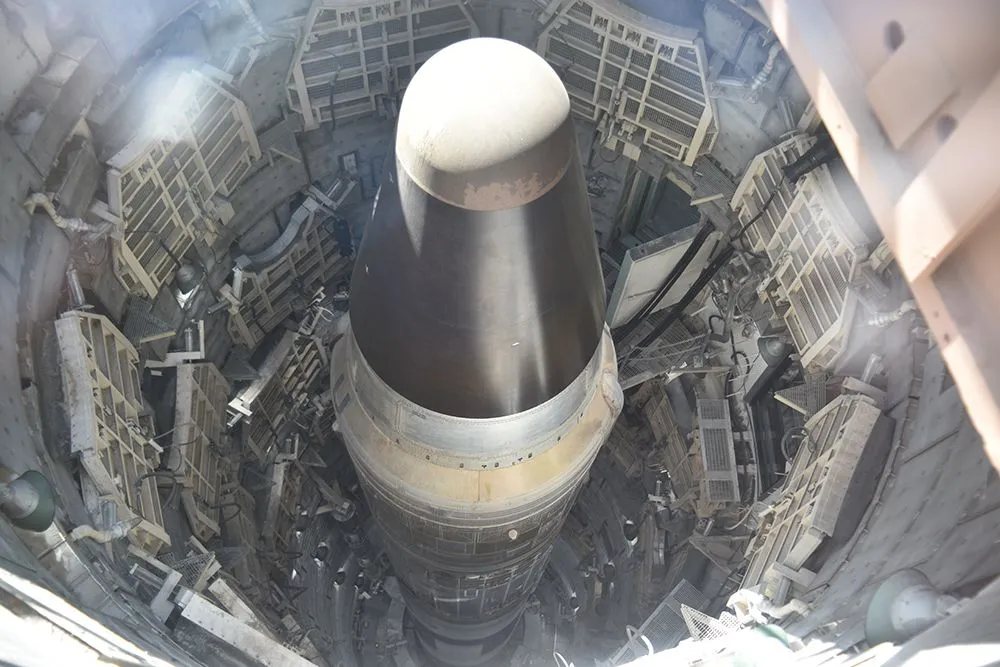
A single ICBM can carry more than one nuclear warhead, in which case it is also known as an MIRV (multiple independently targetable reentry vehicle). Before you proceed further, we implore you to read up on the subject of ICBMs here.
Is A Missile The Same Thing As A Bomb?
Since these words get tossed around interchangeably in headlines, it’s worth pausing to untangle three terms: bomb, missile and warhead. A bomb, in the strictest sense, is just the explosive package itself. The original nuclear bombs were ‘gravity bombs’, with no engine and no steering; once released from an aircraft, gravity does all the work. A missile, on the other hand, is a self-propelled vehicle with its own guidance system, essentially a courier hired to carry an explosive payload to a distant address. The payload riding in a missile’s nose is called a warhead.

The U.S. military draws the line on precisely this basis: weapons that must interface with a launch platform or delivery vehicle are called warheads, while those with no such requirements, like gravity bombs, are simply called bombs. So, is a missile a bomb? No. Is a missile automatically a nuclear weapon? Also no. The overwhelming majority of missiles around the world carry conventional explosives, and only a small fraction are tipped with nuclear warheads. The missile is the courier; the bomb (or warhead) is the package it delivers.
Can A Nuclear Missile Actually Be Shot Down?
An ICBM is theoretically most vulnerable during the boost phase, when it is slow, has a hot, easy-to-track exhaust plume and has not yet released decoys. In practice, though, hitting a missile during boost is very hard: your interceptor has to be close to the launch site, and the boost lasts only a few minutes. That is why the U.S. Ground-based Midcourse Defense (GMD) system targets warheads later, during the midcourse phase, when they are coasting through space outside the atmosphere. Even then, secondary countermeasures, decoys and stealth treatments make a successful intercept anything but guaranteed.
GMD is hardly the only player. Different defenses are designed for different flight phases and different classes of threat: the Aegis BMD system (with SM-3 interceptors) handles midcourse intercepts from sea-based platforms, Israel’s Arrow-3 targets long-range ballistic missiles in space, and THAAD covers the terminal phase as a warhead descends toward its target. Iron Dome, despite its fame, belongs to a different league entirely; it is a short-range system meant for rockets and artillery, not strategic nuclear missiles. Layered together, these systems improve the odds, but none of them turns interception into a sure thing.
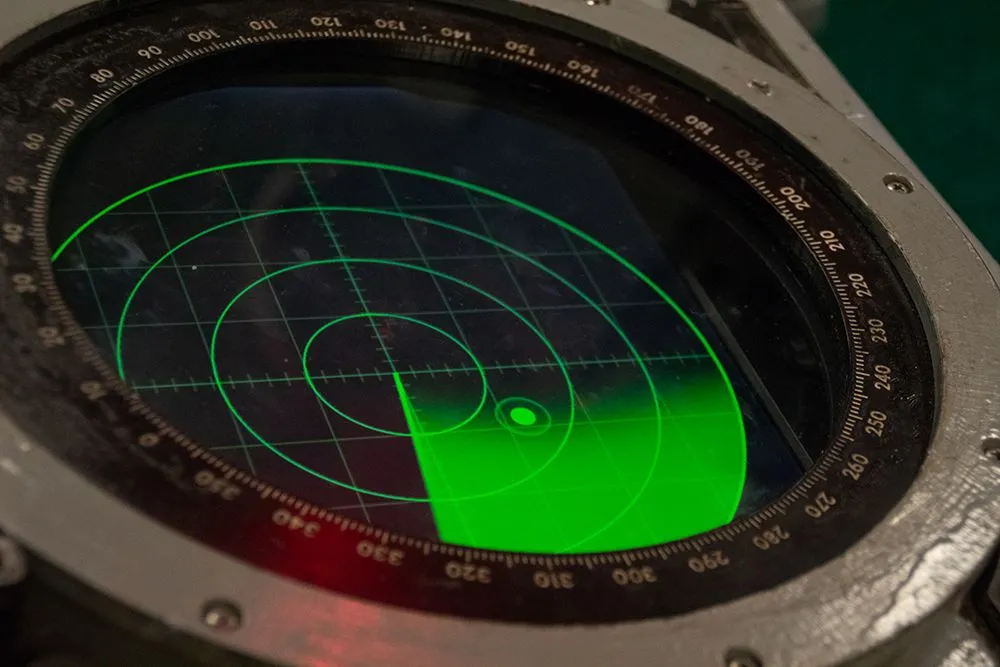
Interceptors are projectiles, so they have a single point of impact. If one somehow manages to breach the warhead’s core containing the critical mass, it will still do so from a single point. This will disturb the symmetry of the explosion required to start the first fission reaction, so the bomb will most likely end up as a fizzle.
However, damage to the warhead’s canister containing the mechanism can cause its contents to spill out. When these contents fall back to the earth’s surface, they will contaminate the area, which must then be isolated.
Could The U.S. Actually Stop An Incoming ICBM?
This is the question many readers are really asking, and the honest answer is: only a very small attack, and even then, with no guarantees. The GMD system fields just 44 interceptors in total, with 40 sitting in silos at Fort Greely, Alaska and four at Vandenberg Space Force Base, California. In flight tests, where the defenders know roughly when and where the target is coming, GMD has succeeded in 12 of 21 intercept attempts.

Those numbers explain the official fine print. GMD is sized to blunt a limited strike from a small arsenal, the kind North Korea might someday launch, and the Pentagon’s own 2022 Missile Defense Review states that it is “neither intended nor capable of defeating the missile capabilities of Russia and China.” A bigger salvo would simply run the defense out of interceptors, especially since several interceptors are typically assigned to each incoming warhead to improve the odds. Upgrades are on the way (a Next Generation Interceptor is slated to begin entering silos around 2028), but for now, missile defense is a thin shield, not an umbrella.
Do Regular Missiles Explode When They Are Shot Down?
Here’s the twist: for ordinary, non-nuclear missiles, the answer flips entirely. Conventional warheads are packed with chemical explosives that are designed to go off, and their triggers are nowhere near as picky as a nuclear firing circuit. An impact fuze detonates the charge the instant the weapon strikes something solid. A proximity fuze goes a step further: a small onboard radio transmitter listens for its own signal bouncing off a nearby object, and fires the warhead once the target is close enough to be damaged. No contact required.

This is why footage of air defense systems at work shows bright flashes in the sky, rather than missiles politely tumbling down in one piece. When an interceptor’s blast and fragments tear into a conventional warhead, they can set off its explosive filler directly (a ‘sympathetic detonation’), or wreck it so that its own fuzing triggers the blast. Even in a clean intercept, leftover rocket fuel and hot debris still rain down, which is why civil defense instructions tell people to stay under cover while interceptions are happening overhead.
A conventional warhead, then, behaves like a loaded mousetrap: any sufficiently rude poke can set it off. A nuclear warhead is more like a combination lock; unless every step fires in exactly the right sequence, you get a radioactive mess, not a mushroom cloud.
What If You Shot A Nuclear Bomb With A Gun?
If your mental image is more cinematic than military (a lone hero with a rifle, a stolen warhead in some warehouse, one well-placed shot), the answer is essentially the same as before: no, the bomb will not detonate. As enumerated above, the conventional chemical charges that initiate a nuclear weapon must fire in an exquisitely synchronized pattern (often within microseconds of each other) to compress the core symmetrically. A bullet, or even a high-velocity fragment from an interceptor, delivers a single off-axis impulse, which is precisely the opposite of what the weapon needs to actually go off.
Modern nuclear weapons go a step further. To prevent them from going off accidentally, they employ insensitive high explosives, formulations like TATB that are deliberately engineered to resist heat, shock and even rifle fire. Thus, even if the projectile of an anti-ballistic missile (or, for that matter, an enterprising marksman’s bullet) breaches the core, it cannot accidentally set off the nuclear reaction. (Source)
What you might get instead is a ‘dirty’ outcome: the explosive layer detonating asymmetrically and scattering plutonium or uranium across the impact area, without the multimegaton fireball. A serious mess to clean up, no doubt, but a far cry from a mushroom cloud.
Closing Remarks
So where does that leave us? With two probabilities, both small but in very different ways. Successfully intercepting an incoming ICBM is genuinely hard; even with layered defenses, a sophisticated warhead surrounded by decoys is a difficult target. Triggering an actual nuclear explosion by intercepting it is harder still; the chain of events a working warhead needs is simply too precise to be set off by a fragment, a bullet or a rogue impact.
Historically, we have come very close to the accidental detonation of nuclear devices on several occasions. Yet despite all the broken arrows, dropped bombs, plane crashes and assorted ‘what could possibly go wrong’ episodes, there has not been a single actual instance of this type. The real hazard from a shot-down warhead isn’t the mushroom cloud; it is the radiological mess left behind, which is reason enough to hope no one ever has to find out.
Thus, our original adage of poison defeating poison still holds somewhat true!
References (click to expand)
- Fact Sheet: Ballistic vs. Cruise Missiles.
- Nuclear Weapons Primer.
- Assuring Nuclear Weapon Safety.
- How Do Nuclear Weapons Work?.
- Nuclear Scholars Initiative.
- Bomb Design and Components - Manhattan Project.
- Science > Bomb Design and Components > Gun-Type ....
- Initiators and Polonium - Bomb Design and Components.
- Science > Bomb Design and Components > High Explosives.
- Fuzes and Detonators.
- Hydrogen Bomb - Manhattan Project.
- Implosion Design - Manhattan Project.
- Nuclear Matters Handbook 2020 [Revised], Chapter 4. U.S. Department of Defense.
- U.S. Missile Defense Programs at a Glance. Arms Control Association.
- Ground-based Midcourse Defense (GMD) System. Missile Threat, CSIS.
- Ground-based Midcourse Defense (GMD). U.S. Missile Defense Agency.
- Proximity fuze. Encyclopedia Britannica.
- Bomb. Encyclopedia Britannica.