The Martian (2015) is one of the most scientifically accurate space films ever made. NASA scientists praised its 8-month Hohmann-transfer trip to Mars, the inflatable habitat (similar to BEAM, now actually attached to the ISS), the hydrazine-to-water chemistry Mark Watney uses, and the idea of growing potatoes in Martian soil. The big liberties: the opening dust storm — Mars’ atmosphere is far too thin to lift a person — and the depiction of working on Mars at Earth-like effort, when Martian gravity is only 38% of Earth’s.
The Martian a space thriller featuring Matt Damon, was released in 2015 and gained worldwide attention for its scientific accuracy. However, like any other movie, there are inaccuracies as well.
Dr. Robert Zubrin, an aerospace and astronautics engineer, commented on some aspects portrayed in the movie that are borderline unrealistic.
While the movie became famous for being the first realistic Mars movie involving humans and receiving praise from NASA scientists, it is essential to consider both the aspects that the movie got right and those that are not feasible in real life.
The Shelter
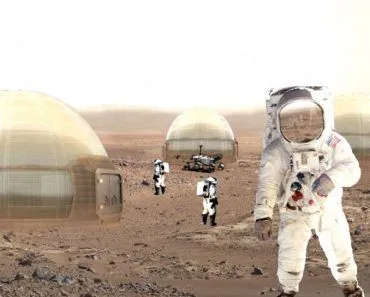
The makeshift shelter where Mark Watney (Matt Damon’s character) lives during his stint on Mars is quite realistic.
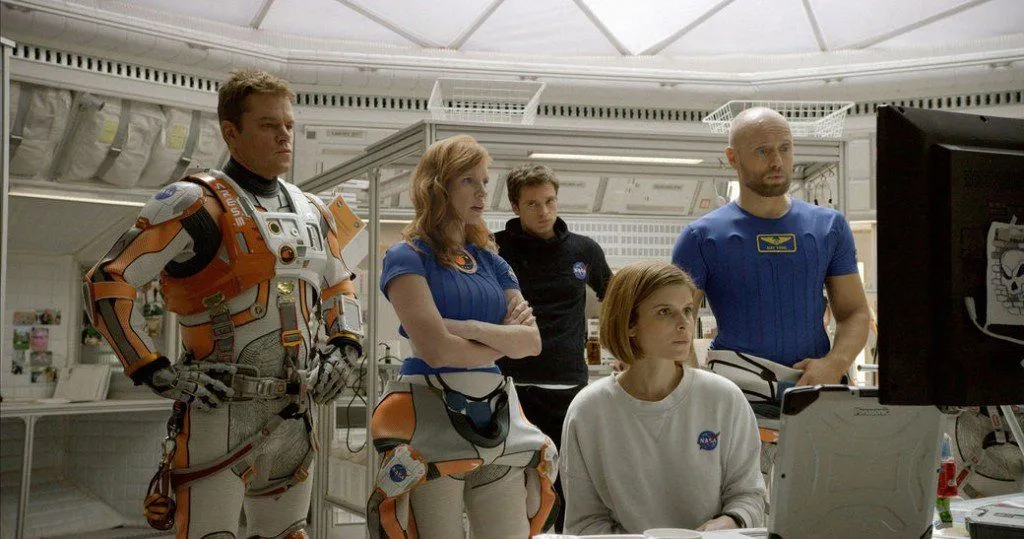
In fact, NASA already attached a Bigelow Expandable Activity Module (BEAM) — an inflatable habitat module with a basic design that is not too different from the one shown in the film — to the International Space Station back in 2016. It is still in orbit, and is being used as a long-term technology demonstration for the kind of soft-shell habitats astronauts would actually use on Mars.
The Storm
The atmosphere of Mars is much thinner than that of Earth, so the air on Mars is not as dense as the air on Earth.
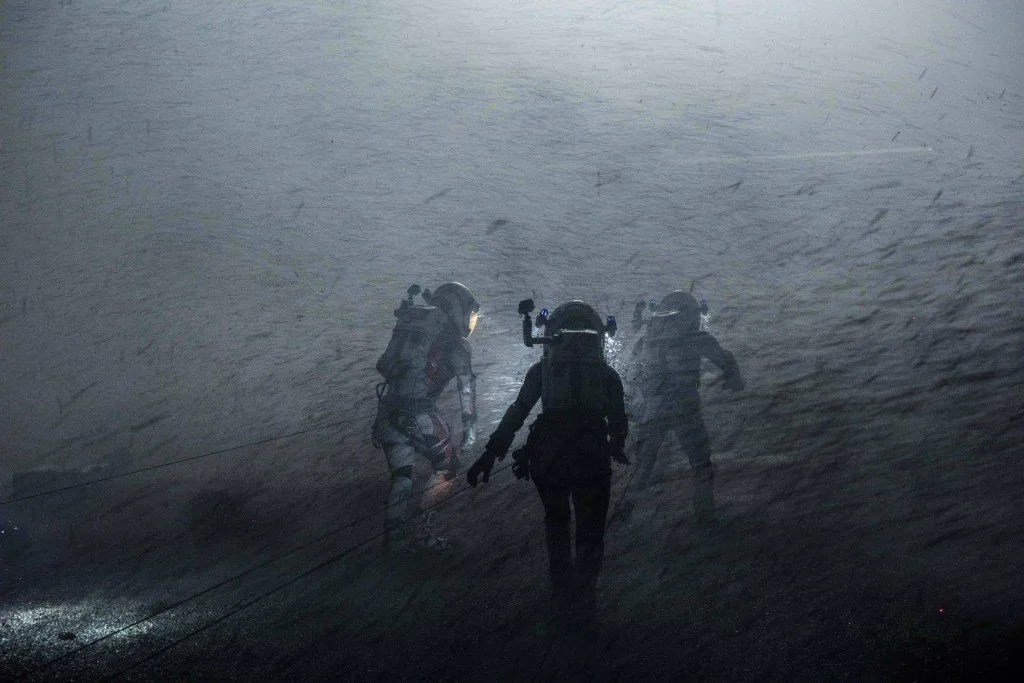
To give you a better idea, a 100 mph wind on Mars would feel just like an 11 mph breeze on Earth. This kind of wind wouldn’t even mess up your walk on Earth, let alone lift you up like the scene in the movie.
Andy Weir, who wrote the book the movie is based on, also agrees that the storm shown in the movie was blown way out of proportion. (pun intended)
Time Taken To Travel To Mars
The movie did an excellent job of portraying space travel accurately. Unlike most other space movies prioritizing dramatic effects over realistic depictions of space journeys, The Martian got it right by showing that it would take approximately eight months to reach Mars using current technology.
Gravity
Did you know that gravity on Mars is almost one-third of what we experience here on Earth? This means that if you weigh 90 pounds on Earth, you would weigh roughly 34 pounds on Mars (Mars gravity is about 38% of Earth’s, not exactly one-third).
This difference in gravity would make everyday activities such as walking and climbing ladders much easier on Mars, as it would require less exertion.
Even wearing astronaut gear, you wouldn’t feel as heavy as on Earth. In fact, in one particular scene, Mark is seen climbing a ladder on Mars and exerting himself, but in reality, it would require much less effort due to the planet’s lesser gravity.
Synthesizing Water
Mark used hydrazine from the MAV’s rocket fuel and decomposed it over an iridium catalyst, breaking it into nitrogen and hydrogen. He then burned the hydrogen in the habitat’s oxygen, producing water vapor that condensed onto cool surfaces. The chemistry is correct, though in real life it would be a fire-and-explosion hazard — which the film does dramatize, when an experimental run goes wrong.

However, if you were stranded on Mars, extracting water from the soil would be more efficient. Martian regolith contains roughly 2–3% water by weight in equatorial regions (as measured by NASA’s Curiosity rover) and far more — up to and exceeding 50% as buried ice — at high latitudes near the poles.
This method is less resource-intensive and significantly improves your chances of survival, eliminating the need to use rocket fuel to produce water.
Window-less Rocket
Towards the end of the movie, Mark straps himself into a rocket, which happens to be his only chance to survive, but there’s a catch – the rocket is window-less! Can you imagine being shot away into space in a rocket that doesn’t have any windows?

Well, scientifically, it’s plausible. The Martian atmosphere is pretty thin, which means that you can get high enough through the atmosphere before it actually starts to become a threat to your survival. Everything depends on the thrust profile of the rocket, and as the calculations seem alright (in the movie), then yes, it may just be possible.
The Toilet Issue
Admittedly, this is a little odd. In the movie, they show that the fecal matter of astronauts has been sealed individually and then stored for later study. The most efficient way to deal with that stuff would be to bag and seal it and ultimately burn it once a day. Obviously, it will be more useful if it’s treated through a number of processes and turned into fuel (this will take extra effort, but you’ll have plenty of time if you’re stranded on Mars).
However, packing and storing everyone’s fecal matter for later study? That doesn’t sound too practical.
Science Behind Growing Potatoes
The most remarkable part of the entire movie was Mark’s idea to grow potatoes on Mars! Is it even feasible?
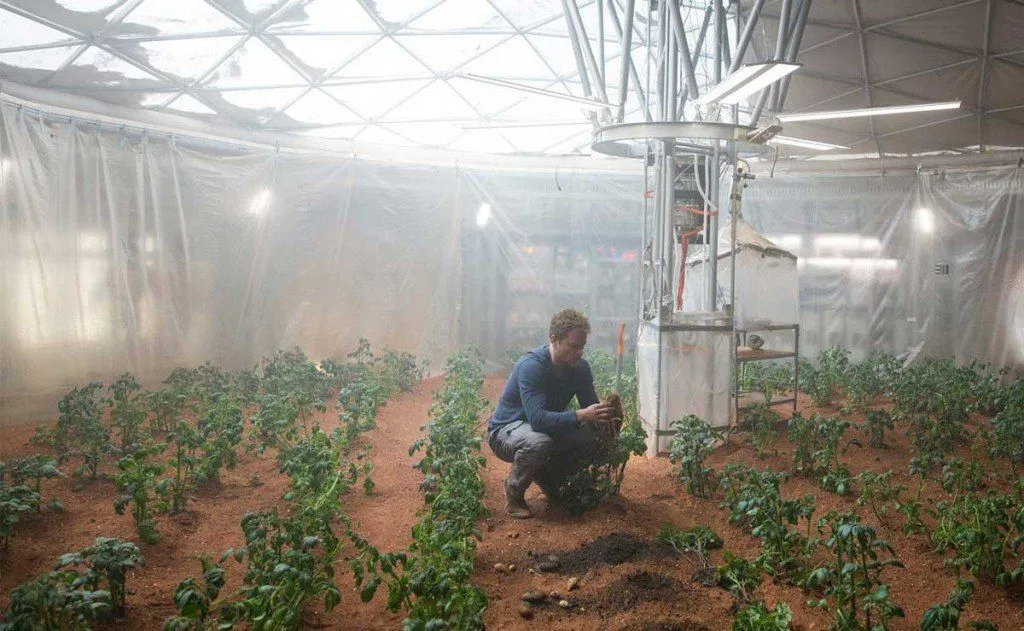
The biggest challenge with that concept is soil quality since Mark had already considered other crucial factors.
However, regarding primary chemical and mineral content, it is possible to cultivate potatoes on Mars. In fact, NASA researchers are conducting experiments using simulated Martian soil.
Is The Martian Based On A True Story?
Short answer: no. No human has set foot on Mars yet, let alone been stranded there, so Mark Watney’s ordeal is pure fiction. What makes it feel like a documentary is where the story came from.

The film is based on the 2011 debut novel by Andy Weir, a software engineer and self-confessed space nerd. Weir first posted the story one chapter at a time on his website, for free. His readers happened to be fellow geeks, and they flagged every place he fumbled the science. As Weir later described it, it was like having thousands of fact-checkers, and one of them was even a geologist at NASA’s Jet Propulsion Laboratory. He patched the errors as they arrived, so the book was effectively peer-reviewed before it was ever sold.
To pull off that realism, Weir taught himself orbital mechanics, astronomy, and the history of human spaceflight, and he leaned only on technology that already exists. Demand from his readers pushed him to self-publish a 99-cent Kindle edition, which sold well enough that Crown Publishing released it properly in 2014. Ridley Scott’s 2015 film, starring Matt Damon, inherited that hard-won accuracy, which is why it holds up to scientific scrutiny far better than many other space films.
What About Radiation?
Here is the big thing the movie quietly skips: radiation. Unlike Earth, Mars has no global magnetic field and only a wispy atmosphere, so cosmic rays and energetic particles from the Sun reach the surface almost unhindered.

We actually have hard numbers for this. NASA’s Curiosity rover carries an instrument called RAD, and it recorded an average dose of about 0.67 millisieverts (mSv) per day on the surface at Gale Crater. For comparison, a single chest X-ray is roughly 0.02 mSv, so a day on Mars is like absorbing around 30 chest X-rays back to back. Add the eight-month journey each way, and NASA estimates a round-trip crewed mission would total on the order of 1 sievert (1,000 mSv).
To put that in perspective, a 2021 review for NASA recommended a career radiation limit of roughly 600 mSv per astronaut. A single Mars mission would sail straight past it. Watney, meanwhile, spends more than 500 sols (Martian days) shielded by little more than a fabric habitat and a spacesuit, neither of which stops much of this. The film glosses over the issue for the sake of the story, but in real life, radiation is one of the toughest problems standing between us and a crewed Mars landing.
Apart from this, the movie has some genuinely awe-inspiring scenes that set it apart from other space thrillers. The idea of a man going to Mars and surviving alone is enough to give anyone goosebumps. It also carries an important message for movie-goers: no matter how daunting the situation may appear, there is always hope.
Last Updated By: Ashish Tiwari
References (click to expand)
- Nine Real NASA Technologies in 'The Martian'.
- A 'Martian'-inspired science project: Growing potatoes in ....
- Sands, J. (2018, January 2). Technical filmmaking and scientific narratives: Has science overtaken fiction in recent science fiction? An analysis of Gravity, Interstellar, and The Martian. South African Journal of Philosophy. Informa UK Limited.
- Moss-Wellington, W. (2020, March 16). Individual and Collaborative Labour in the Space Crisis Movie: From Apollo 13 to The Martian. Quarterly Review of Film and Video. Informa UK Limited.
- Northwestern's McCormick School of Engineering
- The Secret of 'The Martian' Success? Scientific Peer Review. Smithsonian Magazine.
- The Martian (Weir novel). Wikipedia.
- NASA Curiosity: First Mars Age Measurement and Human Exploration Help. NASA Jet Propulsion Laboratory.
- Space Radiation and Astronaut Health: Managing and Communicating Cancer Risks (2021). National Academies of Sciences, Engineering, and Medicine.