Table of Contents (click to expand)
The Stroop effect is the delay you experience when naming the ink color of a word that spells a different color, such as the word ‘red’ printed in green ink. Because reading is more automatic than color naming, the brain struggles to ignore the word. The Stroop test uses this delay to measure selective attention, processing speed, and cognitive control.
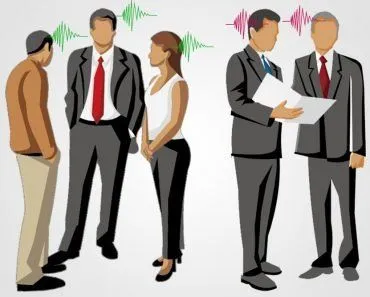
Our brain constantly deals with incoming information from our senses, processes this information, and helps us make sense of the world around us. The brain simultaneously receives different streams of information from the same or different sense organs.
For example, if you’re lying on the bed listening to music and sipping some hot tea late at night, your brain simultaneously receives input from (1) your ear about the music, (2) your tongue about the tea, and (3) your skin and body about the bed, the temperature in your room, etc. However, seldom do we face difficulties due to such simultaneous processing by the brain.
What if the brain receives two stimuli with conflicting information? What does the brain do then?

Rarely, when this happens, where both stimuli compete for our attention, the brain can ‘glitch’ in certain ways. Below, we will look at this type of ‘glitch’ in the brain, widely referred to as the ‘Stroop effect’ in psychology.
Selective Attention
In many ways, attention can be considered to be the brain’s preferred currency. Amongst the simultaneous and constant influx of information from our senses, the brain must choose where to direct its attention. This is why, in the above example, you may not really pay attention to how your bed feels when lying down when your favorite song is playing. This process, where your brain decides which stimulus to pay attention to, and suppresses information from other distracting stimuli, is called selective attention.
Let’s look at a demonstration of our brain’s selective attention ability. Watch this video and try to count the number of times the players in white pass the ball.
Even if you did get the answer right (15), how many of you noticed a gorilla casually walking past the players?!
This is a fine example of how devoted your attention can be once you select what to pay attention to. Once the stimulus of choice is decided on (the players in white), the distractor (gorilla) is of no significance to your brain, making you practically blind to it!
However, selective attention has its flaws, and the Stroop effect is a good example that demonstrates it.
The Stroop Effect – Color Naming Vs Reading
Selective attention helps the brain choose its target and ignore distractions. But what happens when two stimuli contain conflicting information and they compete for selective attention? Which stimulus will the brain choose?
John Ridley Stroop discovered this curious effect while carrying out experiments where he studied participants who verbally named color words written in various colored inks to determine if learning could improve their responses. He carried out three sets of experiments in which participants (1) read color words printed in black ink, (2) named the ink color of color words printed in conflicting colors, and (3) named the color of solid squares shown to them.
The trouble starts in that second task. Picture the word ‘red’ printed in green ink and your job is to say the ink color, ‘green’. The modern version of the test sorts these trials into three conditions: a ‘neutral’ baseline (for example, the word ‘red’ in black ink, or a row of colored squares), a ‘congruent’ condition where the word and ink match (‘red’ in red ink), and an ‘incongruent’ condition where they clash (‘red’ in green ink). Stroop found that people took significantly longer to name the ink color when the word and the color did not match. This extra delay in the ‘incongruent’ condition, compared to the ‘congruent’ one, is what we call the Stroop effect.
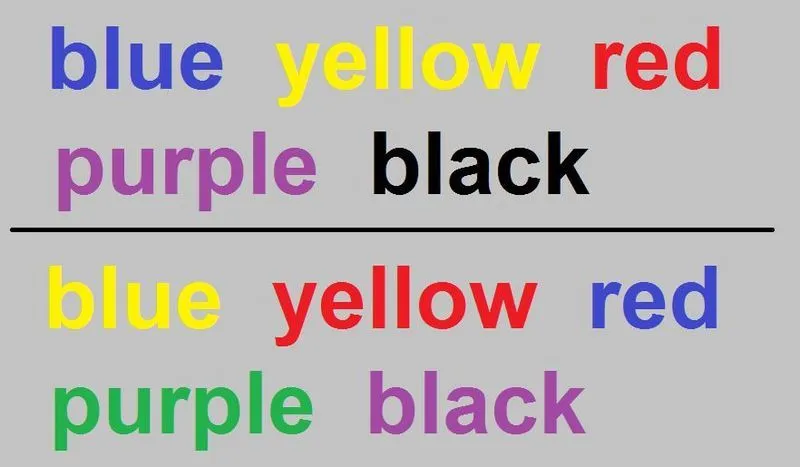
Stroop reasoned that this delay in naming happens because reading the color word happens more automatically than color naming. Therefore, participants have a hard time suppressing meaning from the color word ‘red’ and end up reading it out loud instead of naming the color of the ink. In other words, selective attention chooses the reading process over color perception, in this case. Eventually, reading ‘interferes’ with our color naming ability.
Interestingly, in bilingual people who read two languages, the Stroop effect is found in both languages when tested. The degree of the Stroop effect is often dependent on their fluency in the language; the more fluent they are in a language, the bigger their Stroop effect was in it.
Applications And Variations
The Stroop test is commonly used in psychology as a test of selective attention and to check for cognitive function in patients with brain damage or disorders.
Several variations of the classic Stroop test also exist. In the ‘emotional’ Stroop test, words eliciting strong emotions or neutral words are shown in various colored inks. Participants show more of a delay in naming the ink color for words eliciting emotional responses than for neutral words. In the ‘numerical Stroop test’, participants are asked to compare numbers in font sizes that are incongruent with their numerical value. For example, when asked ‘Is 3 bigger than 5?’, participants take longer to respond when 3 is shown to be bigger in size than 5, than they do when the question is reversed.
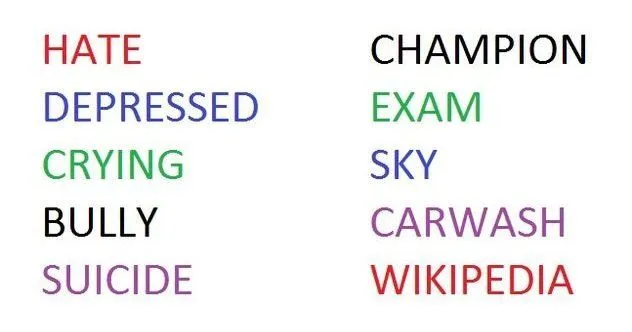
Regardless of these variations, all Stroop tests deal with two incongruent properties of a stimulus and a resulting delay in its cognitive processing by the brain. Eventually, the more automatic process among the two gets access to selective attention and is processed, while the other is ignored.
Conclusion
Selective attention ability helps the brain choose what stimulus to attend to and what to ignore among the constant stream of incoming stimuli. When the brain encounters incongruent information from stimuli, selective attention is devoted to the more automatic and easy process. The Stroop effect is a simple demonstration of this aspect of selective attention.
Although it looks like a neat party trick, the Stroop effect is very useful in measuring our cognitive ability and brain function, particularly in clinical settings where brain disorders are studied. This curious ‘glitch’ in our brain process is actually very telling!
References (click to expand)
- Stroop, J. R. (1935, December). Studies of interference in serial verbal reactions. Journal of Experimental Psychology. American Psychological Association (APA).
- ROSSELLI, M., ARDILA, A., SANTISI, M. N., ARECCO, M. D. R., SALVATIERRA, J., CONDE, A., & LENIS, . and B. (2002, September). Stroop effect in Spanish–English bilinguals. Journal of the International Neuropsychological Society. Cambridge University Press (CUP).
- Ben-David, B. M., Nguyen, L. L. T., & van Lieshout, P. H. H. M. (2011, February 15). Stroop Effects in Persons with Traumatic Brain Injury: Selective Attention, Speed of Processing, or Color-Naming? A Meta-analysis. Journal of the International Neuropsychological Society. Cambridge University Press (CUP).
- Hepp, H. H., Maier, S., Hermle, L., & Spitzer, M. (1996, December). The Stroop effect in schizophrenic patients. Schizophrenia Research. Elsevier BV.
- Frings, C., Englert, J., Wentura, D., & Bermeitinger, C. (2010, January). Decomposing the emotional Stroop effect. Quarterly Journal of Experimental Psychology. SAGE Publications.
- Henik, A., & Tzelgov, J. (1982, July). Is three greater than five: The relation between physical and semantic size in comparison tasks. Memory & Cognition. Springer Science and Business Media LLC.