Table of Contents (click to expand)
- What Does "Almost The Speed Of Light" Mean?
- Why Does Energy Explode Near The Speed Of Light? (The Lorentz Factor)
- How Much Energy Does A Needle Carry At 99.9% The Speed Of Light?
- What Would A Needle Hitting Earth At Near Light Speed Look Like?
- What If A Grain Of Sand Hit Earth At 99% The Speed Of Light?
- Has Anything Ever Hit Earth At Nearly The Speed Of Light?
- What If An Asteroid Hit Earth At The Speed Of Light?
- Would A Needle At Near Light Speed Destroy Earth?
- Can We Reach 1% Or 50% Of The Speed Of Light?
- So, What Would Happen If A Needle Hit Earth At Almost The Speed Of Light?
A steel sewing needle weighing a tenth of a gram, arriving at 99.9% of the speed of light, carries about 190 trillion joules of energy of motion, the same as roughly 46,000 tonnes of TNT, or three Hiroshima bombs. It would not reach the ground: the air cannot get out of its way, so it would burst high in the sky as a cloud of superheated gas and radiation, like the 2013 Chelyabinsk meteor at a tenth of the power. Blowing Earth apart would take about a billion billion times more energy, so the needle is a city-scale disaster, not a planet-killer.
In October 1991, a detector called the Fly's Eye was watching the night sky over Utah. It sat on the Dugway Proving Ground, hunting cosmic rays, and it caught a single subatomic particle from space carrying about 51 joules of energy. That is a bit more than a brick dropped on your toe from waist height, packed into a speck smaller than an atom. The physicists who found it nicknamed it the Oh-My-God particle.
A brick on the toe is survivable. The question people keep asking the internet is what happens when you scale that up. Swap the proton for a whole sewing needle, moving at 99.9% of the speed of light, aimed at the ground.
The answers online run from "a small bang" to "it would crack the planet in half". Both camps are guessing. The real answer is a number, and you can work it out with one formula and a kitchen scale.
What Does "Almost The Speed Of Light" Mean?
Light in a vacuum travels at 299,792,458 meters per second. Call it 300,000 km (186,000 miles) every second. In this article, "almost" means 99.9% of that speed. Our needle loses the race with light by about 300 km per second. Even its losing margin is 15 times faster than the 20 km per second at which the Chelyabinsk meteor hit the air.
Now the other half of the question: what does a moving object carry? Throw a ball at a wall and it hands over its energy of motion, which physicists call kinetic energy. The school rule is KE = ½mv². Double the mass and you double the energy. Double the speed and you get four times the energy. OpenStax gives the everyday version: a car at 100 km/h has four times the kinetic energy it has at 50 km/h. Fast crashes are so much worse for that reason.
Physicists measure energy in joules, and a joule is small. For explosions we use a bigger unit. NIST defines one tonne of TNT as 4.184 billion joules, and a kiloton is a thousand of those. The bomb dropped on Hiroshima was about 15 kilotons. The needle's answer will come in that unit.
Why Does Energy Explode Near The Speed Of Light? (The Lorentz Factor)
The school formula has a flaw. Feed it the speed of light and it hands back a finite number, half the mass times c². That cannot be right, because no object with mass can attain the speed of light. Einstein's special theory of relativity replaces it with a formula that behaves:
KE = (γ − 1)mc²
Here m is the object's mass, c is the speed of light, and γ (the Greek letter gamma) is the Lorentz factor:
γ = 1/√(1 − v²/c²)
In plain words, γ is a stretch factor set by how close your speed v sits to c. At everyday speeds it equals 1, so (γ − 1) is 0 and a parked car has no energy of motion. The quantity mc² is the object's rest energy, the energy locked up in its mass. So the formula says kinetic energy equals (γ − 1) copies of the rest energy. The Lorentz factor is what makes the needle dangerous. At 50% of light speed, γ − 1 is 0.15; at 90% it is 1.3; at 99% it is 6.1; and at 99.9% it is 21.4.
Notice the shape of that list. The trip from a standstill to 90% of light speed buys 1.3 rest energies. The step from 99% to 99.9%, less than 1% of extra speed, buys 15 more. As the speed approaches c the kinetic energy heads to infinity. That wall is also why we can push protons to near light speed but not rockets.

How Much Energy Does A Needle Carry At 99.9% The Speed Of Light?
The mass comes first, and it is smaller than you think. A fine hand-sewing needle from Prym, the No. 11 sharp, is 0.5 mm thick, 32 mm long and made of steel. Treat it as a thin rod: its volume is π × (0.025 cm)² × 3.2 cm, about 0.0063 cubic centimeters. Steel has a density of about 7.8 grams per cubic centimeter, so that needle weighs about 0.05 grams. A thicker everyday needle lands nearer 0.1 grams, so we will use 0.1 g, or 0.0001 kg. The answer scales with mass: a needle twice as heavy carries twice the energy.
Now the four steps of the arithmetic:
- At 99.9% of light speed, γ − 1 = 21.37.
- c² is 299,792,458 squared, about 90 million billion (a 9 followed by 16 zeros).
- KE = 21.37 × 0.0001 kg × 90 million billion = about 190 trillion joules (1.9 followed by 14 zeros).
- Divide by 4.184 billion joules per tonne: about 45,900 tonnes of TNT, or 46 kilotons.
Three Hiroshima bombs, delivered by a tenth of a gram of steel. The needle itself has not changed; it is still the thing you lose in the sofa. Relativity did the inflating. Newton's ½mv² gives about 4.5 trillion joules for the same needle. Einstein's formula comes out 43 times bigger, and the whole difference is the Lorentz factor at work.

What Would A Needle Hitting Earth At Near Light Speed Look Like?
Not a puncture. There is no clean hole and no crater, because the needle never gets near the ground.
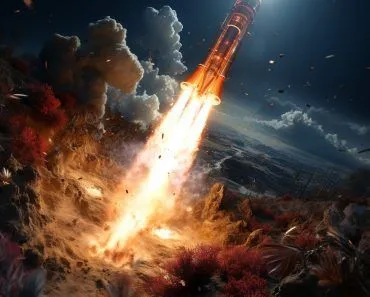
The best-known walkthrough is Randall Munroe's Relativistic Baseball, from his What If? series. It sends a baseball at 90% of light speed. His reasoning carries straight over to a needle. The air molecules in its path have no time to move aside. Munroe writes that the ball "smacks into them so hard that the atoms in the air molecules actually fuse with the atoms in the ball's surface". Within a few meters the object is "a bullet-shaped cloud of expanding plasma". Plasma is gas so hot that its atoms have lost their electrons. Munroe's numbers are a thought experiment, and he says so, but the mechanism is the point. At these speeds, air is a wall. Every gram of needle becomes heat and radiation high in the atmosphere.
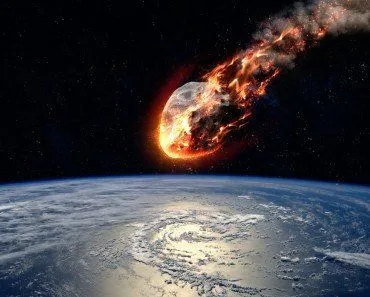
Nature has run a smaller version for us. On 15 February 2013, a rock about 19 meters across came apart over Chelyabinsk, Russia. The Nature paper on the event puts the airburst at about 500 kilotons of TNT. Its authors file such events under "nuclear-weapon-sized" detonations in the atmosphere. NASA's account puts the flash 20 to 30 km above the city, from a rock weighing 7,000 to 10,000 tonnes. Our needle carries a tenth of that energy in a tenth of a gram. Expect a flash bright enough to hurt and a shock wave that breaks windows across a city. Add a burst of radiation from the plasma, all from an object that no longer exists. As for the person under it, Munroe's ruling applies. The batter "would be considered 'hit by pitch', and would be eligible to advance to first base".

What If A Grain Of Sand Hit Earth At 99% The Speed Of Light?
Same formula, two knobs turned down. Geologists define sand as grains between 62.5 micrometers and 2 mm across. Take a 1 mm grain of rock at granite's density of 2.7 grams per cubic centimeter. It weighs about 1.4 milligrams, 70 times less than the needle. At 99% of light speed, γ − 1 drops to 6.1.
So: 6.1 × 0.0000014 kg × 90 million billion = about 770 billion joules, or 185 tonnes of TNT. Big enough to level a block, far short of a nuclear weapon. Push the same grain to 99.9% and it climbs to about 650 tonnes.
Those two numbers hold the whole lesson. Mass is a linear knob: ten times the mass, ten times the energy. Speed near c does not behave that way. The step from 99% to 99.9% multiplies the energy by 3.5, and the next 0.09% would triple it again.

Has Anything Ever Hit Earth At Nearly The Speed Of Light?
Yes, every day, in the form of cosmic rays, and the record holder is the particle from the opening. The 1995 paper by Bird and colleagues reports a 51-joule (320 ± 90 EeV) cosmic ray detected by the Fly's Eye. An EeV is a billion billion electron volts. The authors add a caution. The shower's shape "does not uniquely identify the type of primary particle". If it was a proton, its speed fell short of c by about four parts in a trillion trillion.
The record has company. On 27 May 2021, the Telescope Array caught a particle at 244 EeV, about 40 joules. The array is a grid of 507 detectors spread over 700 square kilometers of desert near Delta, Utah. The team named the particle Amaterasu, after the Japanese sun goddess.
So why is a 51-joule particle a curiosity and a 190-trillion-joule needle a catastrophe? Count the passengers. Iron has an atomic weight of 55.845 and a mole holds 6.022 × 10²³ atoms. So a 0.1 g steel needle holds roughly a thousand billion billion atoms (a 1 followed by 21 zeros). Each carries about a 300-millionth of the Oh-My-God particle's energy. The needle wins on headcount: one cosmic ray is a brick on your toe, and a needle is a billion billion of them arriving together.

What If An Asteroid Hit Earth At The Speed Of Light?
At the speed of light itself, nothing happens, because nothing can get there. The energy required becomes infinite first. At 99.9%, the formula still works, and the mass knob now goes to eleven.
Take Bennu, the asteroid NASA's OSIRIS-REx sampled. It is about 500 meters across and weighs 73 billion kilograms. Multiply 21.37 × 73 billion kg × 90 million billion. You get about 140 billion billion billion joules (1.4 followed by 29 zeros). The asteroid that ended the dinosaurs hit Chicxulub 66 million years ago. That impact released about 10²³ joules, a 1 followed by 23 zeros. Bennu at 99.9% of light speed would deliver a million of those at once. No crater, just a sterilized surface.
This is where the "why is 2029 so scary?" searches come from. On 13 April 2029, the asteroid Apophis, about 340 meters wide, will pass 20,000 miles (36,000 km) from Earth. Observers in the Eastern Hemisphere will see it without binoculars. NASA's verdict is blunt: "There is no danger to Earth, to anyone or anything living on it, or to astronauts or satellites in space." Apophis moves at ordinary rock speeds, tens of kilometers per second. Nothing in the solar system can push a rock to 99.9% of light speed. That fact is the part of this article that should let you sleep.

Would A Needle At Near Light Speed Destroy Earth?
No, and the margin is not close. To blow a planet apart you have to lift every piece of it away from every other piece, against gravity. Florian Freistetter ran the sum for Earth in Scientific American. He got around 200 nonillion joules, a 2 followed by 32 zeros. That matches, he notes, the energy locked in the whole mass of the 17-km asteroid Eros.
The needle brings 1.9 followed by 14 zeros. It is 18 zeros short, a factor of about a billion billion. Even Bennu at 99.9% of light speed, with its 1.4 followed by 29 zeros, falls about 1,400 times short of unbinding the planet. It would end life on the surface, but Earth would still be a ball. To reach the 2-followed-by-32-zeros mark at 99.9% of light speed, you need about 100 billion tonnes of rock. At granite density that is a boulder about 4 km across. Planet-killing is a job for mountains, not needles.

Can We Reach 1% Or 50% Of The Speed Of Light?
One percent of light speed is about 3,000 km per second, or 6.7 million miles per hour once you convert meters to miles. The fastest thing humans have built is NASA's Parker Solar Probe. At its closest passes of the Sun it reaches about 430,000 mph (700,000 km/h). That record came in 2024, six years after it first became the fastest-ever human-made object. NASA says that is quick enough to get from Philadelphia to Washington in one second. It is also 0.064% of light speed. We are not at 1% yet; we are at a fifteenth of 1%, and that took a slingshot around the Sun.
The one serious plan to go faster is Breakthrough Starshot, announced in 2016. It calls for a "gram-scale wafer" of a spacecraft, pushed by a laser array. That array "could potentially be scaled up to the 100 gigawatt level". The craft "could fly at 20 percent of light speed" and reach Alpha Centauri within about 20 years of launch. Note the mass, in grams: it is the needle's lesson read in reverse. Fifty percent of light speed for a crewed ship runs into the energy wall from the Lorentz section. Whether a human could survive the trip at all is its own question.

So, What Would Happen If A Needle Hit Earth At Almost The Speed Of Light?
A tenth of a gram of steel at 99.9% of light speed carries about 190 trillion joules. In bomb units, 46 kilotons of TNT, or three Hiroshimas. It would not touch the ground. The air in its path cannot move aside. The needle becomes a cloud of plasma within meters of entering the atmosphere. It bursts tens of kilometers up, a smaller cousin of the Chelyabinsk airburst: the same shattered windows, flash and radiation. For the city beneath it, that is a disaster. For the planet, it is nothing, because Earth needs a billion billion times more energy than that to come apart.
Two ideas carry the whole result. Mass scales the energy in a straight line, so a heavier needle is a bigger bomb and a grain of sand at the same speed is a truck bomb. Speed does not scale in a straight line. The Lorentz factor makes the last 1% of the way to light speed cost more than the first 99%, and the energy heads toward infinity before you arrive. It is also why the Oh-My-God particle, for all its 51 joules, left no mark on Utah beyond a line in a data file.
The honest shape of the answer is "nuclear bomb, not extinction event", and the uncertainty lives in the mass you pick for the needle, not in the physics. The Telescope Array is still out in the desert near Delta, waiting for the next 51-joule speck. Apophis will pass on 13 April 2029 at a few tens of kilometers per second, the only speed rocks ever have.
References (click to expand)
- Detection of a Cosmic Ray with Measured Energy Well beyond the Expected Spectral Cutoff due to Cosmic Microwave Radiation — Bird et al., The Astrophysical Journal (1995)
- Telescope Array detects second highest-energy cosmic ray ever — University of Utah, @theU
- An extremely energetic cosmic ray observed by a surface detector array — Telescope Array Collaboration, Science (2023)
- Speed of light in vacuum — NIST CODATA
- Kinetic Energy and the Work-Energy Theorem — OpenStax College Physics 2e
- NIST Guide to the SI, Appendix B.8: Factors for Units Listed Alphabetically (ton of TNT, mile) — NIST
- The Atomic Bombing of Hiroshima, August 6, 1945 — U.S. Department of Energy, OSTI OpenNet
- 5.10: Relativistic Energy — University Physics III (OpenStax), Physics LibreTexts
- Sewing needles sharps, No. 11, 0.50 x 32 mm — Prym
- 11.2 Density (Table 11.1, densities of various substances) — OpenStax College Physics 2e
- Relativistic Baseball — Randall Munroe, What If?
- A 500-kiloton airburst over Chelyabinsk and an enhanced hazard from small impactors — Brown et al., Nature (2013)
- APOD: 2013 February 23 – Chelyabinsk Meteor Flash — NASA
- Open-File Report 2006-1195: Nomenclature (grain-size classes) — USGS
- Atomic Weights and Isotopic Compositions for Iron — NIST
- Avogadro constant — NIST CODATA
- Taking the measure of an asteroid — University of Colorado Boulder Research Report 2018-19
- The Chicxulub impact and its environmental consequences — Morgan et al., Nature Reviews Earth & Environment (2022)
- Apophis Facts — NASA Science
- How Much Energy Would It Take to Blow Earth to Smithereens? — Florian Freistetter, Scientific American (2024)
- Parker Solar Probe — NASA Science mission page
- Parker Solar Probe Becomes Fastest-Ever Spacecraft — NASA (2018)
- Breakthrough Starshot announcement — Breakthrough Initiatives
- Proton mass energy equivalent in MeV — NIST CODATA
- Electron volt — NIST CODATA