Your brain can process certain types of information within as little as 13 milliseconds. This means that your brain can identify what it’s looking at approximately 30 times faster than you can blink your eye!
Have you ever cursed yourself for being too slow or for your brain being a bit dull? If so, give yourself a break and prepare for a new cool fact about your brain that will ease your worries!
What if I told you that your brain could process certain types of information within as little as 13 milliseconds? To put that in perspective, it takes you 300 to 400 milliseconds to blink your eye, which is 1/3 of a second. This means that your brain can identify what it’s looking at approximately 30 times faster than you can blink your eye!

Research: Theme Of An Image
Scenic information in the environment hits the retina, which transfers it through electrical signals to the area of the brain that processes visual information, where it can then be interpreted. Scientists in the past thought that a rudimentary interpretation of these images to understand their general theme took at least 1/10 of a second. However, research conducted by researchers at MIT’s Brain and Cognitive Sciences department has helped reveal this fascinating new fact.
Method Of Study
In their study, participants were rapidly presented with a set of six or twelve images, one after the other, with each image being exposed for 13 to 80 milliseconds. Participants were asked to detect a picture specified by a name (e.g., a smiling couple) that was given just before or immediately after the sequence. As predicted, as the exposure times decreased, participant performance of the task declined, but they could still accurately detect the majority of the time. Even at 13 milliseconds, participant responses was more than 50% accurate, suggesting that they were not just guessing. Want to try it? Look at the image below and see if a ‘car and street’ image is available. The images are changing at a speed of 200 ms, which is still quite slow.

However, there’s a catch. There is a small possibility that they could report the accurate description of an image because, after a while, they were more skilled at detecting in short times. Also, researchers couldn’t present the images for shorter than 13 milliseconds due to technical difficulties. To prevent both these factors, further research should be conducted by flashing different images individually for shorter times to arrive at a stronger conclusion and establish an average threshold for human beings’ visual recognition speed.
In order to remember the finer details of an image, we would definitely need more time than 13ms.
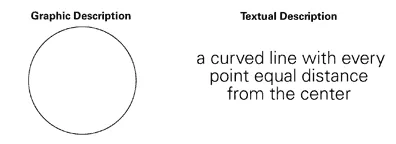
More trivia? In the case of information that we see, images or scene-related information is processed faster than words or sentences. Different and more steps of processing are involved in reading a word which makes it longer. Take a look at the image below. Which one did you understand more quickly?
How Fast Is Our Brain?
Our brain has around 86 billion neurons (the older "100 billion" figure was revised down in 2009 by Suzana Herculano-Houzel's "brain soup" cell-counting method). 86 billion is still a staggering amount of processing power. This lets us have responses that feel instantaneous. It takes 400-500 milliseconds (1 millisecond = 0.001 seconds) on average for us to respond to visual stimuli. If you consider that half of this time is spent on the second motor signal and giving the response, the time taken to analyze and decide on the response is really low. Neuronal activity of around 50-100 milliseconds is enough to create the information, and approximately 20-30 milliseconds are required to identify and discriminate complex visual stimuli.
How Long Does It Take To React To What You See?
Spotting the gist of an image in 13 milliseconds is one thing; actually doing something about it is another. The moment light hits your retina, the signal still has a surprisingly long road to travel. It runs down the optic nerve, crosses a junction called the optic chiasm, pauses at a relay station deep in the brain known as the lateral geniculate nucleus, and only then fans out to the visual cortex at the very back of your head. Just getting the signal that far takes roughly 20 to 40 milliseconds.

After that, your brain still has to interpret the scene, decide what to do, and fire off the motor commands to move a muscle. Add it all up and a simple visual reaction, such as hitting a button the instant a light flashes, takes around 190 milliseconds in a young adult. Curiously, we react to sound a touch faster, at roughly 160 milliseconds, because an auditory signal reaches the brain in only 8 to 10 milliseconds against the longer visual route. That speed gap is one reason sprinters start to a starting pistol rather than a flash of light.
So when we say the brain can grasp an image in 13 milliseconds, that is the recognition step on its own. Once a genuine choice is involved, the full perceive, decide and act loop stretches to the 400 to 500 milliseconds mentioned above, with a hefty share of that time spent on the motor response rather than on the seeing. This loop is also slower than a true reflex, which can trigger a movement before the signal ever reaches your conscious brain.
How Many Frames Per Second Can The Human Eye See?
Here is a question that fuels endless arguments among gamers and movie buffs: how many frames per second can your eye actually see? You have probably heard that we "only see 24 or 30 frames a second." That is a myth. The smooth motion on any screen is really a kind of optical illusion stitched together from a rapid run of still frames.

What scientists actually measure is the critical flicker fusion threshold, the point at which a flickering light stops looking like a flicker and melts into a steady glow. For most people that happens somewhere between about 50 and 90 flashes per second (50 to 90 Hz), and the exact figure depends on how bright the light is and where it lands on your retina, since your peripheral vision is more sensitive to flicker than the center. A 2024 study from Trinity College Dublin clocked an average threshold near 50 flashes per second but found a striking spread, with some healthy adults of the same age differing by as much as 30 Hz. In effect, two people can see the world refresh at noticeably different speeds.
Flicker fusion is not quite the same thing as smooth motion, though. Judging whether a steady light looks steady is easier than judging whether movement looks fluid, and trained viewers can often tell apart frame rates well above 100 per second. That is why a 120 Hz display can still look visibly smoother than a 60 Hz one, even though both are well past the point where a flickering bulb would appear perfectly continuous.
Why Can’t We Calculate As Fast As A Supercomputer?
So now we know that our brain is really fast. But we still need computers to analyze things or perform calculations. It is said that a computer whose power is comparable to the brain could process more than 38 thousand trillion operations per second and hold about 3,584 terabytes of memory. Overwhelming, isn’t it? So much power and we can’t clear our exams properly. As of late 2025 the fastest supercomputer on the Top500 list is the U.S. Department of Energy's El Capitan at Lawrence Livermore National Laboratory, which hits roughly 1.8 exaFLOPS (1.8 quintillion floating-point operations per second) across 11.3 million CPU/GPU cores. That is more than 20,000 times faster than IBM's old BlueGene/L, which held the world record around 2005 at about 92 teraFLOPS. So why can’t we be that quick?
Well, the difference lies in how the brain and a computer function. There can be no simple comparison between a code being executed and a neuron firing. When given a particular operation, a supercomputer concentrates its computing power to figure out and complete the operation. It can dedicate its power to a specific function. But where the supercomputer is still lagging behind, is having a single conscious thought.
This is where our brain is different and brilliant. Our brain has multiple parallel processes to carry out at the same time. One of them is keeping us alive. It is constantly active. From birth until death, the brain works for 24 hours, keeping track of everything and coordinating everything. External stimuli received through our 5 senses is another major task. And the biggest one keeping us self-aware. Its processing power is stretched across various functions, which it cannot stop to just to perform one single function.
So, haven’t you always wished that you could be superhuman and process information at lightning speed? Turns out that you already can, but you simply don’t know how impressive your brain truly is. Maybe you should get practicing and flex those mental muscles a bit more often.
References (click to expand)
- In the blink of an eye | MIT News. news.mit.edu
- Human Brain Can Recognize Objects Much Faster Than .... Science Daily
- It takes just 13 milliseconds to see an image, scientists discover. The Daily Mail
- A comparative study of visual and auditory reaction times. PMC, NCBI
- The speed of sight: Individual variation in critical flicker fusion thresholds. PLOS ONE / PMC, NCBI