Table of Contents (click to expand)
The IQ scale is a deviation-based range with a mean of 100 and a standard deviation of 15. About two-thirds of people score between 85 and 115 (Average). Scores above 130 are considered Gifted/Very Superior, while scores below 70 fall into the Intellectual Disability range. The two most widely used tests – the Stanford-Binet (SB5) and the Wechsler scales (WAIS-IV and the 2024 WAIS-5) – use slightly different classification labels but the same statistical scale.
Many attempts have been made throughout history to quantify human intellectual prowess. We classify people based on their cognitive abilities, like other things we do to categorize people (tall/short, religious/atheist, white collar/blue collar), using this metric of intelligence.
The most famous tool used today to gauge a person’s intellect is the ‘Intelligence Quotient’ (IQ); consequently, this method categorizes various levels of intelligence in the ‘IQ Scale Range.’
We use this range to determine where a person’s cognitive abilities lie on the total possible human intelligence spectrum and their intellectual abilities relative to others. However, this range is not static, meaning that different kinds of IQ tests have different ranges, and even within a single type of IQ test, the ranges keep being updated.
Why is this the case? Let’s find out!
IQ And Our Intelligence
Sir Francis Galton pioneered mental testing in the 1880s, opening his Anthropometric Laboratory in London in 1884. His sensory-based methods are not considered a modern intelligence test by today's standards, but he was of the view that intelligent people are those who have the best sensory abilities. He observed that information from the outside world passes through our senses. And so, the sharper your senses work, the more we can make decisions and judgments about our environment using our intellectual abilities. According to his perspective, tests that assess one’s auditory and visual abilities are in fact tests of intelligence. He attempted to measure intelligence through several sensorimotor and perception-related tests.
He was also the first researcher to write about the heritability of intelligence, contributing to the debates on whether intelligence is acquired through nature or nurture.
Alfred Binet and his colleague Theodore Simon were critical of Galton’s approach to assessing intelligence. They called for the development of more complex ways to measure intellectual ability. While Galton believed that intelligence consists of several different abilities that separate tests could assess, Binet believed that we should use different abilities to solve problems.

For instance, when an individual is asked to repeat numbers they were told, they use both memory and concentration abilities to respond correctly. It isn’t possible to determine how much memory or concentration alone contributed because the abilities interact with each other to recall the numbers correctly.
This interaction of different abilities in particular task performance is why Binet and Simon decided to develop complex measures to assess intelligence.
Binet also never explicitly defined what intelligence is, but he always maintained that reasoning, judgment, memory, and abstraction are the main components of intelligence. Binet and Simon developed a method for approximating intelligence.
Their research’s main finding was that the assessment could gauge a young child’s intellectual growth between the ages of three and twelve. Simon thought their approach to be efficient, realistic, and quick. Their work gave rise to the term “mental age.”
This concept was introduced in 1905.
The experiments conducted by Binet on French school children helped set the stage for other researchers interested in intelligence testing in the 20th century. He devised an assessment of intelligence that was intended to be performed quickly and was administered to kids of different ages.
Binet’s IQ test was known as an “age scale” because he had questions of different gauging different abilities clustered in an age format ranging from ages three to twelve, the questions increased in difficulty as the ages progressed.
Understandably, older children generally surpassed younger ones on such examinations. However, younger students who did better than the norm for their age range were considered to have a greater “mental age,” and younger students who fared poorly were thought to have a lower “mental age.”
Binet’s tests used a child’s mental age, but the familiar IQ formula came later. The ratio IQ – mental age divided by chronological age and multiplied by a hundred – was proposed by the German psychologist William Stern in 1912, and popularized in Lewis Terman’s 1916 Stanford-Binet revision. For example, if a child’s mental age is 12 and their chronological age is 10, then their ratio IQ would be 120 (12 / 10 × 100).
What Is The IQ Scale?
IQ is the measure of your intelligence, a testament to your cognitive abilities and your intelligence concerning the average IQ of the general populace. Your score above or below the average IQ will dictate where you are on the spectrum, so the IQ Scale denotes the spectrum of human intelligence.
If a person’s mental age matches their physical age, their IQ will always be 100, considered the average IQ. If an individual’s mental age is above the physical age (> 100), they have an above-average IQ, and if their mental age is below the physical age ( < 100 ), they have a below-average IQ.
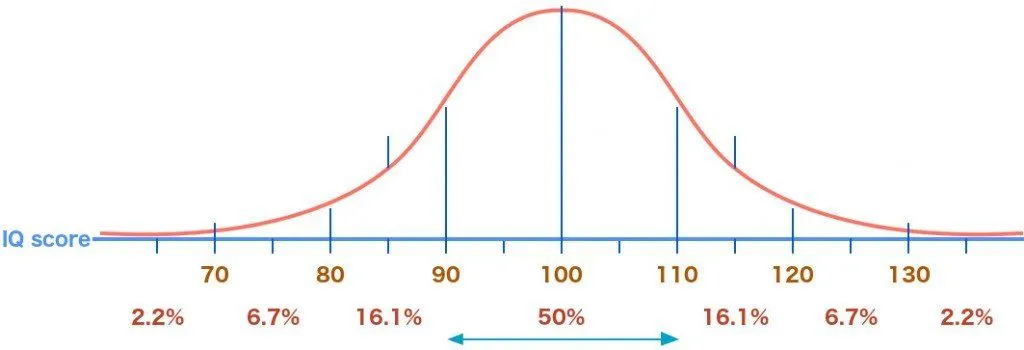
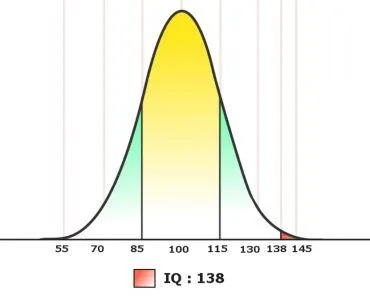
Although there are multiple IQ tests today, they collectively give similar insights about people’s intelligence. When the IQ scores of a sizable group of people are plotted on a graph, it comes out much like a bell curve. This indicates that most people fall into the average bracket of 85 – 115 IQ – roughly two-thirds of the population, within one standard deviation of the mean. The graph seems to diminish towards both ends, with below- and above-average scores on either side.
The Stanford-Binet test and the Wechsler Intelligence Scales are two of the most widely used IQ tests today. Let’s take a look at them and their subsequent IQ scales.
Stanford-Binet Test
Binet and Simon’s intelligence test was revised in 1937 by Lewis Terman and Maude Merrill (Stanford-Binet Forms L and M). The concept of Deviation IQ – which replaced the ratio IQ – was actually introduced by David Wechsler in his 1939 Wechsler-Bellevue Scale; the Stanford-Binet itself only adopted deviation IQ in its 1960 (Form L-M) revision. Deviation IQ helps the administrator understand how much the test taker’s performance deviates from the average. In contrast, ratio IQ compares the test taker’s performance with themselves by seeing whether the test taker’s intellectual abilities align with their chronological age.
The deviation IQ scale was discussed in the above section, “What is IQ Scale?”
According to the 5th edition of the test, the IQ scale range is as follows:
- IQ score of 145 – 160: Very gifted or Highly advanced
- IQ score of 130 – 144: Gifted or very advanced
- IQ score of 120 – 129: Superior
- IQ score of 110 – 119: High Average
- IQ score of 90 – 109: Average
- IQ score of 80 – 89: Low Average
- IQ score of 70 – 79: Borderline impaired or Delayed
- IQ score of 55 – 69: Mildly impaired or Delayed
- IQ score of 40 – 54: Moderately impaired or Delayed
The Wechsler Intelligence Scales
Wechsler defined intelligence as one’s aggregate or global capacity. According to him, intelligence is the global capacity of an individual to be able to act with purpose, think rationally, and to be able to deal with the environment appropriately.
According to him, the best way to measure the global nature of intelligence was to measure the number of abilities that comprise intelligence. These abilities are qualitatively different.
The two qualitatively different abilities that Wechsler has written about extensively are verbal abilities (language, grammar) and performance abilities (reasoning, abstract thinking). The IQ tests developed by Wechsler measure one’s Verbal IQ, Performance IQ, and Full-Scale IQ (Global Intellectual ability).
The test was initially published in 1955 and went through its first revision in 1981. The third revision, called the (WAIS-III), was made in 1997 and is used to test the intelligence of adults aged 16 and above. The IQ scale range of this iteration is as follows:
- IQ score of 130 and above: Gifted
- IQ score of 120-129: Very High
- IQ score of 110-119: Bright Normal
- IQ score of 90-109: Average
- IQ score of 85-89: Low Average
- IQ score of 70-84: Borderline Mental Functioning
- IQ score of 50-69: Mild Mental Retardation
- IQ score of 35-49: Moderate Retardation
- IQ score of 20-34: Severe Retardation
- IQ score of 20 and below: Profound Retardation
The test was further revised in 2008 as the WAIS-IV, and Pearson released the next edition, the WAIS-5, in 2024. Modern psychological and medical practice has also moved away from “mental retardation” – the DSM-5 (2013) and U.S. federal Rosa’s Law (2010) replaced it with Intellectual Disability. The WAIS-IV / WAIS-5 IQ scale is as follows:
- IQ score of 130 and above: Very Superior
- IQ score of 120-129: Superior
- IQ score of 110-119: High Average
- IQ score of 90-109: Average
- IQ score of 80-89: Low Average
- IQ score of 70-79: Borderline
- IQ score of 69 and below: Extremely low
What Is The Highest Possible IQ?
This is one of the most common questions people ask about the scale, and the honest answer is a little counterintuitive: there is no fixed mathematical maximum. Because a modern IQ is a deviation score rather than a raw count of correct answers, the scale simply keeps assigning higher numbers to rarer and rarer performances. In principle, you can always describe someone who is one notch more unusual than the last.

In practice, though, the tests stop being trustworthy long before those numbers get exotic. The standardization samples that the Stanford-Binet and Wechsler scales are built on thin out dramatically past about four standard deviations above the mean, which works out to an IQ of roughly 160. Beyond that point there are simply too few real people in the reference group to anchor a score, so anything higher is extrapolated rather than measured. That is why most psychologists treat any single score much above 160 with caution.
So where do the headline figures of 180, 200 or even 250 come from? Almost always from older ratio-IQ tests, self-scored ‘high-IQ society’ puzzles, or plain anecdote. Marilyn vos Savant was famously listed in the Guinness Book of World Records with a childhood score of 228 on the 1937 Stanford-Binet, but Guinness retired its ‘Highest IQ’ category in 1990 after deciding the tests were too unreliable to crown a single record holder. The child prodigy William James Sidis, who enrolled at Harvard at the age of 11, is often quoted with an IQ of 250 to 300, yet that figure traces to a single second-hand account from 1946 and there is no record of him ever sitting a standardized test. When a score climbs far past 160, in other words, it usually tells you more about the limits of the test than about the person taking it.
Does Your IQ Score Change With Age?
Another thing people often wonder is whether their IQ rises or falls as they get older. The reassuring answer is that your score is built to stay roughly stable. Modern tests are age-normed, which means you are always compared with other people in your own age group rather than against young adults at their peak. A 70-year-old and a 25-year-old who both score 100 are each simply sitting at the middle of their respective age brackets.
What does change with age is the underlying machinery the score is measuring. Psychologists tend to split mental ability into two broad types. Fluid abilities (raw processing speed, on-the-spot reasoning and short-term memory) tend to peak early and then drift downward. A large study run by researchers at MIT and Massachusetts General Hospital found that processing speed crests around the age of 18 or 19, while short-term memory holds up until roughly 25 before declining. Crystallized abilities (accumulated knowledge, vocabulary and verbal comprehension) follow the opposite path, climbing for decades; the same study found that vocabulary did not peak until people were in their late 60s or early 70s.
That split is why a sharp 20-year-old and a knowledgeable 60-year-old can land on the same IQ figure for entirely different reasons. It is also a useful reminder that a single number flattens a great deal of detail. The brain does not simply get ‘better’ or ‘worse’ with age; it trades one kind of strength for another, and that is before you even consider dimensions like emotional intelligence that an IQ test never sets out to capture.
Closing Thoughts
Although IQ tests are a good way to test someone’s intelligence and see where they lie in the spectrum of human intelligence, they are not the ultimate metric of human cognition.
These tests do not include many factors, such as a person’s culture, the environment they were brought up in, their physical fitness level, and whether they are free of crippling diseases, among many other factors. We should also consider all these points when categorizing a person.
I would suggest taking an IQ test for yourself. It’s a fun way to see your abilities and makes you exercise your logical, visual, and aesthetic abilities.
References (click to expand)
- What is IQ?.
- http://web.archive.org/web/20200402080950/http://www.iupui.edu:80/~flip/wechsler.html
- CiteSeerX - Penn State.
- CHAPTER 8: INTELLIGENCE.
- Weiss L. G. (2006). Wechsler Intelligence Scale for Children-four Advanced Clinical Interpretation. Academic Press/Elsevier
- Almost Forgotten Research Contexts: William Stern’s Giftedness Research. PMC, NCBI.
- Who has the highest IQ in the world? BBC Science Focus Magazine.
- William James Sidis. Wikipedia.
- The rise and fall of cognitive skills. MIT News, Massachusetts Institute of Technology.