Table of Contents (click to expand)
Crossing your eyes hurts because you force your eyes to over-converge, contracting the inner eye muscles much harder than normal vision ever demands. It is uncomfortable but not dangerous, and your eyes cannot get permanently stuck that way. The ache is simple muscle strain, and it fades the moment you relax and let your eyes drift back to normal.
Unless you’re something besides a mere mortal, there are limitations to your energy levels. When you run for too long, your muscles begin to get sore and you start to cramp up. When you stay up for days at a time, your brain stops functioning as clearly, and you become more prone to accidents and mental mistakes. In that same vein, our eyes have limits, and can become sore, just like any other muscle in our body. Interestingly enough, there are certain eye positions that are more tiring than others.
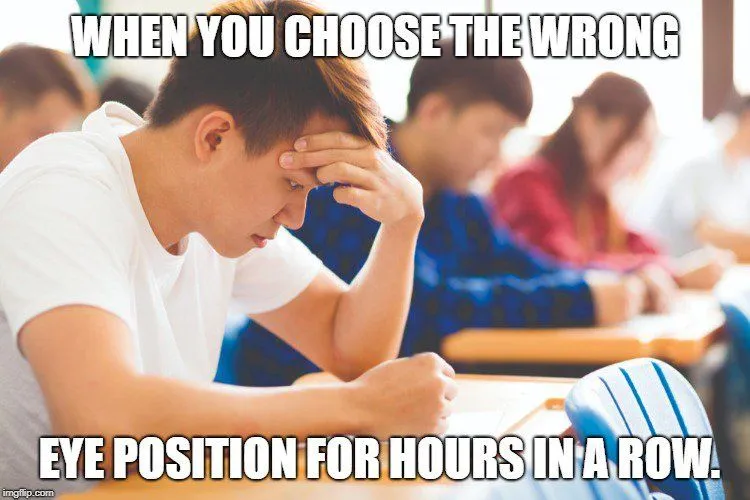
For example, when you curl up with a book and spend the afternoon devouring literature, your eyes may grow tired after a few hours, which may cause your eyes to close, sparking an unplanned nap. This use of your eyes is different than your normal vision as you walk through the world. However, there is an even more extreme use of your eyes, crossing them, which causes discomfort much more rapidly, often within a few seconds!
This leads many people to wonder whether crossing your eyes is inherently dangerous or, according to a popular superstition, may leave your eyes stuck in such a position!
The Science Of Crossed Eyes
When we use our eyes in the normal world, for example, as we walk down the street, our eyes will typically focus on the horizon, gazing towards infinity. Walking in a straight line down the street, not changing our gaze or focusing on anything in particular, is the most relaxed state for those muscles.
This requires relatively little effort from our eyes, or the muscles that help us see. There are actually two separate muscle systems at work. Six muscles (the extraocular muscles) sit on the outside of each eyeball and aim it left, right, up or down. A separate ring of muscle inside the eye, the ciliary muscle, fine-tunes our focus by changing the shape of the lens. We are directly in control of where we look, but only indirectly in control of focus. When we want to look at something specific, say 10 meters (33 ft) away or 5 cm (2 in) away, both systems fire together. The extraocular muscles rotate the eyes inward (a movement called convergence) to point at the nearby object, while the ciliary muscle squeezes the lens into a rounder shape so the object is seen clearly. Eye doctors call this coordinated near-focusing the "near triad."
In order for these muscles to be engaged, just like any other muscle in the body, they require energy, and may grow tired over time. This is like the example from the introduction; when our eyes are locked on the pages of a book, which is very close to our face, our focus and directional muscles must both be engaged for an extended period of time. After an hour or two, it will be harder to focus, and we will feel like our eyes are “tired”.
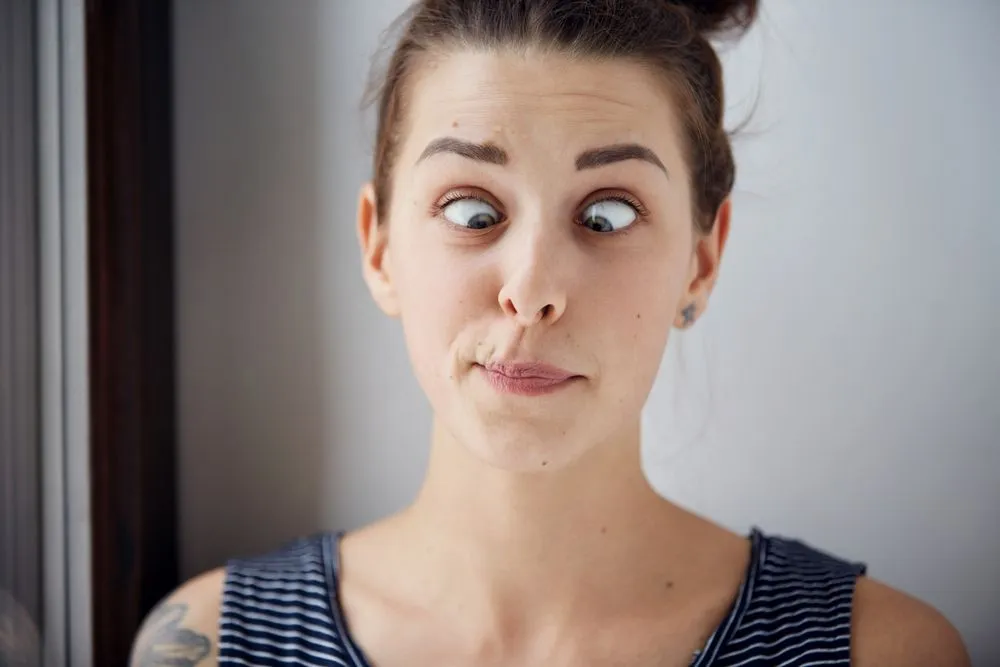
Now, when we cross our eyes, we are essentially trying to fixate on something right at the tip of our nose, far closer than the 0.5 or 1 meter (1.5 to 3 ft) range our eyes handle comfortably. To do this, the inner (medial rectus) muscles of both eyes have to pull the eyes inward much harder than normal vision ever requires, a state called over-convergence, while the ciliary muscle strains to focus on something almost impossibly close. Holding that maximal contraction is what hurts. The same thing would happen if you tried to bench press 160 kg (350 lb) when your previous best was 145 kg (320 lb). You are asking your muscles to do something very difficult, and the strain is immediately apparent and somewhat painful.
Negative Effects Of Crossing Your Eyes
When you were growing up, your parents may have warned you, “Don’t cross your eyes or they’ll stay that way!” While this may have been enough to terrify you into not crossing your eyes as a child, some people still worry that it could happen to them. Fortunately, there have been no recorded cases of someone’s eyes becoming “stuck” in a crossed position.
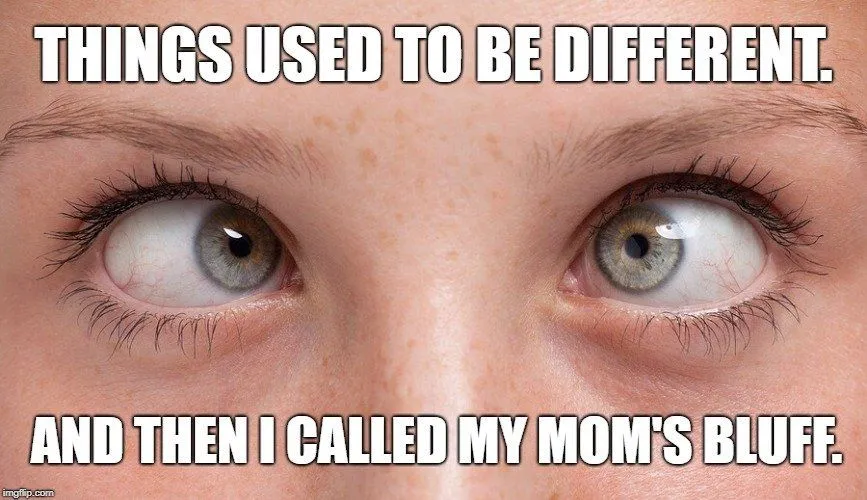
The pain that you feel when you try to cross your eyes for a long period of time, however, should be enough to dissuade you from this practice. You can experience the same thing by looking too far into your peripheral vision. You can always look to the left and right, and your eyes’ directional muscles should be able to control that quite normally. However, if you not only look far to the right, but also try to focus on something very close, you will experience the same discomfort and “pulling” sensation that comes when you cross your eyes.
Strabismus
The reason for this fear of accidentally crossing your eyes permanently, perhaps, is the existence of an actual condition in which one’s eyes do stay crossed, called strabismus. This can come in various forms, and is caused by poor eye muscle control. This condition usually appears in infants and young children, most often by age three, and is characterized by an eye turning away from central focus, particularly when a person is tired or after they have used their eyes in a strenuous manner (i.e., reading a book). Left untreated, strabismus can lead to more permanent problems, such as amblyopia, commonly known as a “lazy eye,” which is why it is treated with glasses, prism lenses, an eye patch, vision therapy or, in some cases, eye-muscle surgery. If you notice that your child does not always have centrally focused vision, it is important to see an eye doctor as early as possible, since the best outcomes come from catching it young.
Can Your Eyes Get Stuck Crossed?
This is easily the most common worry people have about crossing their eyes, so let us settle it plainly: no, your eyes cannot get stuck crossed. The American Academy of Ophthalmology lists “if you cross your eyes, they'll stay that way” among its classic vision myths, pointing out that your eye muscles let you look in every direction and that looking left or right, up or down, will not force them to remain in those positions, just as crossing the eyes will not force them to stay that way.

The reason comes down to how these muscles work. The six extraocular muscles that aim each eye are ordinary voluntary skeletal muscles, much like the ones that move your fingers. Crossing your eyes is an active command that keeps the inner (medial rectus) muscles firing; the moment you stop giving that command, they relax and your eyes drift back to their neutral, forward-facing position. There is no latch or ratchet that can hold them turned inward, which is exactly why you cannot “lock” your gaze off to one side either.
So what actually happens if you hold the position for too long? Nothing lasting. You will feel the muscle strain described above, and you may notice brief blurring, a flicker of double vision or a mild headache, all of which clear within moments of relaxing. In uncommon cases, usually tied to stress, fatigue or marathon sessions of close-up work, the eyes can temporarily get locked into the near-focusing pattern, a condition ophthalmologists call spasm of the near reflex (or convergence spasm). It produces exactly that unsettling feeling of the eyes wanting to cross on their own, along with blurred distance vision, but it is a temporary, treatable condition rather than the permanent “stuck” state of playground legend. Genuinely permanent misalignment, strabismus, comes from problems with muscle or nerve control, as covered above, and never from pulling a funny face.
A Final Word
We usually associate a painful experience with potential danger, but while crossing our eyes may be uncomfortable or even painful at times, there is no direct danger. Your eyes will eventually return to their neutral state, the muscles will relax and recover, and the discomfort will fade. The reason this hurts so much more than our regular vision is because we are pushing our focusing and convergence muscles beyond their normal capacity, resulting in muscle strain. Avoiding eye strain in its many forms (e.g., screen time, wearing incorrect prescriptions, etc.), including keeping your eyes uncrossed, should help you prevent eye fatigue and keep your brain and vision sharp!
References (click to expand)
- Eye Fatigue: Causes, Symptoms, and Treatment - WebMD. WebMD
- Strabismus (crossed eyes) - American Optometric Association. The American Optometric Association
- Hietanen, J., & Yrttimaa, K. (2005, January). Where a person with a squint is actually looking: Gaze-cued orienting in crossed eyes. Visual Cognition. Informa UK Limited.
- Campos, E. C. (1995). Update on strabismus and amblyopia. Acta Ophthalmologica Scandinavica. Wiley.
- (1988) How the Human Eye Focuses - jstor. JSTOR
- Common Eye and Vision Myths - American Academy of Ophthalmology
- Convergence Spasm: Patient Education - Moran CORE, University of Utah