Looking directly at the sun causes solar retinopathy: your eye’s lens focuses an intensely bright spot of sunlight onto a tiny patch of retina, where short-wavelength visible light (with smaller contributions from UV-A and near-infrared) triggers a photochemical injury. Glancing at the sun in your peripheral vision is far safer because much less light reaches the most sensitive part of the retina.
You may already know that it’s pretty difficult to look directly up at the sun at noon. It’s not only immediately discomforting, but can also have long-term or permanent adverse effects on your eyes. In fact, that’s why scientists and stargazers strongly advise you to avoid watching a solar eclipse without protective glasses.

Basically, intense sunlight can damage your eyes if you look at the sun directly. But what about the times when you look at the sun with your peripheral vision, or in other words, from the corners of your eyes? We don’t usually hear about people getting eye problems by looking at the sun sideways, right? Why is that?
Why does having the sun visible in your peripheral vision not do any damage to your vision?
How Are Eyes Affected When You Look At The Sun Directly?
When one stares at the sun for too long, intense sunlight floods the retina and triggers a photochemical injury called solar retinopathy. The harm actually isn’t done mostly by ultraviolet rays (your cornea and lens absorb the bulk of those before they reach the retina), but by short-wavelength visible light, especially blue light, with smaller contributions from UV-A and near-infrared. In the worst cases, this can cause permanent blindness (although that’s rare), but looking directly at the sun is so painful that it’s usually impossible for anyone to stare at the sun for that long. Typical damage to the eyes after staring directly at the sun include dark or yellow spots, dimmed or blurred vision, and loss of vision in the center of the eye (the fovea), among others.
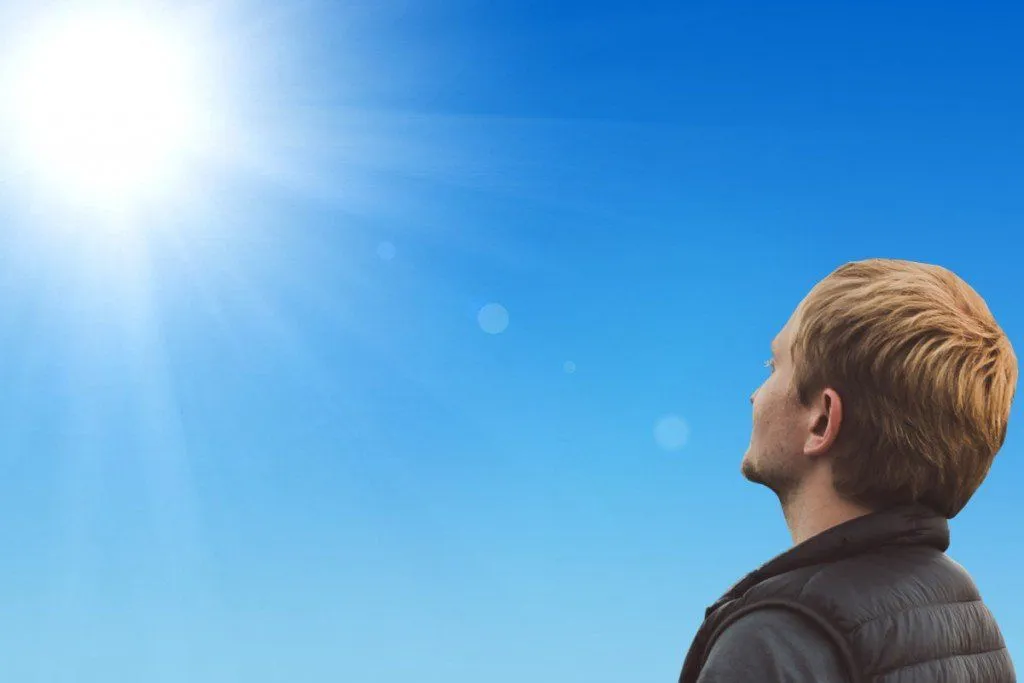
Now, let’s try to understand the specifics of this issue – there is a lens in the front of the eye, whose primary job is to focus incoming light onto the macula – an oval-shaped pigmented area near the center of the retina. It has the highest concentration of cone photoreceptors and the thinnest protective layers.
The pupil is directly in front of the eye; so, when you look at the sun directly, the lens focuses the light right on the retina, which can result in damage.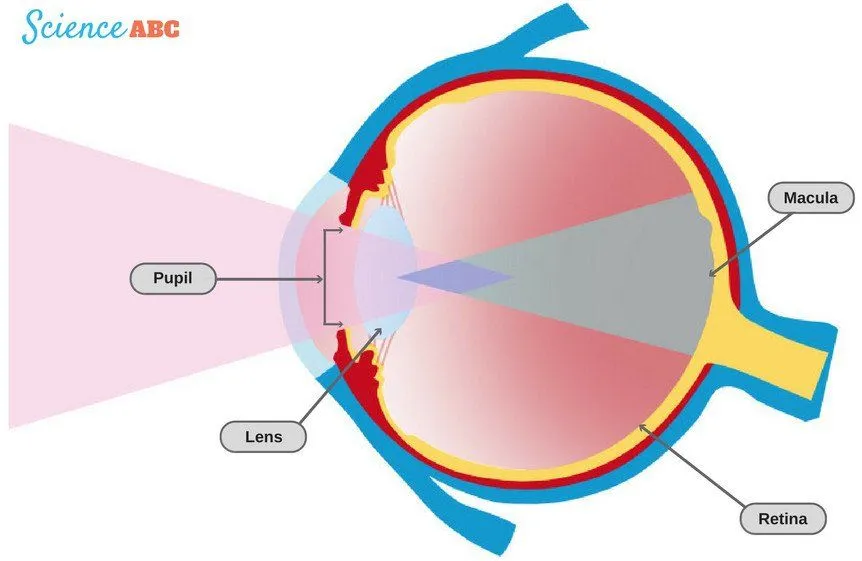
Why Does Nothing Happen To Your Peripheral Vision?
It should be clear that if you look at the sun directly without protective glasses, your eyes can sustain damage. However, when you don’t look at the sun directly, but look at it from the corner of your eye, how does the aforementioned scenario not still cause any damage to your eye?
Actually, it’s pretty similar to burning a piece of paper through a magnifying lens. If you’ve ever tried this experiment, you know that you can burn a hole through paper only when you hold the magnifying lens at a certain angle so that the sunlight focuses sharply at a single point on the paper.
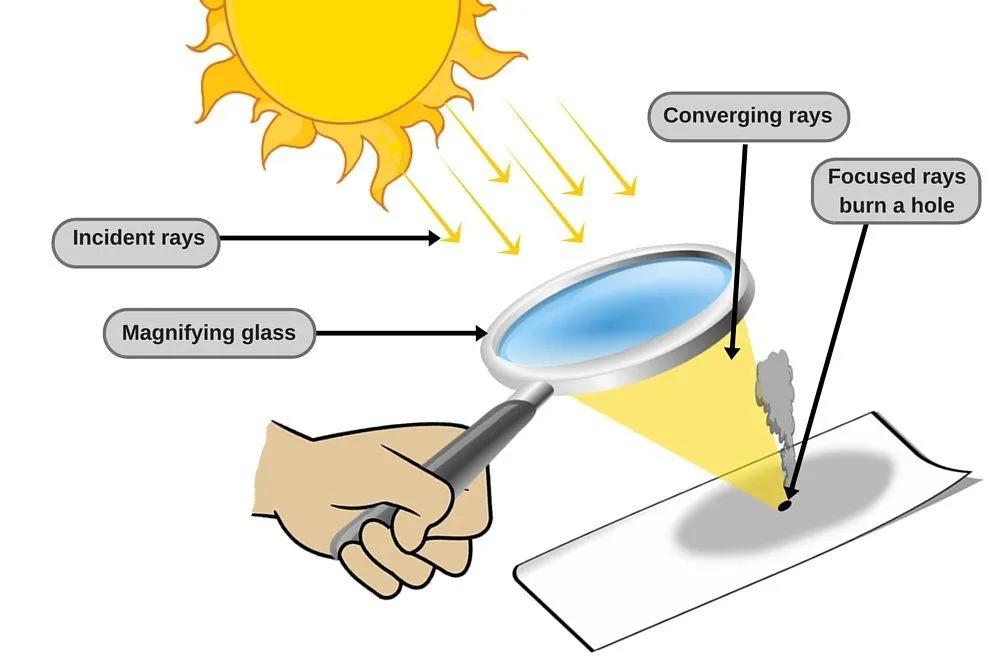
If you hold the magnifying glass at the wrong angle, nothing happens. This is because the sunlight is not focused into a death ray, and is simply passing through the glass normally without being focused on a single point.
The same thing happens with your vision. When you’re looking directly at the sun, the eye lens focuses the sunlight and the most intense light falls directly on your retina, potentially causing damage. However, when you’re not looking at the sun directly, but rather through your peripheral vision, less light gets into your pupil and subsequently onto your retina. That’s why the sun doesn’t dazzle or cause discomfort when it’s firmly in your peripheral vision.
Simply put, the further a source of light is from the center of your field of vision, the less light gets into your eyes, which lessens your risk of damage.
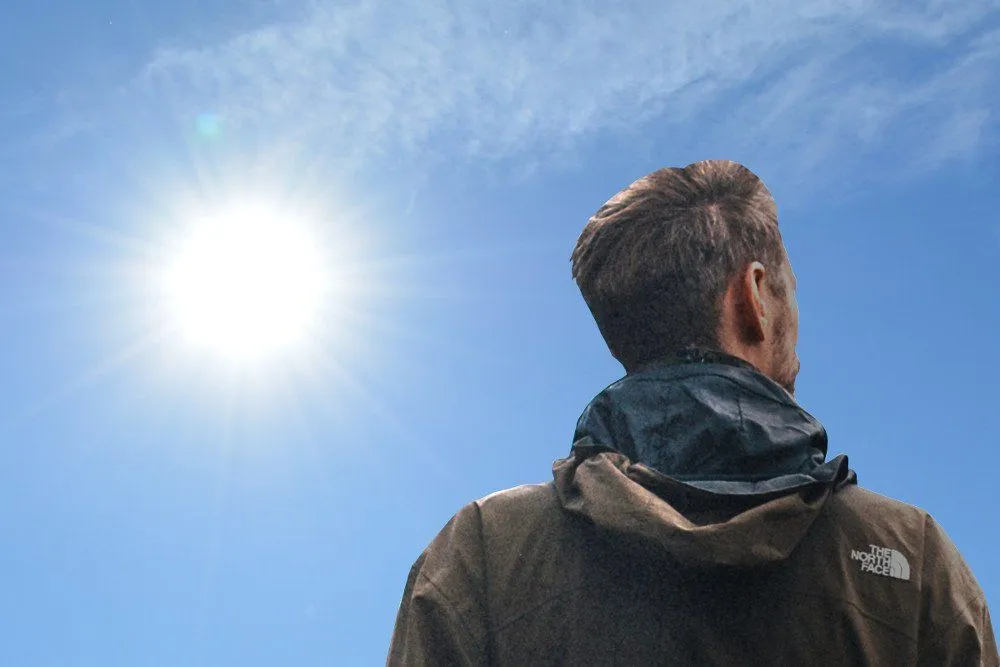
That said, if you stand at any place in the sun, with your eyes locked in one position for too long, it can potentially cause problems, even when the sun is in your peripheral vision. However, that doesn’t usually happen, since our eyes are constantly darting around, especially when we’re outside and there’s so much to look at!
How Long Does It Take To Damage Your Eyes?
This is the question people ask in the lead-up to every solar eclipse, and the honest answer is that there’s no precise threshold. Case reports collected by the American Academy of Ophthalmology have documented lasting solar retinopathy after just a few seconds of direct gazing during a partial eclipse, when the eclipse dims the surrounding sky enough to suppress the natural ‘blink and look away’ reflex. Outside of eclipses, the sun is normally so painfully bright that you simply can’t keep staring at it, which is why everyday solar retinopathy is rare. Even very brief glances can occasionally leave a small permanent blind spot or visual distortion right in the center of your vision.
And if you suspect you have stared too long? See an ophthalmologist promptly. There isn’t a specific cure for solar retinopathy. Many mild cases recover gradually over weeks or months, but a fraction of people are left with permanent central-vision damage. The smart move is to avoid the situation in the first place by using ISO 12312-2 certified eclipse glasses (or a proper solar filter for a telescope or camera) during eclipses, and a hat plus UV-blocking sunglasses for everyday glare.