Table of Contents (click to expand)
We get nervous because high-stakes situations trigger the body's ancient fight-or-flight response. When the brain's threat detector, the amygdala, signals the hypothalamus, the sympathetic nervous system fires and the adrenal glands flood the bloodstream with adrenaline and noradrenaline. That surge speeds up the heart, redirects blood to the muscles, and produces the racing pulse and "butterflies" we feel as nervousness.
Why do I get nervous? The answer is that feeling nervous is a natural consequence of our hardwired fight-or-flight response! The butterflies in your stomach occur as blood is redirected away from your digestive system.
An extremely important exam or presentation, getting married, starting a new job, proposing to your girlfriend/boyfriend, expecting a baby, the illness of a parent… these various life events all have something in common. Apart from the fact that they are normal parts of life, all these incidents invoke certain emotions, and one that is common to all major life events is the feeling of nervousness.
Nervousness seems like that old grumpy uncle at a wedding whose presence can be ignored, but it affects the mood nonetheless. That may be a bad analogy, but nervousness does seem to bring us down, regardless of the exterior circumstances, often making a happy event much less enjoyable, or a tense moment, such as an exam, even worse. If it’s so detrimental to us, then why have we developed this response over thousands of generations? Shouldn’t evolution be taking care of this stuff?
Well, the answer is that evolution knows better than us, and is taking care of you by making you nervous. Don’t believe me? Let’s take a look at why we get nervous in high-pressure situations, and perhaps you’ll begin to understand.

Role Of The Primitive Brain
The human brain has evolved over hundreds of millions of years to become the brain it is today. The basic survival circuitry that drives the fight-or-flight response is genuinely ancient: the brainstem and the core structures that regulate heart rate, breathing, and the body's automatic functions trace back to the earliest vertebrates, roughly 500 million years ago. The threat-detecting and emotional structures we lean on, including the amygdala and the rest of the limbic system, are also shared widely across mammals and other vertebrates.
You may have heard the tidy story that we carry a leftover "reptilian brain" inside our heads, with the limbic system sitting unchanged beneath a newer, rational cerebrum. It is a memorable picture, but neuroscientists have largely abandoned it. Those older regions did not stay frozen in time; they kept evolving right alongside the rest of the brain. What is true, and what matters here, is that the wiring behind fight or flight is deep, fast, and largely automatic, which is exactly why it can hijack a job interview or a first date just as readily as it once helped our ancestors escape a predator.

The limbic system performs several critical functions, such as regulating blood pressure, heart rate, body temperature, and blood sugar levels, in addition to maintaining homeostasis, sexual arousal, memory, learning, and even the fight or flight response. It performs all these functions by influencing the autonomic nervous and endocrine systems. The response of interest here is fight or flight, which is driven by two parallel pathways: a fast one running through the sympathetic branch of the autonomic nervous system, and a slower hormonal one known as the hypothalamic-pituitary-adrenal (HPA) axis. In the past, when an early human perceived a threat or danger, such as a wild animal approaching, this circuitry was activated, which prepared the body either to fight (if the animal was weaker) or flee (if it was stronger) in order to survive. Both these actions require energy and blood to be directed to your muscles that will enhance their functioning.

Fight Or Flight
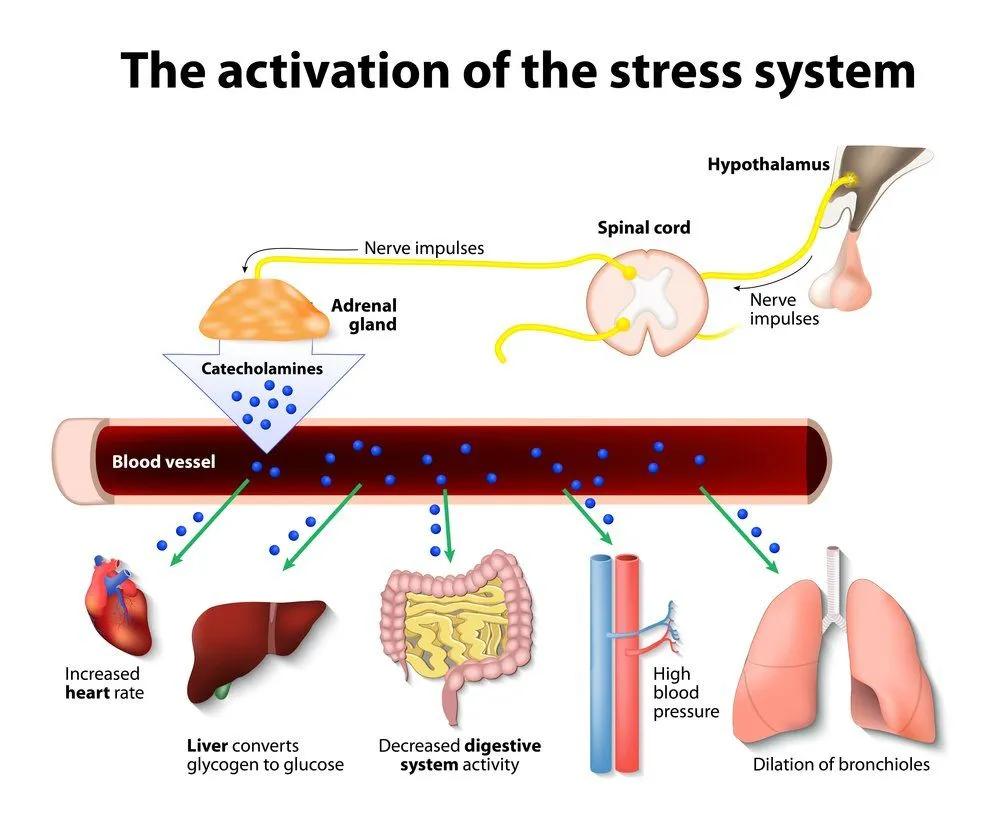
When your neocortex (in essence, you) attaches extreme importance to an activity, such as those mentioned above, that sense of stakes reaches the amygdala, the brain’s rapid threat detector. The amygdala treats the situation as a kind of danger, since it is not considered “normal,” and alerts the hypothalamus. The hypothalamus thus triggers the fight-or-flight response, in which the sympathetic nervous system sends out impulses to glands and smooth muscles, and directs the adrenal medulla to release adrenaline and noradrenaline into the bloodstream, which increases heart rate and blood pressure.
Simultaneously, the hypothalamus releases corticotropin-releasing hormone, which prompts the pituitary gland to send out a chemical messenger called ACTH. ACTH travels through the bloodstream to the adrenal glands, perched on top of your kidneys, and tells the outer layer (the adrenal cortex) to release stress hormones such as cortisol, which keep the body primed for action. Meanwhile, the adrenaline already pumping through your veins is busy redirecting blood and energy to the parts of the body that need to take rapid action, such as the heart and muscles, and away from less urgent processes, such as digestion. Since blood flow is shunted away from the gut and normal digestion is paused, you feel that fluttering, tingling sensation (butterflies in your stomach), which we commonly attach to being nervous.
The misinterpretation happens because this survival circuitry is fast and automatic, kicking in long before your slower, conscious, decision-making brain has a chance to weigh in. So, the fight-or-flight response for an exam may ease off a little as your conscious brain gets better at overriding that automatic alarm, but it’s not switching off anytime soon.
Have you noticed that once you start feeling nervous, it’s very difficult to get back to your pre-anxious state? This is because as soon as you think you’re feeling nervous, your brain once again receives a signal concerning some sort of threat, so it continues to stimulate that fight-or-flight response until the threatening situation is over.
However, some people feel nervous/anxious even in low-pressure daily situations or without recognizable triggers. In psychological terms, these people are thought to be trait anxious, i.e., they may have lower thresholds than the majority of the population for situations that they consider stressful. Being perpetually nervous could also be a precursor of an anxiety disorder.
The good news is that there are hordes of simple methods or exercises to control your nervous feelings, irrespective of whether you are situationally nervous, trait anxious, or suffering from an anxiety disorder, so that they don’t overwhelm you.