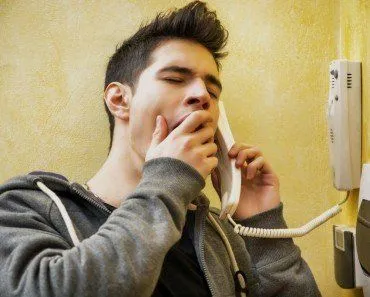
A grunt is a low, short sound made by exhaling forcefully against closed vocal cords. We grunt when lifting heavy things because the brain signals the working muscles to fire harder, and holding the breath creates a “pressure ball” in the belly that braces the spine. Studies show grunting can also boost force and speed, as in tennis.
Have you ever been embarrassed by those involuntary grunting noises that your mouth and nose produce of their own accord when you lift heavy weights in a gym or hit a ball with all your might during a tennis match? In those and similar situations, you couldn’t even control those grunts, no matter how hard you tried, right?
So, why does this happen? Why do humans grunt while exerting themselves physically? Is there a definitive scientific reason behind it or is it just another way of ‘blowing smoke’?
What’s ‘Grunting’?

‘Grunting’ is something that we do on a regular basis; to quote the dictionary definition though, a grunt is “a low, short guttural sound made by an animal or a person.” In more scientific terms, grunting is a type of exhalation, i.e., a process through which air is released from the body through the nose or mouth. However, grunting is different from normal exhalation in the sense that when you grunt, you exhale against a partially or entirely closed vocal cord.
The vocal cords are relaxed and open when you breathe in, but when you grunt, your vocal cords close, and the air forced past them produces that low, ‘turbulent’ sound.
People tend to grunt while lifting something heavy, or while doing any kind of activity where they are required to exert themselves physically, such as working out, playing sports like tennis, boxing and so on.

Why Do People Grunt While Exerting Themselves Physically?
We do know that for some people, according to their own admission, grunting makes the activity in question somewhat easier, or less difficult to perform than doing it without making this noise. However, is there any scientific reason behind that?
It is widely believed that grunting is a natural and somewhat necessary physical response to exerting large amounts of force. For many people, it is difficult to exert an intense force without letting out a grunt.
Take tennis, for example. If you’ve ever watched a tennis match, the only sounds you hear apart from the ball hitting the players’ racket in an otherwise silent stadium are the loud grunts of the players when they hit the ball. In fact, some players are quite famous for their particularly loud grunts on the court.

Although scientists don’t know the exact reason behind this (somewhat) involuntary verbal response, a number of hypotheses have been proposed as to why people grunt while applying significant force. One such hypothesis is that grunting during an intense physical activity is probably related to communication signals from a particular part of the brain that controls breathing to the particular muscle group that is applying the large physical force. When we push air out forcefully, the brain transmits a signal to the muscle group in question that either decreases inhibition or excites it. The end result is the ‘oomph’ factor that makes us exert ourselves more forcefully.
Can Grunting Help To Improve Performance?
According to a 2014 study conducted by a team led by Dennis O’Connell, “grunting” college tennis players hit their serves and forehands significantly faster (roughly 5% quicker, on the order of a few miles per hour) than when they were not allowed to grunt or make any other verbal sound. The grunting trials also produced greater force and more muscle activity in the external oblique and pectoralis major. The gender of the subject had no effect whatsoever on the speed boost, and even players who never grunted in their normal game got faster when asked to grunt.

While performing an intense lifting activity (such as lifting weights in gym), we usually take a breath and hold it in. As a result, the middle section of our body is pressed together to make a small ‘pressure ball’ in the belly, which helps to stabilize the body and guards it against spinal injuries. In other words, as it turns out, grunting protects your spine too!
With all this in mind, next time you find yourself in the middle of an important tennis match, don’t be shy; let that grunt out and watch the tremendous power of the human grunt play out before you!
Does Grunting Actually Help You Lift More?

The tennis court isn’t the only place where letting a grunt fly seems to pay off. The same effect shows up in tasks that have nothing to do with a racket. In a study of 50 martial artists, participants squeezed a handgrip dynamometer as hard as they could, once while staying quiet and once while performing a kiap (the sharp shout used in martial arts). Across both novices and experts, the grunting trials produced significantly more force, around 437 newtons versus 408 without the shout, an improvement of roughly 7%. That isn’t nothing when you’re straining at the very top of your strength.
Why would a noise help at all? The leading explanation is neural rather than muscular. The forceful exhale appears to nudge the nervous system into recruiting more of your available muscle fibers, so a slice of strength that normally sits in reserve gets switched on for that single rep. A 2018 study even found a second, sneakier benefit on the sports field: a well-timed grunt also distracts the opponent, delaying their reaction and making them more error-prone, which is one reason loud grunting is sometimes accused of being gamesmanship in tennis.
So yes, within reason, grunting can help you lift or hit a little harder. The boost is real but modest, on the order of a few percent, not the cartoonish strength surge the gym mirror might promise you. And bear in mind that the breath-hold powering the grunt also briefly spikes your blood pressure, so it is a tool for the occasional heavy effort, not something to strain through on every rep.
Why Do We Grunt When We Stretch or Stand Up?
Here’s the curious part: you don’t need a barbell at all. Plenty of people let out an involuntary groan simply standing up from a low couch, bending to tie a shoe, or stretching first thing in the morning. It feels like an old-person cliché, but the noise isn’t really about age. It’s the same machinery that fires under a heavy lift, just turned down to everyday volume.
According to Susan Saliba, a professor and exercise-science researcher at the University of Virginia, the groan is part of a feed-forward mechanism: before you actually move, your brain quietly sets your core muscles and diaphragm to stabilize the joints of your spine. As Saliba puts it, “your body is actually doing what it needs to do to create a muscle contraction to stabilize all the joints in your spine.” That pre-tensioning often comes with a small held breath, and when you finally release it past partly closed vocal cords, out comes the audible oof. It is largely involuntary, which is why you can’t always stop it even when you try.
Two things can make the groan louder as the years add up: tighter, stiffer muscles that take more effort to move, and a touch of pain or discomfort that adds a reflexive vocal response. Neither is cause for alarm on its own. If the grunting is genuinely involuntary, frequent, and unrelated to any effort, though, that can point to something else, such as a tic disorder or a breathing or neurological issue, and is worth raising with a doctor rather than chalking it up to a creaky body.
References (click to expand)
- The effects of “grunting” on serve and forehand velocities in collegiate tennis players. Journal of Strength and Conditioning Research (PubMed)
- Intra-abdominal and intrathoracic pressures during the Valsalva manoeuvre in resistance exercise. PMC (NCBI)
- The science of grunting while weightlifting. Drexel University News
- Grunting’s competitive advantage: Considerations of force and distraction. PLoS ONE (PubMed)
- Something to Shout About: A Simple, Quick Performance Enhancement Technique Improved Strength in Both Experts and Novices. Journal of Applied Sport Psychology
- All Groan Up: UVA Expert Explains the Sounds of Middle Age. University of Virginia (UVA Today)