We swing our arms when we walk because it is the most energy-efficient way to move on two legs. Biomechanical engineers at the University of Michigan showed the swing is largely passive, like a pendulum, and that walking with arms held still costs roughly 12% more metabolic energy. Persistent loss of arm swing, especially on one side, can also be an early sign of Parkinson's disease.
It’s a pretty slow day at work and you are terribly bored, so you decide to take a stroll outside. In order to kill the apparent boredom, you begin observing things around you. Within a few moments of watching people walk past, a random thought pops up in your head – why does everyone feel compelled to swing their arms while walking, even when it’s not really required? In order to confirm your confusion, you try to walk a few steps without moving your big arms.

Surprisingly, you realize that you can do it quite easily, as long as you are concentrating on keeping your arms still. As soon as you start walking unconsciously, letting your mind wander to other things, you will find yourself back in the arm-swinging routine.
What Compels You To Adopt That Swinging Motion?
The answer to this question boils down to one simple aspect – biomechanics.
Researchers once believed that this practice of arm swinging began as an evolutionary relic from the early human years of walking on all fours, but a recent study shed new light on the subject.
Biomechanical engineers from the University of Michigan, led by Steven Collins, found that arm swinging is a part of the process of walking on two limbs, and that walking while letting your arms swing is the most economical form of motion. The swing is largely passive, not muscle-driven. In their treadmill experiments, walking with the arms held still cost about 12% more metabolic energy than letting them swing naturally; even just strapping the arms down lightly cost a few percent more. In other words, "keeping your arms still" is the costly option, not the default one.
Think of it as a simple pendulum. When your legs move, so does your body. This movement forces your arms to sway, just like a pendulum. Your arms move involuntarily as a result of this motion. In this way, the muscles aren’t being exerted. An insignificant amount of energy is spent by the muscles to keep the motion in control.

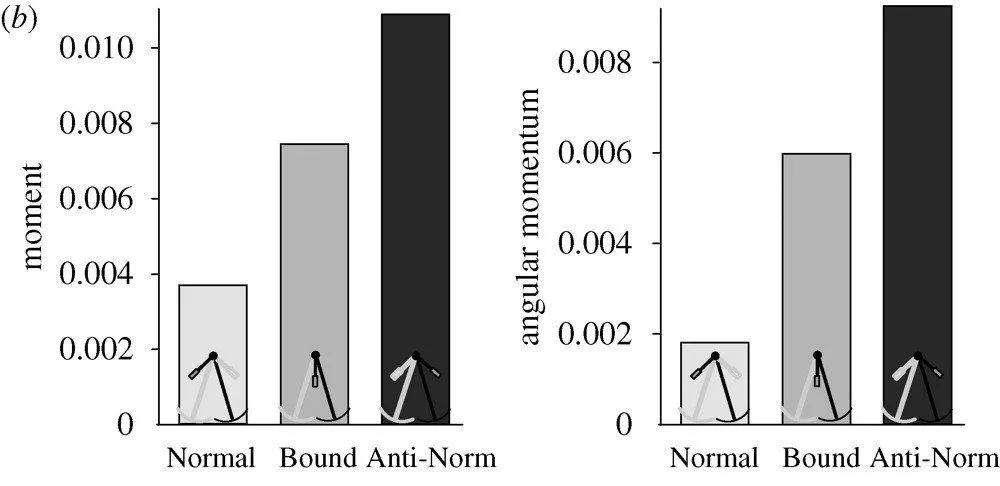
Holding the arms still doesn’t just cost more energy; it also forces your torso to fight harder to stay pointed forward. When the arms are pinned, the vertical ground-reaction moment (essentially the twist your feet have to apply to the ground to stop your body from rotating about its long axis) jumps by about 63%. A normal arm swing cancels out most of that twist, which is exactly why a relaxed walk feels effortless and a stiff-armed one doesn’t. Worse still is swinging in sync with your legs, i.e. putting your left foot forward with your left arm out at the same time. This "anti-normal" gait uses 26% more energy than a normal one, which is why it feels so unnatural the moment you try it.
Physics aside, swinging arms just seems aesthetically right.
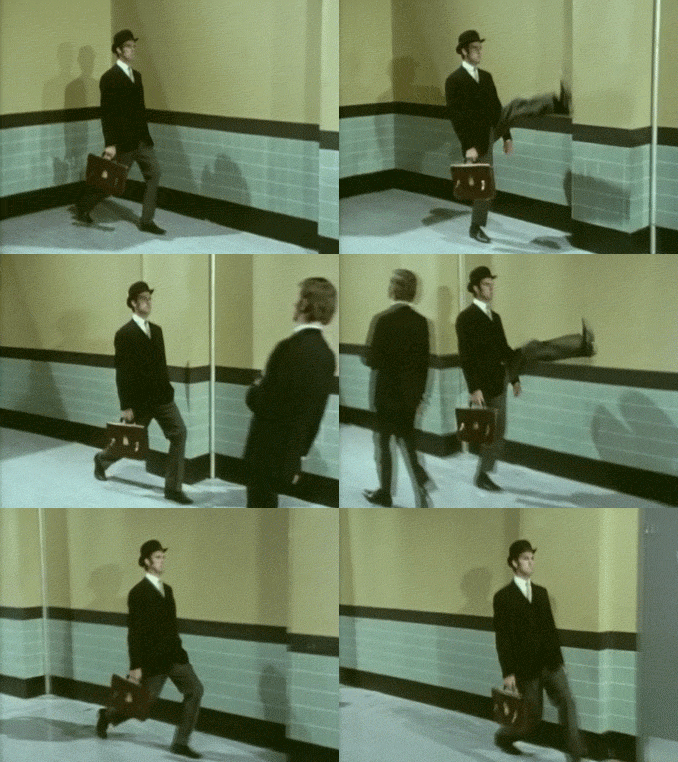
Imagine people walking around with their arms tightly glued to their sides. It would look like a scene taken out of some bizarre dystopian setting, where a dictator controls the thoughts and behavior of every individual (North Korea anyone?).
Do Swinging Arms Help You Keep Your Balance?
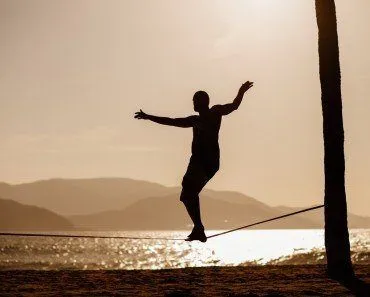
Watch anyone inch along a fallen log or a slackline and the first thing they do is throw their arms out wide. It is tempting to assume the gentle swing of everyday walking is doing the same job, quietly keeping you upright. The research says the truth is a little more surprising than that.

Sjoerd Bruijn and colleagues at VU University Amsterdam tested exactly this in 2010. Eleven volunteers walked on a treadmill, once with their arms swinging normally and once with the arms held still, and on half the trials the researchers gave the walker a sudden forward pull to knock them off balance. During ordinary, undisturbed walking, taking the arm swing away made almost no measurable difference to how stable the gait was. On smooth, level ground, in other words, the swing is not the thing keeping you from toppling over.
The arms earned their keep only when something went wrong. After a perturbation, walkers with free arms recovered their normal stride faster and returned closer to it than those whose arms were pinned. The authors chose their words carefully: arm swing itself does not make walking more stable, but the recovery movements of the arms do.
You can watch that mechanism in slow motion in a separate experiment by Mirjam Pijnappels and colleagues, who tripped people in mid-step. Within roughly 100 milliseconds the shoulder muscles fired, flinging the arms outward in a lopsided burst. By stretching out that swing, the arms delay the handover of angular momentum to the trunk, rotating the body into a better position to plant a big, balance-saving recovery step. The arms act as a fast, heavy counterweight, much the way a tightrope walker uses them. It also helps explain why a fading, one-sided arm swing, the kind flagged earlier as a sign of Parkinson's or a stroke, can quietly raise the risk of a fall.
What If Someone Doesn’t Swing Their Arms?
So if arm swinging is the body’s default lazy setting, what does it say when someone walks without it?
Most of the time, very little. You don’t swing your arms when you’re holding a coffee, glued to your phone, or carrying grocery bags. People who feel self-conscious in public also tend to lock their arms tight against their bodies. None of that is medically interesting.
What is interesting is when one arm consistently swings less than the other, or when both arms gradually go quiet without a reason. That kind of change has been studied carefully because it can be one of the earliest visible signs of Parkinson’s disease, often showing up before tremor or any obvious change in the legs. In a Duke University study of early-stage Parkinson’s patients, the asymmetry between left and right arm swing was roughly three times larger than in healthy controls, and 83% of patients exceeded the asymmetry threshold versus 0% of controls. The total amount of arm swing was actually similar between the two groups; it was the lopsidedness that gave it away.
A sudden, one-sided loss of arm swing combined with the leg circling outward as it steps can also point to a mild stroke or other form of hemiparesis. In gait exams, it is sometimes the only abnormality a clinician spots in a patient who otherwise feels fine.
There is even a mood angle to this, which is probably why so many people search for the "psychology" of not swinging your arms. Motion-capture work by Johannes Michalak and colleagues found that people with major depression walked more slowly, took smaller arm swings, slumped forward more, and swayed more from side to side than non-depressed controls. The same gait signature showed up when researchers experimentally put non-depressed volunteers into a low mood. None of this is diagnostic on its own, but it is a reminder that how you walk and how you feel are more connected than they look.
Should You Actively Swing Your Arms When You Walk?
Once you know how cheap a natural swing is, the obvious next question is whether you should exaggerate it for fitness. The short answer: not really.
The metabolic data is pretty consistent. Letting your arms swing freely is the cheapest option. Restricting them, whether by holding them still on purpose or by carrying something heavy in both hands, costs an extra 5–12% in metabolic energy depending on the study. Going the other way and forcing a much bigger swing than your body wants also costs more, because now your shoulder and core muscles are doing work that gravity used to do for free.
If your goal is to burn more calories during a walk, the evidence-backed move is not to wave your arms more dramatically, but to add resistance. Nordic walking, which uses two lightweight poles and recruits the upper body to push you forward, increases calorie burn by roughly 18–20% compared with regular walking at the same speed, and it has the side benefit of taking some load off your knees. Carrying a light backpack or walking up a gentle incline works on the same principle.
For everyday walking, though, the best thing you can do is the boring thing: keep your hands free, drop your shoulders, and let the pendulum do its job.
References (click to expand)
- Collins SH, Adamczyk PG, Kuo AD. Dynamic arm swinging in human walking. Proceedings of the Royal Society B. 2009. PubMed.
- Pontzer H et al. Control and function of arm swing in human walking and running. Journal of Experimental Biology. 2009. PubMed.
- Lewek MD et al. Arm swing magnitude and asymmetry during gait in the early stages of Parkinson’s disease. Journal of NeuroEngineering and Rehabilitation. 2010. PubMed Central.
- Movement Symptoms. Parkinson’s Foundation.
- Michalak J et al. Embodiment of sadness and depression — gait patterns associated with dysphoric mood. Psychosomatic Medicine. 2009. PubMed.
- Ortega JD, Fehlman LA, Farley CT. Effects of aging and arm swing on the metabolic cost of stability in human walking. Journal of Biomechanics. 2008. PubMed Central.
- Fitness trend: Nordic walking. Harvard Health Publishing.
- Bruijn SM et al. The effects of arm swing on human gait stability. Journal of Experimental Biology. 2010. PubMed.
- Pijnappels M et al. Armed against falls: the contribution of arm movements to balance recovery after tripping. Experimental Brain Research. 2010. PubMed.
- Arm swing in human locomotion. Wikipedia.