Table of Contents (click to expand)
A pendulum clock is a clock that uses a pendulum, a swinging weight, as its timekeeping element. The pendulum swings back and forth, and the clock uses the pendulum’s swing to keep accurate time. The clock has a weight that falls down slowly, and the pendulum’s swing controls the speed of the weight’s fall. The clock also has a second hand, which is driven by gears, that keep all of the needles synced. The clock makes a tick-tock sound because the pendulum’s swing locks and unlocks the clock’s gears.
As a child, I often wondered how pendulum clocks managed to continue swinging back and forth for so long. “They must have really powerful batteries,” I thought, “considering that they have such a huge pendulum to swing day in and out.”
Little did I know back then, but pendulum clocks don’t need batteries at all! And the pendulum itself? It may seem like it’s just idling around, serving no real purpose as it swings to and fro, but that action is actually what keeps the clock accurate to the second.
Pendulum Clock

You have almost certainly seen pendulum clocks in movies, TV shows, museums or even at someone’s house, given their great decorative value. Even if you haven’t seen one, you’d be able to identify a pendulum clock in a single glimpse. The most basic and notable characteristic of a pendulum clock is implied in the name – a pendulum – which is a swinging weight that acts as the clock’s timekeeping element.
Unlike modern clocks, which consist of electrical or electronic parts and are powered by batteries, pendulum clocks consist only of mechanical parts that function in absolute harmony to tell accurate time.
The pendulum clock was invented by Dutch scientist Christiaan Huygens on 25 December 1656 and patented the following year. His design slashed the timekeeping error of mechanical clocks from roughly 15 minutes per day to about 15 seconds per day, and from that moment until the 1930s (when quartz oscillators finally took over) the pendulum clock remained the most accurate timekeeper in the world.
Inside A Pendulum Clock
Parts Of A Pendulum Clock
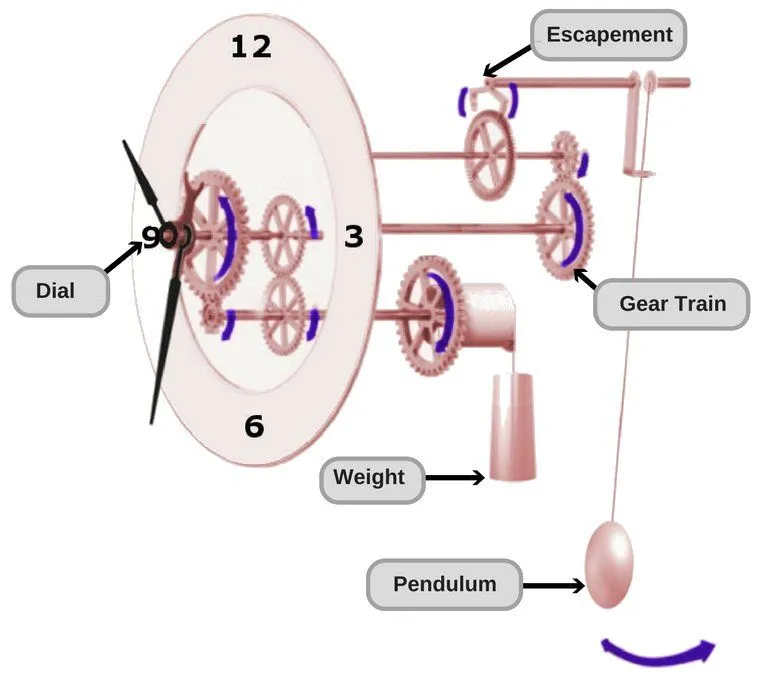
Every mechanical pendulum clock consists of a few basic components:
1. A weight on a cord that turns a pulley or a mainspring
2. An escapement (or an anchor) that gives timed impulses to the pendulum to keep it swinging
3. A gear train to regulate the speed of power to be used by the pendulum
4. A set of time-keeping gears to move the different needles
5. A pendulum, i.e. a bob attached to a rod
6. A dial or clock face that displays the time via needles and numbers
Working Of A Pendulum Clock
If you took a science class or two back in high school, you know that energy can be converted from one form to another. This is the same principle on which every pendulum clock on Earth works.
A rubber ball, when held at a certain height above the ground, has a certain amount of potential energy, which rapidly converts to kinetic energy after it is dropped.

Similarly, in a pendulum clock, a weight attached to a string falls down steadily (albeit very slowly) and its potential energy is what powers the gears, which in turn pull at the axle that drives the second hand. The second hand is installed on an axle driven by time-keeping gears. The purpose of this setting is for all the needles to remain synced. In other words, the minute needle moves one place to the right when the second needle completes 60 moves; similarly, the minute needle moves the hour hand at 1/60th of its speed.

The reason this works is a beautiful piece of physics: the period of a swinging pendulum depends almost entirely on its length, not on how heavily it is pushed or how wide it swings. The relationship is given by the formula T ≈ 2π√(L/g), where L is the length of the pendulum and g is the local acceleration due to gravity. A pendulum about 0.994 metres (39.1 inches) long ticks once every second on Earth, which is exactly why “seconds pendulums” of roughly that length sit inside tall grandfather clocks. Because the period is so stable, the pendulum acts as a remarkably reliable metronome for the rest of the mechanism.
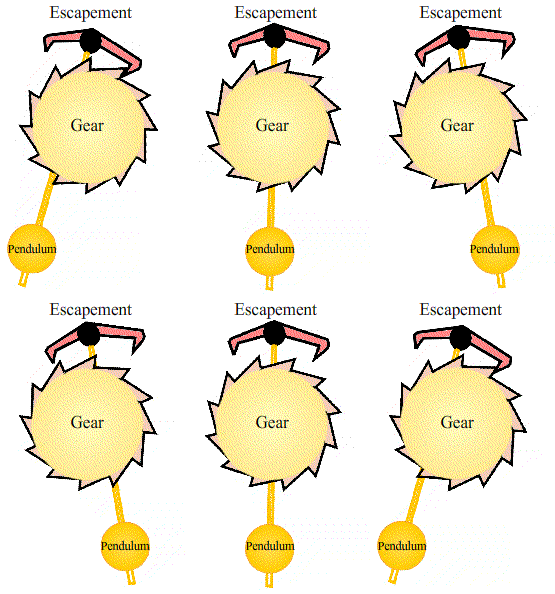
However, since you’re working with a falling weight, you have to control its fall somehow; if not, the weight will fall rapidly due to the force of gravity, making the second needle move too fast. This is where the pendulum steps in. When it swings, it rocks a lever (escapement), which makes the gear trains move forward a very small amount with each swing. In other words, the escapement locks and unlocks the controlling mechanism (gear train) to let the weight ‘escape’ or fall once per second. It is this locking and unlocking of the gear train by the escapement that produces the characteristic tick-tock sound we’ve all come to generally associate with clocks. Robert Hooke is credited with the first anchor escapement around 1657, and the more accurate “deadbeat” escapement (introduced by English clockmaker George Graham in 1715) is what most modern precision pendulum clocks still use today.
Once the weight has fallen down the entire height, it must be wound back to its starting position. The time required for winding a pendulum clock varies according to its internal design. For instance, a clock with a heavier weight can store more potential energy, and can therefore run longer than a lightweight clock before any winding is required. There are some variants of pendulum clocks, such as the aptly named 400-day clock or anniversary clock, which runs for a year before needing to be rewound.
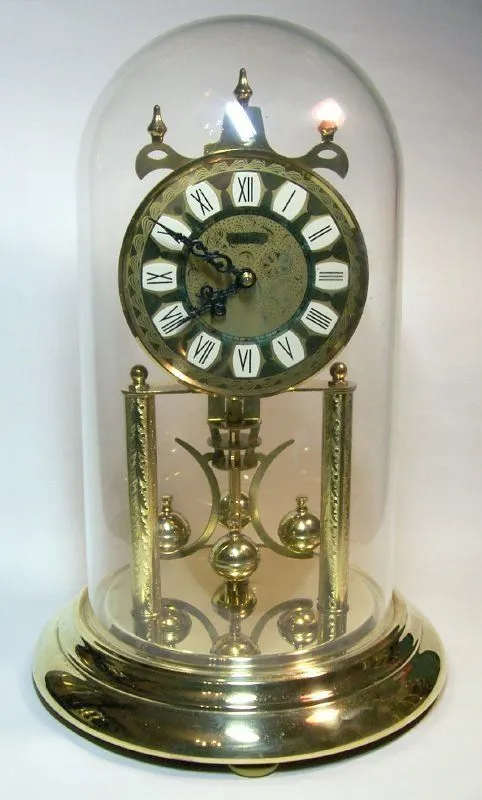
While these clocks may have lost their popularity in the face of more sleek and sophisticated modern clocks, they aren’t dependent on either batteries or electricity (unlike almost all modern clocks), yet they are incredibly accurate. Pendulum clocks are undoubtedly one of the most astonishing and utterly priceless mechanical marvels that man has ever created.
How Does A Grandfather Clock Work?
Here is a fact that surprises most people: a grandfather clock is not really a special kind of clock at all. It is simply a pendulum clock dressed up in a tall wooden case (clockmakers call it a longcase clock). Everything we have just described, the falling weight, the swinging pendulum and the ticking escapement, is happening quietly inside that elegant cabinet. The English clockmaker William Clement developed the form around 1670, pairing the long case with the newly invented anchor escapement.

So why make the case so tall? Two reasons, and both come down to physics. First, the anchor escapement let clocks use a long, slow-swinging seconds pendulum about 1 metre (39.1 inches) long, which completes one swing every second, and that pendulum needs vertical room to move. Second, and just as important, a taller case lets the heavy driving weights fall a longer distance before they reach the bottom. The farther they can drop, the longer the clock runs between windings.
The anchor escapement was a genuine leap forward. In the older verge clocks, the pendulum had to swing through a wide arc of roughly 100°; the anchor trimmed that down to a gentle 4° to 6°. A pendulum that swings through a narrow arc keeps time far more reliably, which is why longcase clocks became the household time standard for over two centuries. As for the charming name, we owe it to Henry Clay Work's 1876 song "My Grandfather's Clock", which sold over a million copies of sheet music and permanently attached the word "grandfather" to the tall longcase clock.
Do Pendulum Clocks Need Batteries?
No, and that is exactly what makes them so remarkable. A pendulum clock has no battery, no plug and no electronics anywhere inside it. Every bit of energy it uses to run for days on end comes from a single source: a heavy weight that you have lifted against gravity (or, in smaller clocks, a coiled mainspring that you have wound up tight). As that weight slowly descends, its potential energy trickles into the gear train one tick at a time.

So how did clocks keep time before batteries existed? In exactly the same way the antique on a mantelpiece still does today. "Winding" a clock simply means lifting the weight back to the top (or re-tightening the mainspring), which reloads it with the potential energy it has spent. How often you need to do this depends on the movement: a 30-hour clock needs winding every day, the common eight-day movement runs for a week on one wind, and some designs go far longer (the torsion "anniversary" clock mentioned earlier runs a full 400 days). You wind a weight-driven clock either by turning a crank or key in holes on the dial face, or by pulling on a chain to haul the weight back up.
This is why the pendulum clock ruled timekeeping for centuries without a single electrical part. Only in the 1930s did the quartz oscillator, with its battery-powered electronic vibration, finally beat the pendulum for accuracy and begin to replace it. Until then, a falling weight and a swinging rod were the most precise way humanity had to measure time.
References (click to expand)
- Pendulum clock - Wikipedia. Wikipedia
- How Pendulum Clocks Work - Electronics | HowStuffWorks. HowStuffWorks
- How do pendulum clocks work? - Explain that Stuff. explainthatstuff.com
- A Walk Through Time: A Revolution in Timekeeping. NIST
- The Long Case Clock: Engineering Behind a Grandfather Clock. Illumin, USC Viterbi School of Engineering
- Grandfather clock - Wikipedia. Wikipedia
- My Grandfather's Clock - Wikipedia. Wikipedia