The electric shock comes from your ulnar nerve, a long nerve running from the neck to the pinkie. At the elbow it lies exposed behind a bony bump (the medial epicondyle), shielded only by skin. Hitting your funny bone pinches the nerve against the bone, firing pain down your forearm to the pinkie.
As you reach back to pull your chair and sit up straight, your elbow smashes into the chair’s arm, hitting directly on the “sweet spot.” Waves of pain, what people often describe as an “electric shock,” promptly ripple through your arm, from the mighty elbow to your little pinkie.
But what’s so special at this point? Why does it hurt so terribly?
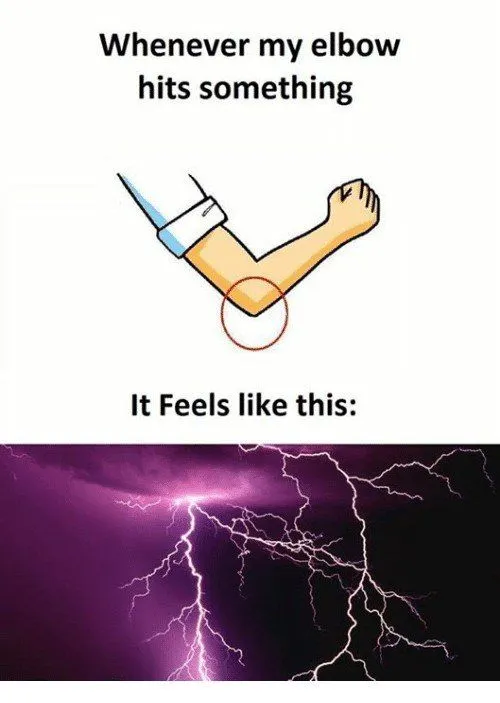
Funny Bone
The spot is called the funny bone, although it is anything but a bone and certainly does not make you laugh. Whether the spot is called “funny” because of the uncanny sensation it evokes or is just a pun on the upper arm, the name of the bone under which this area is located, is still unclear.
The funny “bone” is actually a long vine of a nerve called the ulnar nerve that emanates from your neck, runs alongside the shoulder, bicep, and forearm, enters the wrist, and finally culminates halfway across the ring finger and the tip of your pinkie. The nerve is named after the ulna, the long bone that runs along the little-finger side of your forearm and whose sharp, protruding tip (the olecranon) forms the point of your elbow. The bone above your elbow is the humerus, and the nerve actually crosses behind a bony knob on its inner end called the medial epicondyle.
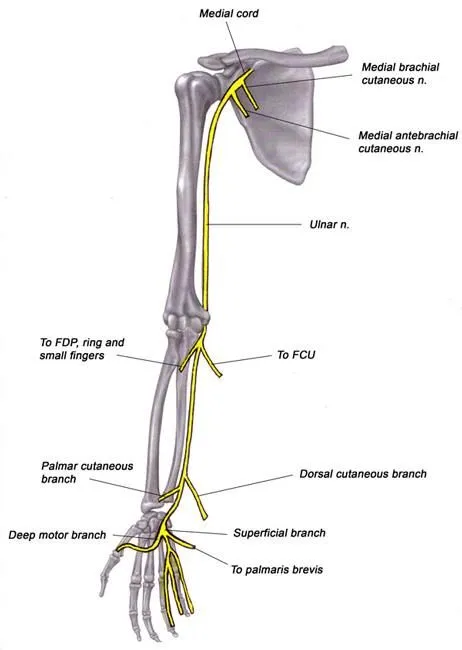
Every nerve in our body is covered and protected by the muscles it innervates. The same applies to the ulnar nerve: it is protected by the flesh and muscles that make up the biceps, forearm, ring finger, and pinkie. However, as it bends around the inner elbow it passes through a narrow channel called the cubital tunnel, tucked right behind the medial epicondyle. This is where the nerve is most vulnerable: as it rounds that bony knob, only skin and a thin layer of tissue stand between it and the outside world.
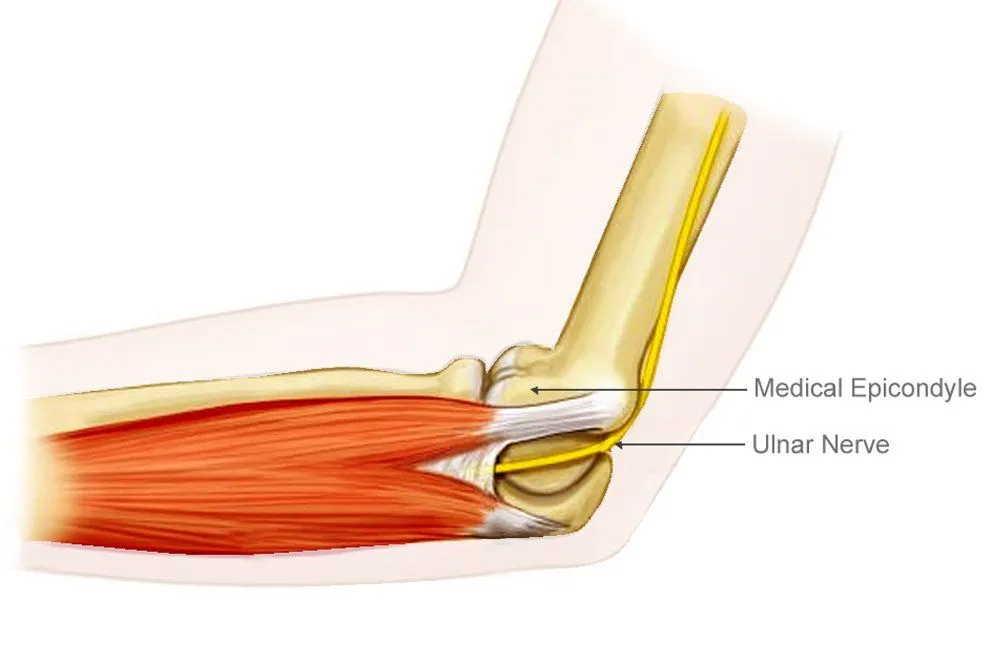
When you hit your funny bone against something, the exposed nerve is squashed against that hard medial epicondyle. The squeezed, irritated ulnar nerve fires off waves of pain, the unmistakable “electric shock.” The waves race along the regions the nerve serves: the inner forearm, the pinkie, and half of the ring finger.
Cubital Tunnel Syndrome
Over the generations, torturers have discovered novel techniques and devised sinister methods to punish their subjects. Still, none of them realized that the cruelest act requires only a chair and a stick. Constantly beating the funny bones of a subject means inflicting the worst torment.
It’s the stuff of nightmares or revenge fantasies, but, as it turns out, this nightmare is a reality for some unfortunate people.

The ulnar nerve is squeezed every time we fold our arms while sleeping, resulting in pain, a strange sensation, and slight numbness, as we know.
However, progressive irritation may cause the effects to persist even after the arm has been unfolded. The continual pain and numbness weaken the forearm’s muscles and often cause the pinkie and ring finger to curl.
The hand then assumes the shape of what is called an “ulnar claw.” This awful condition is called cubital tunnel syndrome, and abating it may require hand therapy or even surgery in extreme cases.
Is The Funny Bone Actually A Bone?
Despite the name, the funny bone is not a bone at all. As we have seen, it is the spot at the inner elbow where the ulnar nerve rounds the bony knob (the medial epicondyle) with almost nothing covering it. So where does the “funny” come from? The most popular explanation is a pun. The long bone of the upper arm is called the humerus, which sounds exactly like “humorous,” so a knock to that region became the “funny bone.” The phrase appears in print as far back as an 1842 poem, and the original joke has long since worn off, leaving us with a name that survives even though most people never connect it to the humerus.
There is a second, simpler reading too. In older English, “funny” also meant odd or strange, and few sensations are stranger than the buzzing, electric jolt you get when you clip your elbow. Either way, the takeaway is the same: the “bone” that zaps you is really an exposed nerve, and the only bones involved are the humerus it rests against and the bony bump that pins it when you take a hit.
Why Do You Sometimes Feel An Electric Shock Without Hitting Your Elbow?
Plenty of people search for the cause of an elbow shock that arrives with no bang at all. You are sitting at your desk, or you wake up in the morning, and there it is: a tingling, electric, pins-and-needles feeling running from the inner elbow down to the ring and little fingers. The culprit is usually the same ulnar nerve, just irritated in a slower, sneakier way than a direct knock.

The ulnar nerve has to travel through that tight cubital tunnel behind the medial epicondyle, and the tunnel gets narrower every time you bend your elbow. Keeping the elbow flexed for long stretches, or repeatedly bending it, stretches and squeezes the nerve and cuts down its blood supply, which is why the symptoms so often show up after a night spent sleeping with a folded arm, a long drive, or an afternoon holding a phone to your ear. Leaning on your elbow, say on a hard desk or armrest, presses on the nerve from the outside and does much the same thing.
Early on, these spontaneous shocks tend to come and go: they flare when the elbow is bent or leaned on and fade once you straighten the arm and shake it out. That on-off pattern is the classic early sign of the same cubital tunnel syndrome that a really hard bang can also trigger. The sensation can radiate up into the forearm as well, which is why some people describe an “electric shock in the arm” rather than just the elbow.
When Should You Worry About Elbow Shocks?
A one-off zap from clipping your funny bone is harmless and gone within minutes. The signals worth paying attention to are the ones that do not go away. According to the American Academy of Orthopaedic Surgeons and the Cleveland Clinic, you should see a doctor if the numbness, tingling, or shock-like sensations are severe, or if milder symptoms have hung around for more than six weeks.

The bigger red flags are about strength, not just sensation. A weakening grip, clumsy fingers, trouble with fine tasks like typing or buttoning a shirt, or the ring and little fingers starting to curl into that ulnar claw all point to a nerve that has been compressed long enough to waste the muscles it feeds. This matters because once that muscle wasting sets in, it generally cannot be reversed, so catching the problem early is the whole game. Most cases never get that far and respond to simple measures: a padded splint that keeps the elbow straight at night, nerve-gliding exercises, anti-inflammatory medication, and easing off the positions that pinch the nerve. Surgery to give the ulnar nerve more room is reserved for cases that do not settle.
One last reassurance: an isolated shock or ache in the elbow is not a heart problem. Cardiac pain is a different beast that usually centers on the chest and may spread to the left arm and shoulder, rather than producing the sharp, finger-bound jolt of a knocked funny bone.
References (click to expand)
- Ulnar Nerve Entrapment at the Elbow (Cubital Tunnel Syndrome). OrthoInfo - American Academy of Orthopaedic Surgeons
- Ulnar Nerve (Funny Bone): What Is It, Branches and Function. Cleveland Clinic
- Cubital Tunnel Syndrome: Causes, Symptoms and Treatment. Cleveland Clinic
- Explainer: What Is the Funny Bone? The Conversation