Table of Contents (click to expand)
Yes, many airplanes have Wi-Fi. They get online in two ways. Air-to-ground (ATG) systems link the plane to a network of cell towers on the ground, but only over land. Satellite systems beam the signal through orbiting satellites, which works anywhere, including over oceans. Newer low-Earth-orbit networks like SpaceX's Starlink now deliver fast, often free, in-flight Wi-Fi.
The Internet is everywhere. It’s available in offices, malls and subway stations, along with thousands of other locations. It is no longer a luxury, but practically a privilege or birthright for urban households. It is even available at my dentist’s clinic, so instead of skimming through dreary magazines listing corny toaster, or worse, insurance commercials, I can watch, stream, scroll and envy whatever and whomever I want.

The only places where I cannot access the Internet is in my office when I need it the most and at 30,000 feet above the Earth’s surface on an airplane. While the former is my bad luck, the latter has been taken care of. The fear of missing out has impelled even airplanes to provide other than a sack of three peanuts, a Wi-Fi service, which allows you to Snapchat you and the guy sprawling behind you, and watch Ellen excerpts with the creepy neighbor peeking in. But how does Wi-Fi on an airplane work?
Air-To-Ground (ATG)
The dust-covered, incessantly blinking router at your home or office is connected to the Internet with a direct wired connection. The router then radiates these signals with the help of its antennae. However, airplanes cannot be connected to a wire all the time, so they must connect to an Internet Service Provider (ISP) wirelessly.
One way to achieve this is to enable a wireless connection between the airplane and a cell tower on the ground that is constantly connected to the internet. The cell towers talk to the apparatus on the airplane via radio waves. A grid of uniformly spaced cell towers ensures that a forward-moving airplane connects to the nearest cell tower as it flies above them.
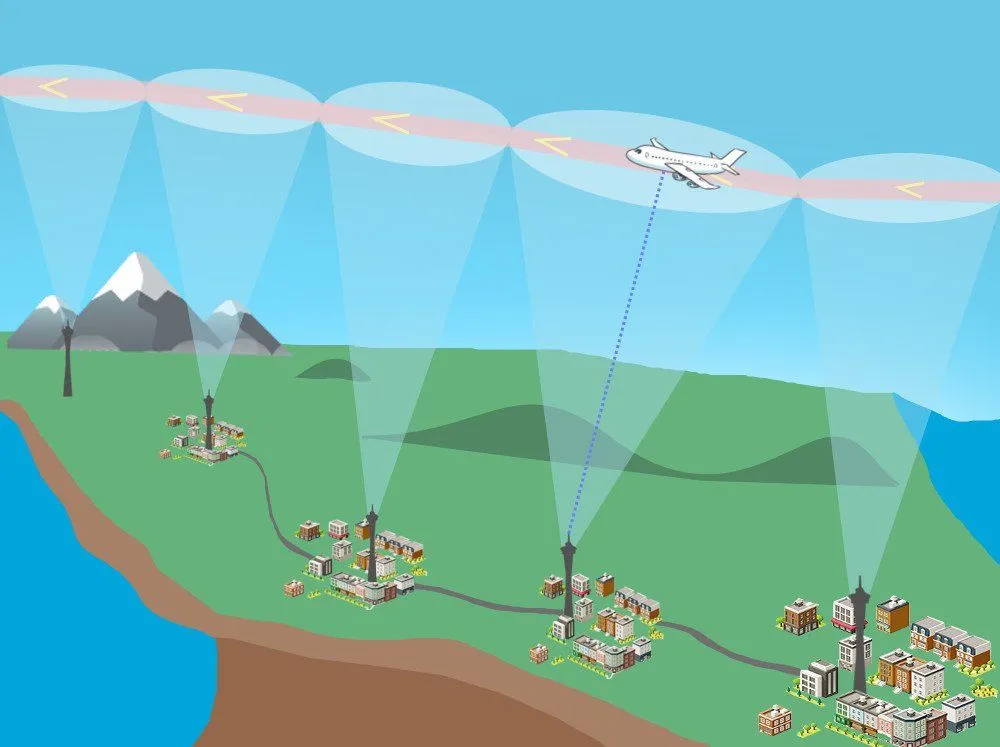
The technology’s function can be thought of as a phone connected to several routers in a large house. As the phone moves throughout the house, it automatically disconnects from routers whose signals weaken as it moves past and away from them, immediately connecting to the next router in its proximity. Because the link points downward, the airplane’s antenna is mounted on its belly. Gogo, long one of the biggest names in in-flight Internet, pioneered ATG service across North America (it later sold its commercial-aviation business to Intelsat in 2020 and now focuses on business jets).
However, the speeds this technology can provide are modest. The original ATG network delivered roughly 3 Mbps shared across the whole cabin, and even upgraded versions like Gogo’s ATG-4 topped out around 10 Mbps. While that might be enough for reading email, you and your neighbor might grow indignant when those video clips start to buffer. Service above oceans, for obvious reasons, is practically non-existent, which is why ATG is limited to flights over land, primarily domestic routes.
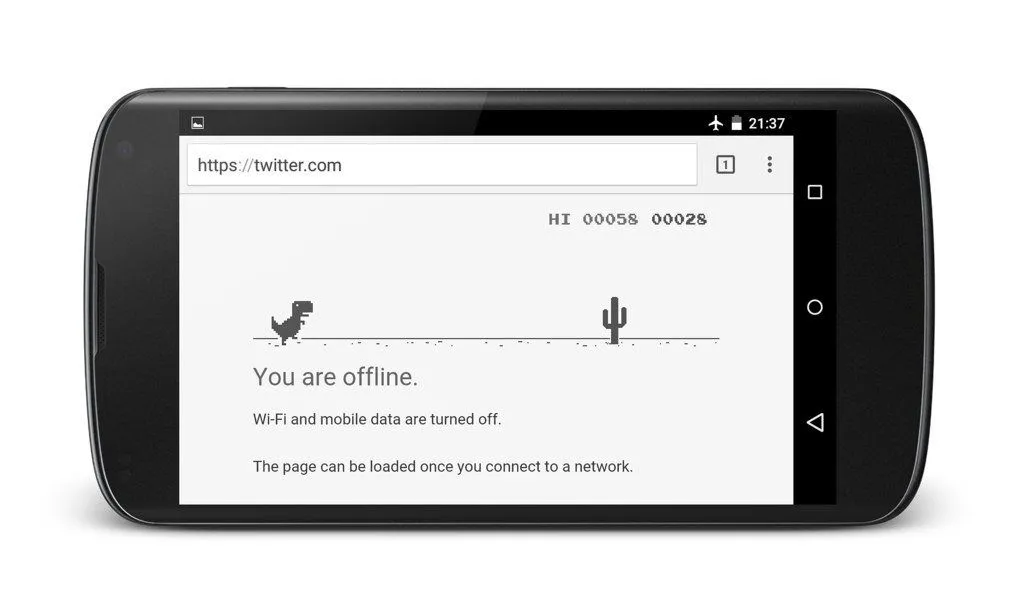
Furthermore, because cell towers cannot be presumptuously planted everywhere, service can decrease above regions with low cell tower density. Even with a suitable cell tower density at its disposal, the plane’s connection is bound to stammer due to technological constraints as airplanes whiz swiftly past the towers.
Ku And Ka-band
The limitations of ATG can be overcome with the help of dedicated satellites hovering above Earth’s atmosphere. These satellites communicate with an airplane via a portion of microwave frequencies called the Ku-band.
Rather than bouncing signals off cell towers, the satellite acts as a relay in space. A ground station (called a gateway or earth station) is wired to the wider Internet and beams data up to the satellite, which forwards it down to the aircraft, and the same path works in reverse. The antenna on the airplane sits inside a dome-shaped radome fixed on top of the fuselage. Like ATG, its position follows the direction of the link, in this case pointing upward, so the antenna faces the satellite above it.
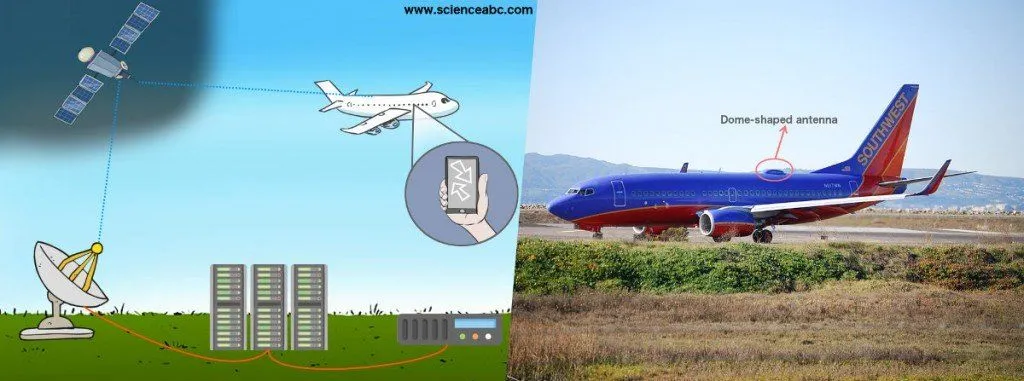
Traditional Ku-band satellites sit in geostationary orbit, roughly 35,800 km (22,200 mi) above the equator, and can provide solid speeds in the range of 30-50 Mbps per aircraft. Because a single satellite serves many planes at once, though, that bandwidth gets shared and speeds can drop. The long round trip up to a distant satellite and back also adds noticeable latency, a lag that ATG, sitting much closer to the ground, largely avoids. Even so, Ku is usually enough to while away your time on Facebook or YouTube, though smooth live streaming has historically been a stretch.
A step up in performance comes from moving to a higher microwave band called the Ka-band. Ka-band systems use a chunk of spectrum (roughly 26-40 GHz) that carries more data than Ku, so they can push aggregate speeds of 70 Mbps or more to an aircraft. JetBlue was an early champion of this approach: its Viasat-powered Fly-Fi service, free on every flight, runs on Ka-band satellites and typically delivers a usable 10-20 Mbps to each device. Emirates and other carriers have likewise leaned on high-capacity Ka-band satellites to give passengers a connection that feels closer to home broadband.
The biggest shake-up, though, has come from low-Earth-orbit (LEO) satellites. Instead of one distant satellite parked 35,800 km up, networks like SpaceX’s Starlink use thousands of small satellites flying at only about 550 km (340 mi). Sitting so much closer slashes the lag and lifts speeds dramatically, often well over 100 Mbps per plane with latency low enough for video calls. Since 2024 the rollout has been rapid: Hawaiian Airlines became the first major carrier to fly free Starlink Wi-Fi in February 2024, Qatar Airways switched on free Starlink across its Boeing 777s and Airbus A350s through 2024 and 2025, and United Airlines began offering free Starlink on regional jets in 2025 with its first mainline flight following that October. Amazon’s rival LEO network, Leo (formerly Project Kuiper), is set to power JetBlue’s next-generation Fly-Fi from 2027.
Why Doesn’t Every Airline Provide Wi-Fi Service?
Well, one reason is obvious and mentioned above: it can be expensive. Equipping a fleet, buying satellite bandwidth and maintaining the hardware all add up. The dome-shaped antenna on top of the plane also creates drag and adds weight, and the heavier and less aerodynamic the aircraft, the more fuel the engines burn. Older satellite radomes added a few hundred pounds and a meaningful drag penalty, so carrying that hardware costs money on every single flight. To pay for these fancy toys, airlines either build the cost into ticket prices or charge for access at the seat.

Fortunately, the technology keeps getting better and cheaper. Engineers have developed thinner, lighter electronically steered antennas whose streamlined radomes can cut the old drag penalty by 75-90 percent, saving fuel and money. Meanwhile, the LEO networks now spreading across airline fleets have pushed speeds high enough that many carriers offer Wi-Fi for free. So the day is here when you can peacefully stream Titanic on Amazon Prime, even with the creepy, peeking stranger beside you.
References (click to expand)
- Ho Dac Tu, Tsuda, Y., Shimamoto, S., Jun Kitaori, & Kato, S. (n.d.). The Next Generation Air to Ground Communication System for Air Traffic Control. IEEE/ACES International Conference on Wireless Communications and Applied Computational Electromagnetics, 2005.. IEEE.
- How to save on inflight Wi-Fi for your next trip - The Points Guy. The Points Guy
- Ku band - Wikipedia. Wikipedia
- Ka Band vs Ku Band: The Difference Between Ku and Ka Band Frequencies. Honeywell Aerospace.
- Gogo Inflight Internet - Wikipedia. Wikipedia
- Fly-Fi: Fast, Free Wi-Fi. JetBlue.
- Starlink Aviation. SpaceX.