When a mobile phone is turned on, it scans for nearby cell-tower signals and locks onto the strongest one through a special control channel that links it to the Mobile Telephone Switching Office (MTSO), the cellular network's central switchboard. The MTSO authenticates the phone using its SIM card and routes calls between cells, handing off the connection as the user moves.
We all know that smartphones are pretty cool devices. They are jam-packed with tons of features, including music, social media, games etc., but their fundamental property is to keep you connected to the cellular network. Our smartphones are basically complex radios. In order to understand how a mobile phone “looks” for a cellular network, let’s take a closer look at how the underlying system is organized.
Why Is It Called A “Cellular” Network?
The word cellular is the key to the whole system. Instead of one giant transmitter trying to cover an entire city, the network is carved up into lots of small patches called cells, and each cell gets its own short-range transmitter and receiver. On maps and diagrams these cells are usually drawn as neat hexagons that lock together like a honeycomb, but in the real world radio waves spill over uneven ground and buildings, so the actual coverage zones are irregular and overlapping.

Why bother chopping the map up like this? Because a phone company only has a limited slice of radio spectrum to work with, and there are millions of subscribers who all want to talk at once. The clever trick is frequency reuse: because each cell transmits at low power, the same set of frequencies handed to one cell can be handed out again in another cell far enough away that the two never interfere. Neighboring cells always use different frequencies, but those channels get recycled over and over across the wider area. That is what lets a network squeeze far more simultaneous calls out of a fixed amount of spectrum than a single big tower ever could.
The design also scales gracefully. When a particular cell gets so crowded that it runs out of channels, the operator simply splits it into smaller cells, each with its own tower, and reshuffles the frequency assignments. That is why dense city centers are dotted with many short-range cell sites, while a quiet stretch of highway might be covered by a single tall tower for kilometers around.
The Cellular Network Approach
Each service provider (such as Verizon and AT&T) controls the entire cellular network of a particular area (mostly broken up by cities) from a central facility known as the Mobile Telephone Switching Office (MTSO), now more commonly called the Mobile Switching Center (MSC) in modern GSM, LTE, and 5G networks. The MTSO acts as the focal communication point of the cellular network. It is responsible for interconnecting calls of mobile phones that are present in different cells, and it also handles the registration, authentication, and location updates of mobile subscribers.
How Your Cell Phone Connects When You’re On The Move?
On a daily basis, most of us commute at least a decent distance for either work or education. How then is your cell phone constantly connected to the cellular network? Well, the process usually begins the moment you switch on your phone. All of today’s phones are programmed with special codes. The first thing your phone does is generate a System Identification Code (SID) on the control channel.
A control channel is a special frequency channel that establishes a constant connection between your phone SID and the MTSO. The control channel is responsible for forewarning the phone before an incoming call, as well as for constant location updates of the user. When the phone is unable to find a control channel to communicate with the MTSO, it usually shows those two dreaded words ‘NO SERVICE’.
What’s Actually On A Cell Tower?
The thing your phone is really talking to is the cell site, also called the base station. In the language of each generation it has a different name, but the job is the same: it is the radio at the edge of the network that bridges your phone and the rest of the system. The combination of the antennas and their associated electronic equipment is what the industry calls a cell site or base station, and the towers that carry them are typically about 15 to 60 meters (50 to 200 feet) tall, which is why they are usually bolted to masts, rooftops, or water tanks where they have a clear line of sight.

Look closely at the panels bolted to a tower and you will usually see them clustered in groups, with each group facing a different direction so that one tower can cover the area around it in slices, or sectors. Within a group, the antennas split the work: one antenna transmits signals down to phones, while the others listen for the much weaker signals coming back up from those phones. The link from the phone up to the tower is the uplink, and the link from the tower down to the phone is the downlink, and the two run on separate frequencies so they never trample on each other.
Every one of these cell sites is wired back to the network’s switching center, the MTSO, by a fixed landline or a microwave link. The MTSO is the part that ties the whole cellular system into the ordinary telephone network, so a call from your mobile can reach a landline on the other side of the world. The tower handles the radio; the switching center handles the routing.
Finding The Signal
The way your mobile phone connects to the cellular network all begins with an important component within the phone known as the Antenna. The antenna is a small metallic element (often copper, though most modern smartphones use multiple antennas embedded around the phone’s frame) that is specifically engineered in shape and dimension to pick up and transmit radio waves. The strength of the signal received depends on the quality of the control channel between the phone and the MTSO.
In practice, your phone is constantly measuring the signal strength from every cell tower it can hear. In 4G LTE and 5G networks, this measurement is called Reference Signal Received Power (RSRP), and it is reported in decibel-milliwatts (dBm). The phone locks onto the tower with the strongest RSRP, and if a neighboring tower becomes meaningfully stronger for more than a brief moment, the network performs a handover and seamlessly hands the connection off to that tower. That is why your phone can stay on a call even while you are walking, driving, or riding a train.
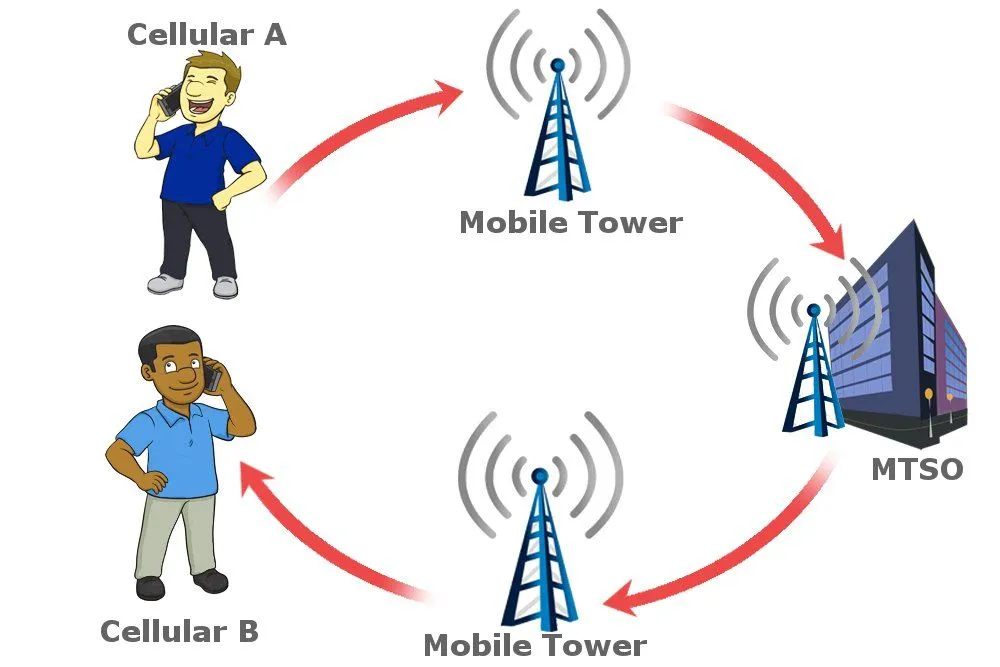
Whenever you need to make a call, a certain procedure is always followed. First, when you wish to make a call, the SID code present in your phone sends a request to the MTSO via the control channel between them. At that point, the MTSO sends a request back to your cell phone for its Subscriber Identity Module (SIM). Popularly known as a SIM card, it is an identification number given to the user.
The SIM helps in letting the MTSO know that they are a registered user of the network (the reason you hear the beeps before the call connects). Once this is over, the MTSO determines the location of the user and the cell within the network in which they are present. Simultaneously, the MTSO also determines the location of the person you intend to call and the cell where they are located. Once both parties have been identified, the call is established.
From just a few channels of communication to being connected to nearly everywhere in the world with just a click of a button… we have clearly come a long way. And the frontier keeps moving: Google’s Loon balloons were grounded in 2021, but the same idea has been picked up by direct-to-cell satellite services like Starlink Direct to Cell and AST SpaceMobile, which let ordinary smartphones connect to low-Earth-orbit satellites for calls and texts from the middle of the ocean, deep wilderness, and other corners of the planet where no terrestrial cell tower could ever reach.
References (click to expand)
- Mobile Telephone Switching Office. Wikipedia
- Cellular network. Wikipedia
- 03.04.07: The Physics of Cell Phones. Yale University
- Handover. Wikipedia
- SIM card. Wikipedia
- Mobile telephone. Encyclopaedia Britannica
- Human Exposure to Radio Frequency Fields: Guidelines for Cellular Antenna Sites. Federal Communications Commission (FCC)