Table of Contents (click to expand)
4G and 4G LTE are not the same. 4G is the fourth generation of mobile telecom, defined by ITU-R (IMT-Advanced) with peak speeds of 1 Gbps stationary and 100 Mbps on the move. LTE (Long-Term Evolution) is the underlying technology, but original LTE falls short of those targets, so it is marketed as ‘4G LTE’ rather than true 4G.
When mobile phones were still a novelty, few customers knew (or cared) what 2G was all about, despite the fact that the entire communication industry depended on it. However, as smartphones gradually gained ground in the wireless communication industry, the need for a faster Internet speed arose, which is when 3G was released.

Now that smartphones dominate the telecom industry, and dramatically influence everything from e-commerce and entertainment to navigation and remote work, 4G is the everyday default for most people on the planet. According to ITU data, mobile broadband subscriptions (3G and faster) reach roughly 90 percent of the world’s population, and 5G already covers about 55 percent. Even so, 4G LTE still carries the majority of mobile data traffic, and you’ll see the ‘4G LTE’ badge on phones from Verizon and AT&T in the US, EE and Vodafone in the UK, Telstra in Australia, Rogers in Canada, and Reliance Jio in India.
Regardless of which company you’re discussing, have you noticed one rather unusual thing in the advertisements for all 4G service providers? Instead of marketing their services as simply ‘4G’, they use the words ‘4G LTE network’, along with a number of other words in their ads.
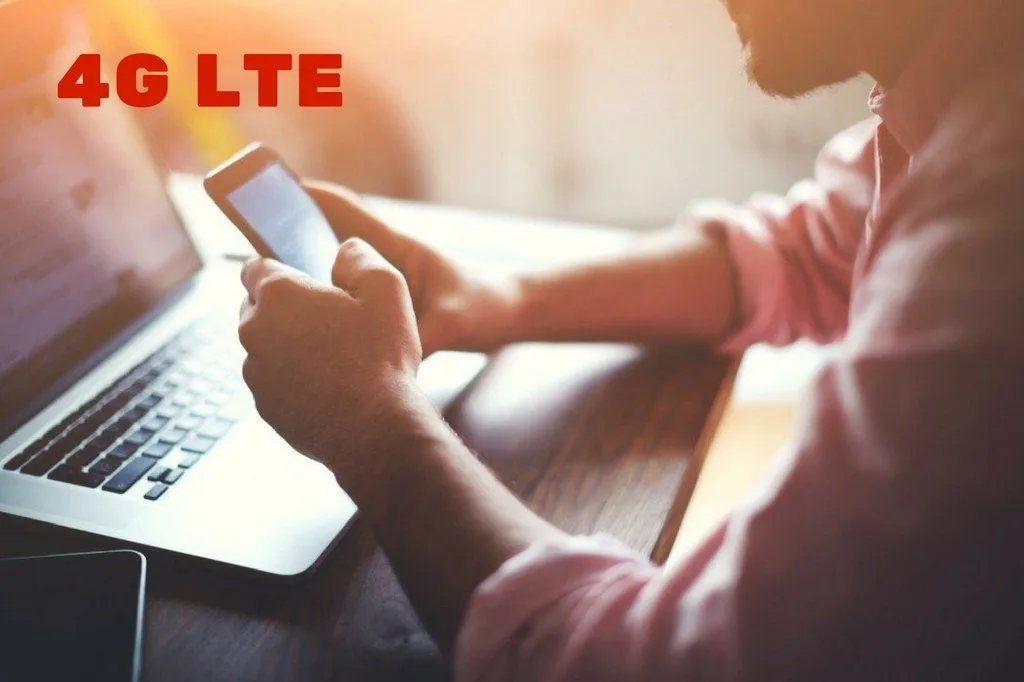
But why is that? Why couldn’t they simply call their services ‘4G’ and be done with it? Is ‘LTE’ an additional feature that is somehow better than just regular old ‘4G’? Simply put, are 4G and ‘4G LTE’ the same thing?
To understand this, we’ll have to take it from the top…
What Is 4G?
In the simplest terms, it is the fourth generation of wireless mobile telecommunication technology. A successor of 3G, it is ideally suited for services like HD video calling, live streaming, mapping and online gaming, thanks to its high download speeds. From a user perspective, 4G systems provide reliable and high-speed Internet connectivity on electronic devices, such as tablets and smartphones, among others.

Note that simply being ‘faster’ than the existing 3G networks does not make a network ‘4G’. There is a set of predefined requirements that must be met first, which is where the problem starts. Let me explain this with the help of a story…
Once upon a time, an international authority on space travel announced that it would confer the title of ‘The Greatest Explorer’ to the first person who traveled to Jupiter and back. In a bid to claim the coveted title, a number of space travelers tried to reach Jupiter, but the farthest anyone could manage to reach was 100 million kilometers beyond Earth.
Then, a guy named Polo built a special spaceship and successfully travelled to Mars (which sits between Earth and Jupiter) and back, shattering the earlier 100-million-kilometer record by a significant margin. Upon his return, the authority handed him the title of ‘The Greatest Explorer’, even though he hadn’t actually reached Jupiter (which was the original requirement). Simply because he broke the 100-million-kilometer record and his spaceship was much more advanced than its predecessors, the authority concluded he deserved to be called ‘The Greatest Explorer’.

A few others copied his spaceship’s design and soon enough, a handful of rich space travelers made it to Mars and back as well. Thus, every one of them was legally allowed to be called ‘The Greatest Explorer’, despite the fact that no one had ever traveled to Jupiter, which was the original goal.
This is precisely what happened with 4G.
The International Telecommunication Union’s Radiocommunication Sector (ITU-R) – the ‘authority’ in our story – spelled out a set of technical requirements for a network to be called ‘4G’ in Report ITU-R M.2134, published in November 2008 as part of the IMT-Advanced framework.
According to those targets (corresponding to the feat of landing on Jupiter), a network claiming to deliver 4G service had to give a connected device, say, a smartphone, peak download speeds of 1 Gbps (one gigabit, or roughly 125 megabytes, per second) when you’re sitting still or strolling around (low mobility), and 100 Mbps when you’re moving fast in a car or train (high mobility).
However, it was soon realized that the bar had been set too high. The two leading candidate technologies of the day (the original WiMAX and LTE) topped out at hundreds of megabits per second, well short of the gigabit mark, so neither was fully IMT-Advanced compliant at launch.
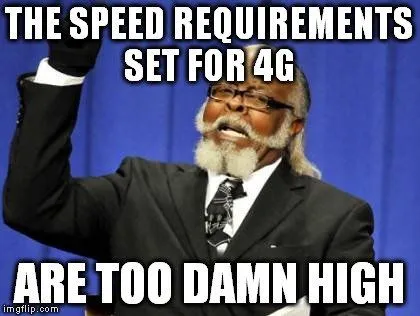
Still, in December 2010, the ITU-R relented and ruled that these technologies could be marketed as ‘4G’ anyway, since they were substantially more advanced than their predecessors and offered significant performance improvements over 3G. This is where LTE (corresponding to the guy named Polo) stepped into the picture.
What Is LTE?
LTE stands for Long-Term Evolution, and it is a standard for high-speed wireless communication. When the regulatory authority realized that the minimum speeds set for 4G were far out of reach, it allowed the technology being used to attain those high-speed standards to be marketed as ‘4G’, provided that it offered significant improvements to the ‘performance and capabilities’ offered by 3G.
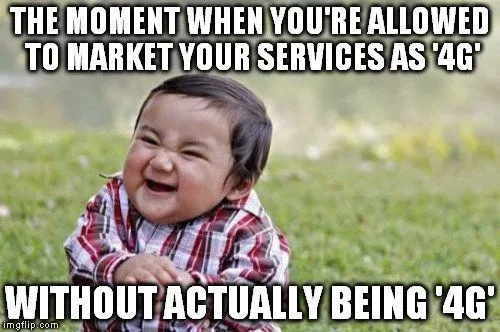
Boy, did telecom companies love that decision! Every major player in the telecommunications industry jumped in and began to market their systems as ‘4G LTE’, effectively luring customers with the much-revered term ‘4G’ attached to their name, without actually attaining the required speeds for that coveted designation.
A few years later, the standards bodies caught up: 3GPP released LTE-Advanced (Release 10, 2011) and LTE-Advanced Pro (Release 13, 2016), which use carrier aggregation to combine multiple LTE channels and can clear the 1 Gbps bar. These newer flavors of LTE genuinely satisfy the IMT-Advanced definition, so if you ever see a phone or carrier badge that says ‘LTE+’, ‘LTE-A’ or ‘LTE Advanced’, that is closer to ‘true’ 4G than the original ‘4G LTE’ label.
So, Are 4G And 4G LTE The Same?
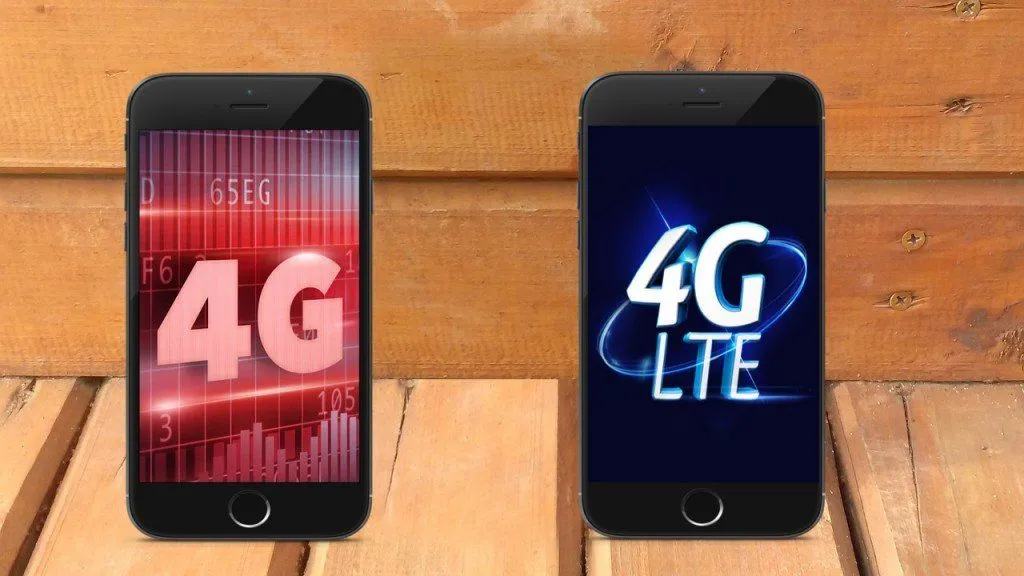
Strictly speaking, no. The original LTE delivers much lower peak speeds than a true 4G network is supposed to, yet it is still commonly marketed as ‘4G LTE’, even though it does not meet the original ITU-R technical requirements for a 4G wireless network. That said, it is comfortably faster than any 3G network, and the newer LTE-Advanced and LTE-Advanced Pro versions do clear the IMT-Advanced bar, so calling them ‘4G’ is fair. In real-world use today, on a healthy LTE network you can usually expect download speeds of around 20–50 Mbps, with LTE-Advanced peaking far higher.
How Could 4G LTE Offer Free Voice Calls?
Consider a legacy carrier such as Vodafone or AT&T that runs 2G, 3G and 4G networks side by side. Because their early 4G infrastructure was not very extensive, they sold restricted 4G data plans and kept charging premium rates for them. Whenever a customer placed a regular phone call or sent a text, the network simply dropped the data session and switched the handset back to the older 2G or 3G voice network. This handover trick is called Circuit Switched Fallback (CSFB).

The biggest problem with using CSFB is that since it works on the relatively older ‘circuit-switched’ system, the company in question has to keep its 2G/3G systems running and incur those costs.
The thing is, 4G LTE was designed from the ground up as a packet-switched, data-only system, so it cannot natively carry an old-school circuit-switched voice call. Consequently, any operator that runs a 4G LTE-only system with no 2G or 3G fallback (notable examples include Reliance Jio in India and T-Mobile US, which has spent the last few years sunsetting its 3G CDMA and HSPA networks) needs a completely different technology to connect calls. This is where VoLTE enters the picture.
What Is VoLTE?
Modern 4G phones and networks support VoLTE (Voice over LTE), a 3GPP specification (TS 23.228, built on the IMS framework) that defines how to deliver voice calls directly over the 4G LTE data network instead of dropping back to 2G or 3G. The result is faster call setup (often around two seconds, versus six or seven with CSFB) and HD voice quality on supported handsets.
You see, at the most basic level, your voice is just another form of data. VoLTE takes that audio, encodes it with the AMR-WB (HD Voice) codec, packetizes it, and ships it over the same LTE bearer that handles your YouTube videos and Instagram scrolling. Because the network reserves a guaranteed quality-of-service slot for those voice packets, the calls stay clear even when the cell is busy, and they normally don’t eat into your data cap.
VoLTE Is Not The Same As WhatsApp Or Skype Calls
It is worth clearing up a common confusion. Apps like WhatsApp, FaceTime Audio and Microsoft Teams (which, incidentally, replaced Skype when Microsoft retired the consumer service in May 2025) are not VoLTE. They are over-the-top (OTT) VoIP apps, which means they ride over your regular data connection (LTE, 5G or Wi-Fi) with no special treatment from the carrier and no quality-of-service guarantees. VoLTE, by contrast, is run by the mobile operator itself, gets a reserved slice of the LTE network, and connects to ordinary phone numbers without any app at all. There is a financial sleight of hand involved with OTT apps, too: those ‘free calls’ are not actually free; the cost is simply deducted from your data allowance in the form of megabytes, instead of coming out of your top-up balance in dollars.
With the speed at which the Internet keeps swallowing up the wireless world through technologies like 4G LTE and VoLTE (and now their 5G successors, 5G New Radio and VoNR, or Voice over New Radio), it is not an exaggeration to say that, at some point, the underlying packet-switched IP network will handle every form of digital communication you do.
References (click to expand)
- Report ITU-R M.2134: Requirements related to technical performance for IMT-Advanced radio interface(s). International Telecommunication Union
- ITU-R Reports on IMT (IMT-Advanced and IMT-2020). International Telecommunication Union
- 5G – Fifth generation of mobile technologies. ITU Media Centre Backgrounder
- Voice over LTE. Wikipedia (supplementary)
- Skype is retiring in May 2025: What you need to know. Microsoft Support