Table of Contents (click to expand)
A samurai sword such as the katana is forged from tamahagane, a high-quality steel that is repeatedly heated, hammered and folded to remove impurities and even out its carbon. It is then clay-tempered, hardening a razor-sharp edge while leaving the spine tough, which gives the blade both its resilience and its signature curve.
Whenever there is any discussion of historical warfare and the importance of sword-fighting skills, the word “Samurai” always seems to enter the conversation. For hundreds of years, heroic tales of the unmatched bravery of the Samurai have been delivered to the ears of eager listeners around the world. The combat skills of the legendary Samurai are greatly complemented by the strength of the swords they possess.
“The sword embodies the soul of the Samurai wielding it.” This aphorism aptly summarizes the Samurai sword. Katana and other Samurai swords are indeed majestic-looking weapons with all the strength that a piece of steel can provide, in addition to the patience and care of a master craftsman. What more could you ask from a sword of such legendary stature!
Dawn of the Samurai Swords
Long ago, before the turn of the second millennium, the main weapon for Samurai on the battlefield were bows and arrows. When the arrows were depleted, warriors would resort to the polearm, which still provided them with ammunition for killing the enemy at a distance. It wasn’t until much later that these warriors decreased their usage of archery and started adopting swords as their primary weapon for battle.
In the early days, Samurai borrowed their sword style (a straight blade) from Koreans and Chinese, but it was then transformed into a sword popularly called Chokuto.
Curved blades, first the Tachi and later the iconic Katana, were developed once Samurai began fighting predominantly on horseback. The curve made it far easier to slash an opponent while mounted, since the blade could slice by being drawn rather than chopped. (The straight-bladed “ninja sword” you see in movies, by the way, is largely a modern invention: there is no solid historical evidence for it before the twentieth century, when films and TV popularized the look.)
During the Tokugawa period in the seventeenth century, an official sword-testing department was formed to evaluate sword quality! During the trial, swordsmiths would demonstrate a Katana’s ability by slicing through a pile of cadavers of persecuted criminals. While the corpses of deceased criminals were used for testing most of the time, some culprits who were convicted of heinous crimes were used for testing the sword while they were still alive. This testing was usually remunerated by the bidder of the sword. It has been recorded in the history books that the cost of testing was sometimes equal to the price of the sword itself!

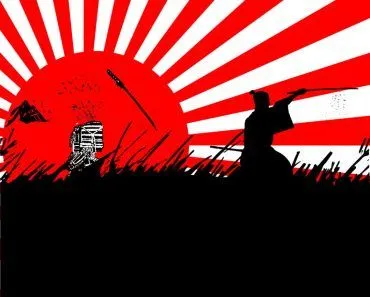
Silhouette of a Samurai warrior Credits: djgis/Shutterstock
Types of Samurai Swords
Over the years, Samurai have mastered the skill of making many different types of swords by varying the curvature, size and handle. This helped to serve different needs on the battlefield and even beyond it. Some of the most popular types of Samurai swords are the Katana, Tanto, Wakizashi, Tachi, Odachi, etc. They all had their own qualities and were used according to the type of duel or conflict in which the Samurai was engaged. Let’s look into each of these swords in a bit more detail:
Katana
Katana is easily the most famous Samurai sword. In fact, many refer to Katana as a “Samurai Sword”. It is characterized by its distinctive appearance, a curved, single-edged blade with a long grip to accommodate two hands. Though there is no fixed size for a Katana, most of them have a blade length between 60 cm and 80 cm (about 24 to 31 inches). Historically, the Katana was worn with the edge facing upwards, allowing a warrior to draw the sword and cut their opponent in two pieces with a single stroke!
Tanto
Tanto is the smallest of all samurai swords, with a blade ranging between 15 cm and 30 cm (about 6 to 12 inches). It is basically a Japanese dagger. Tanto or Wakizashi was usually the second line of defense for a Samurai warrior, accompanying the main Katana or Tachi. It is reported that Samurai warriors who had Tanto were never without them, no matter where they went. Tanto, on account of their diminutive size, were not used for slashing, but were very effective for stabbing.
Wakizashi
Wakizashi is another ‘accompanying’ sword, like Tanto, but bigger in size. Its blade length is generally between 30 cm and 60 cm (about 12 to 24 inches). Wakizashi means “side insertion” in Japanese. Great Samurai warriors used to carry Wakizashi in tandem with their iconic Katana. In fact, there is a Japanese term to articulate this combination: daisho. Daisho translates into large and small, with ‘large’ referencing Katana and ‘small’ implying Wakizashi.

Samurai swords: top (Katana), middle (Wakizashi) and bottom (Tanto) (Photo Credit : Vit Kovalcik/Shutterstock)
Tachi
Tachi is a Samurai sword that is even more curved and longer than the emblematic Katana. Its blade is generally between 80 cm and 100 cm (about 31 to 39 inches). This sword is specifically designed to be used by horse-riding warriors. Its extra length and curve made it optimal for cutting down enemy foot soldiers.

Tachi sword was useful for Samurai warrior on a horseback (Photo Credit : Seita/Shutterstock)
Odachi
The largest type of Samurai sword is the Odachi. Some even call it Nodachi, which is Japanese for “field sword”. Odachi appears similar to Tachi, but is notably longer, with a blade greater than 100 cm (over 39 inches). Odachi was typically carried by foot soldiers as a weapon to attack opponents over a long range. Odachi was only suited for large open battlefields due to its monstrous size. Using Odachi in a constricted environment was almost impossible!

Artistic manifestation of a long-handle Odachi sword (Photo Credit : joeni91/Shutterstock)
Making a Samurai Sword: What Makes Them so Special?
Centuries earlier, when the Katana was in the vogue, swordsmiths were treated with the utmost respect. In fact, many rulers of that time took up the task of making swords for themselves. Making Katana or other Samurai swords was not just about crafting a sword from a fine piece of steel, it was a religious ceremony.
Before Beginning
In earlier times, before beginning the sword-making process, the sword maker had to ‘purify’ himself according to the pious Shinto rituals. This would require a swordsmith to observe fasting, refrain from sexual intercourse and even take a religious pilgrimage.
Once ready to start the forging work, a swordsmith would demarcate his work area, dedicated to making the sword, under the vigilance of a Shinto priest with a sacred rope. To keep himself ‘pure’ as per Shinto rites during the whole sword-making process, the swordsmith would need to stand under a waterfall and recite Shinto prayers every day. If there was no waterfall in the vicinity, the swordsmith would pour a bucket with a predefined amount of water on himself. There are even some folk tales that legendary swordsmiths were assisted by divine powers to make such impeccable Katana!
The Process
The process of making a Samurai sword was always, and remains, an elaborate one. It requires a great deal of conviction and perseverance. The starting material is tamahagane, a high-quality steel smelted from iron sand in a clay furnace called a tatara. This raw steel is then repeatedly heated, hammered and folded.
The repetition of the process has its advantages:
- It squeezes out slag and impurities trapped in the steel (which would otherwise weaken the blade).
- Each fold doubles the number of layers in the steel, helping spread out any remaining flaws so no single weak spot runs through the blade.
- It evens out the carbon that gives the steel its strength, so the blade hardens consistently rather than in patches.
A common myth holds that a Katana is folded thousands or even millions of times. In reality, smiths fold the steel only around ten to sixteen times. Because each fold doubles the count, even sixteen folds already produce tens of thousands of layers. Folding far beyond that would actually burn away too much carbon and ruin the blade.
Cooling
After the sword is heated, hammered and folded to the swordsmith’s satisfaction, it needs to be cooled. However, it cannot simply be plunged whole into cold water, as cooling the entire blade that fast would make it extremely hard but brittle, prone to cracking. On the other hand, if the edge is cooled too slowly, the steel never hardens properly and the blade stays too soft to hold a keen edge.

Man testing out the Katana
To achieve an optimal level of cooling, the swordsmith paints the blade with clay (a mixture of clay, ash and water) before quenching. The cutting edge gets only a thin coat, or none at all, so it cools almost instantly and forms a very hard structure called martensite, keeping it sharp. The spine is buried under a thicker coat, so it cools slowly and stays softer and tougher, essentially acting as a shock-absorbing backbone. The boundary between these two zones shows up as the wavy temper line, the hamon, that runs along a genuine Japanese blade.
This is also why iconic Samurai blades like the Katana or Tachi are gently curved: as the edge and spine cool and contract at unequal rates, the whole blade bends into its signature arc!
“The sword embodies the soul of the Samurai wielding it.” This aphorism aptly summarizes the Samurai sword. Katana and other Samurai swords are indeed majestic-looking weapons with all the strength that a piece of steel can provide, in addition to the patience and care of a master craftsman. What more could you ask from a sword of such legendary stature!
References (click to expand)
- NOVA | Secrets of the Samurai Sword | Making a Masterpiece. The Public Broadcasting Service
- Japanese Swordsmithing (tamahagane, folding and differential hardening). Wikipedia
- Sword (Medieval, Samurai & Katana). Encyclopaedia Britannica
- A Case Study of Medieval Japan through Art: Samurai Life in .... The University of Colorado