Table of Contents (click to expand)
A deepfake is a piece of synthetic media (text, image, video, or audio) in which artificial intelligence swaps one person for another, making them appear to say or do something they never did. The name blends "deep learning" and "fake," and the technique was popularized in 2017 by a Reddit user called "deepfakes."
Since it first surfaced in 2017, deepfake technology has evolved from an innocuous tech geek's chicanery into a malicious slandering weapon, one now powerful enough to drain $25 million from a company in a single video call. In this article, we'll see what exactly this dreaded deepfake tech is, how it works, what different forms it comes in, and how we can detect or bust a deepfake.
What Is Deepfake?
A deepfake is media (text, picture, video, or audio) in which a person takes existing content and manipulates it, i.e., "fakes" it, to look or sound like someone else, using advanced artificial intelligence (AI) and neural network (NN) technology.
The word itself is a portmanteau of "deep learning" (the branch of AI that powers it) and "fake." It traces back to 2017, when an anonymous Reddit user going by the handle "deepfakes" began posting face-swapped clips and the community quickly adopted the name. What started as a niche subreddit has since become shorthand for any AI-generated synthetic media.
Want to put abusive words in the mouth of your nemesis? Or swap the movie protagonist with your favorite Hollywood superstar? Or do you just want to make yourself dance like Michael Jackson? Then deepfake is what you need!
Deepfake content is growing exponentially. Unfortunately, deepfake tech has already been repeatedly used to gain political mileage, to tarnish the image of a rival, or to commit financial fraud.
Let's now look into the three main types of deepfakes and explore the data science that allows them to work. We'll also focus on deepfake detection technologies that researchers and security consultants are working on to curb the malicious use of deepfakes.
Deepfake Text
In the early days of artificial intelligence (AI) and natural language processing (NLP), it was posited that it would be a challenge for a machine to do a creative activity like painting or writing. Fast-forward to today; with the powerful language models that have been built by the incremental work of researchers and data science professionals, AI-generated prose can write with humanlike pith and coherence. The arrival of ChatGPT in late 2022 put that capability in the hands of hundreds of millions of people, and the underlying models have only grown more fluent since.
GPT-2
Take, for example, GPT-2, the breakthrough text-generation system released by research lab OpenAI in 2019. This tech impressed both the layman and domain experts with its ability to churn out coherent text from minimal prompts, and it was the direct ancestor of today's GPT-4-class models.
OpenAI engineers trained GPT-2 on WebText, a dataset of roughly 8 million web pages scraped from outbound Reddit links (about 40 gigabytes of text), and the full model carried 1.5 billion parameters. OpenAI initially held back the largest version, worried it could be misused to mass-produce fake news, and released it in stages over 2019.
The essence of deepfake and other such technologies, all of which leverage artificial intelligence, lies in training the software to recognize patterns and adapt itself using the past data it is fed through data sets.
Using a model like GPT-2, you can just punch in a headline and the text algorithm will generate a fictitious news story around it. Or simply supply it the first line of a poem and it will return the whole verse.
Many media houses are using deepfake algorithms coupled with web scrapping to generate stories or blogs that are written by the software themselves.
Researchers at the Middlebury Institute of International Studies' Center on Terrorism, Extremism, and Counter-terrorism (CTEC) warned that tools like GPT-2 can be misused to propagate racial supremacy or disseminate radical messages by extremist organizations.
Deepfakes On Social Media
In tandem with writing stories or blogs, deepfake technology can also be leveraged to create a fake online profile that would be hard for a normal user to discern. For example, a Bloomberg (non-existing) journalist with the name Maisy Kinsley on social networking sites like LinkedIn and Twitter was plausibly a deepfake. Her profile picture appeared strange, perhaps computer generated. The profile was probably created for financial benefit, as the profile of Maisy Kinsley repeatedly tried to connect with short-sellers of Tesla stock on social media. Short-sellers are people who are bearish on the stock market; they short, i.e., sell stock with the conviction that the price will fall, then buy it back at a lower price, effectively generating a handsome profit.
Another profile with the name Katie Jones, which supposedly mentioned working at the Center for Strategic and International Studies, was found to be a deepfake created with the mala fide intention of spying.
Detecting Textual Deepfakes
Researchers from the Allen Institute for Artificial Intelligence have developed a software tool called Grover to detect synthetic content floating online. Researchers claim that this software is able to detect deepfake-written essays 92% of the time. Grover works on a test set compiled from Common Crawl, an open-source web archive and crawler. Similarly, a team of scientists from Harvard and the MIT-IBM Watson laboratory have come together to design Giant Language Model Test Room (GLTR), a web tool that seeks to discern whether the text inputted is generated by AI.
Deepfake Video
Making fake photos and videos is the main arsenal of deepfakes. It is the most used form of deepfake, given that we are living in the ubiquitous world of social media, wherein pictures and videos elucidate events and stories better than plain text.
Modern video-generating AI is more capable, and perhaps more dangerous, than its natural language counterpart. Seoul-based tech company Hyperconnect developed a research tool called MarioNETte that can generate deepfake videos of historical figures, celebrities, and politicians. This is done through facial reenactment by another person, whose facial expressions are then superimposed on the targeted personality whose deepfake is to be created.
How Deepfake Video Is Produced?
This video trickery employs a technique called generative adversarial network (GAN). GAN is a part of a machine learning branch called neural networks. These networks are designed to emulate the neuronal processes of the human brain. Programmers can train neural networks to recognize or manipulate a specific task.
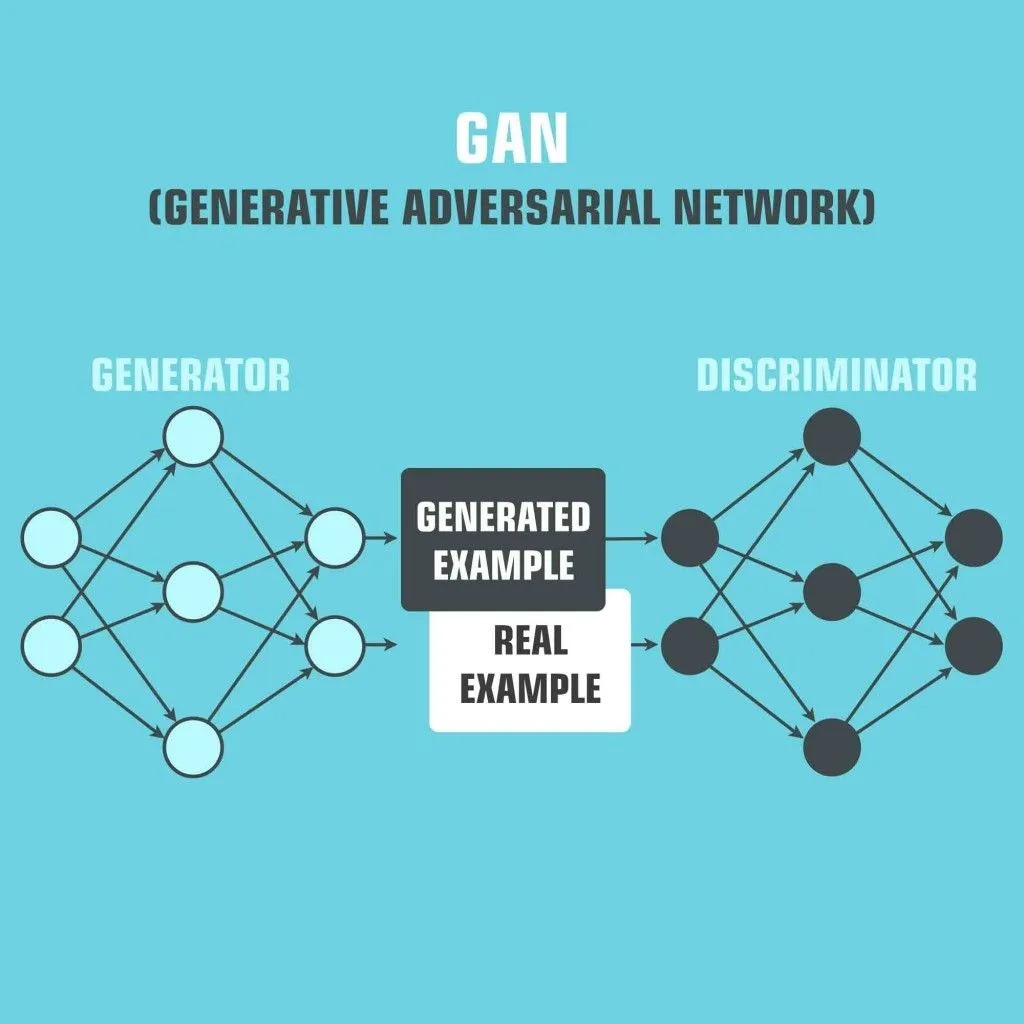
In GAN used for deepfake generation, two neural networks are pitted against each other to generate a realistic output. The purpose of doing so is to ensure that the deepfakes are created to look as real as possible. The essence of GAN lies in the rivalry between the two neural networks. In GAN, the picture forger and the forgery detector repeatedly attempt to outsmart one another. Both the neural networks are trained using the same data set.
The first net is called the generator, whose job it is to generate a forged image using noise vectors (a list of random numbers) that look as realistic as possible. The second net, called the discriminator, determines the veracity of the generated images. It compares the forged image generated by the generator with the genuine images in the data set to determine which images are real and which are fake. On the basis of those results, the generator varies the parameter for generating images. This cycle goes on until the discriminator fails to ascertain that a generated image is bogus, which is then used in the final output. This is why deepfakes look so eerily real.
GANs were the workhorse of deepfakery for years, but the field has since moved on. Since around 2022, diffusion models (the same family of AI that powers image generators like Stable Diffusion and Midjourney) have largely overtaken GANs for synthetic media. Instead of pitting two networks against each other, a diffusion model learns to start from pure visual "noise" and gradually denoise it, step by step, into a coherent image or video frame that matches a text prompt. The results tend to be sharper and more controllable than what GANs produced, which is precisely why they are harder to spot.
The most striking leap has been in text-to-video. In 2024, OpenAI released Sora, a system that turns a sentence of text into a photorealistic video clip with no source footage required at all. Tools like this, alongside cheap consumer face-swapping apps, mean that producing a convincing fake no longer demands a skilled programmer or a large image library. That accessibility is the real shift since deepfakes first appeared.
Detecting Deepfake Videos
Forensic experts across the globe are toiling hard to come up with ways and tools to identify deepfakes, as they are becoming more and more convincing every day.
For example, consider this deepfake demonstration video of Barack Obama released by BuzzFeed in 2018 (with comedian Jordan Peele voicing the fake), which stupefied viewers across the globe. You can check it out here:
As machine-learning tools are reaching the masses, it has become much easier to create convincing fake videos that could be used to disseminate propaganda-driven news or to simply harass a targeted individual.
The US Defense Department (DARPA) has released a tool for detecting deepfakes called Media Forensics. Originally, the program was developed to automate existing forensic tools, but with the rise of deepfakes, they have used AI to counter AI-driven deepfakes. Let’s see how it works.
The resultant video generated using deepfake technically has discernible differences in the way the video’s metadata is distributed, as compared to the original one. These differences are referred to as glimpses in matrix, which is what DARPA’s deepfake detection tool tries to leverage when detecting deepfake media.
Siwei Lyu, a computer science professor then at the State University of New York, noted that early faces created using deepfake technology seldom blinked, and when they did, it looked unnatural. He reasoned that this was because most deepfake videos were trained using still photographs, which are generally taken with the subject's eyes open. Besides eye blinking, other data points on facial movements, such as how the upper lip is raised while speaking or how the head is shaken, can also offer clues as to whether the streamed video is fake.
It is worth stressing, though, that this is a cat-and-mouse game. Once researchers published the eye-blink tell, the next generation of deepfake software simply learned to blink convincingly. Many of the giveaways that worked a few years ago (stiff blinking, mismatched lighting, smeared edges around the hairline) have steadily been ironed out, so detectors now lean more on subtle artifacts in pixels, compression, and physiology than on any single obvious flaw.
Deepfake Audio
The power of artificial intelligence and neural networks isn’t just limited to text, pictures, and video. They can clone a person’s voice with the same ease. All that is required is a data set of the audio recording of a person whose voice needs to be emulated. Deepfake algorithms will learn from that data set and becomes empowered to recreate the prosody of a targeted person’s speech.
Early commercial voice-cloning tools like Lyrebird (later folded into Descript) and Baidu's Deep Voice needed you to speak only a few sentences before the AI grew accustomed to your voice and intonation. As you fed in more audio of yourself, the software became powerful enough to clone your voice. Today's services, such as ElevenLabs, have pushed this even further: a usable clone can be built from a few seconds of audio, and the cloned voice can then read out any text you type in your own intonation. Crucially, the source audio no longer has to be willingly provided; a short clip scraped from a phone call, podcast, or social media video is often enough.
Detecting Deepfake Audio
Dedicated audio-deepfake detectors were scarce when voice cloning first took off, but the field has caught up fast, spurred by high-profile abuses like the fake Biden robocall. A growing roster of developers and cybersecurity companies now offer tools to flag synthetic speech.
For example, developers at tech startup Resemble built an open-source tool called Resemblyzer for the detection of deepfake audio clips. Resemblyzer uses advanced machine-learning algorithms for deriving computation representations of voice samples to predict whether they are real or fake. Whenever a user submits an audio file for evaluation, it generates a mathematical representation summarizing the unique characteristics of the submitted voice sample. Through this conversion, it becomes possible for the machine to detect whether the voice is real or artificially produced by deepfake tools.
The Road Ahead With Deepfakes
An early investigation by Deeptrace labs in 2019 found 14,678 deepfake videos lurking online, a jump of 84% in just seven months. Tellingly, 96% of them were pornographic, and every one of those clips face-swapped a woman without her consent. That number has only grown as the tools have become cheaper and easier to use.
The harms have since spilled well beyond pornography into fraud and political manipulation. In January 2024, voters in New Hampshire received robocalls carrying an AI-cloned voice of then-President Joe Biden, urging them not to vote in the primary; the US Federal Communications Commission later fined the operative behind them $6 million. A few months later, an engineering firm employee in Hong Kong was tricked into wiring out roughly $25 million after joining a video call on which the "chief financial officer" and several colleagues were all deepfakes. And non-consensual intimate imagery (the use Deeptrace flagged back in 2019) remains the single most common abuse, now generated in seconds by apps anyone can download.
Lawmakers have begun to respond. In May 2025, the United States enacted the TAKE IT DOWN Act, which criminalizes publishing non-consensual intimate images, including deepfakes, and requires online platforms to remove them within 48 hours of a victim's request. In the European Union, the AI Act goes further on disclosure: from August 2026, anyone deploying an AI system that produces deepfake image, audio, or video content must clearly label it as artificially generated.
As deepfakes get serious traction, they pose a serious problem of intruding not just on the privacy, but also on the dignity of individuals. Ironically, to counter AI-powered deepfakes, artificial intelligence itself is being used. Although a ‘good’ AI is helping to identify deepfakes, this detection system relies highly upon the dataset it consumes for training. This means they can work well to detect deepfake videos of celebrities, as a vast amount of data is available about them. But to detect the deepfake of a person who has a low profile would be challenging for such detection systems.
Social media tech giants are working on deepfake detection and labeling systems as well. Meta (the company behind Facebook and Instagram) has built automated systems to detect manipulated media and now labels AI-generated content, while X (formerly Twitter) leans on user-driven Community Notes to flag misleading deepfakes. Many AI image and video tools have also started embedding invisible watermarks and content credentials so that synthetic media can be traced back to its source.
Although we acknowledge and appreciate these efforts by tech companies and lawmakers, only time will tell how successful they are at keeping malicious deepfakes at bay!
References (click to expand)
- Deepfake | Meaning, AI, Technology, Uses, & Detection. Encyclopaedia Britannica.
- Solaiman, I., Brundage, M., Clark, J., Askell, A., Herbert-Voss, A., Wu, J., … Wang, J. (2019). Release Strategies and the Social Impacts of Language Models (Version 2). arXiv.
- Politically linked deepfake LinkedIn profile sparks spy fears .... The Register
- Computer Science and Telecommunications Board, Intelligence Community Studies Board, Division on Engineering and Physical Sciences, & National Academies of Sciences, Engineering, and Medicine. (2019). Implications of Artificial Intelligence for Cybersecurity. (A. Johnson & E. Grumbling, Eds.), []. National Academies Press.
- CorentinJ/Real-Time-Voice-Cloning - GitHub. GitHub, Inc.
- The State of Deepfakes: Landscape, Threats, and Impact (2019). Deeptrace.
- Steve Kramer Instigated Illegal Spoofed Robocall Campaign Using AI-Generated Voice. Federal Communications Commission.
- Arup revealed as victim of $25 million deepfake scam involving Hong Kong employee. CNN Business.
- S.146 - TAKE IT DOWN Act, 119th Congress (2025-2026). Congress.gov, Library of Congress.
- Article 50: Transparency Obligations for Providers and Deployers of Certain AI Systems. EU Artificial Intelligence Act.