Table of Contents (click to expand)
Not in the sci-fi sense, but they are getting close. A mind-reading computer at the University of Washington decoded what people were seeing with 96% accuracy, within 20 milliseconds. Newer brain-computer interfaces can turn a paralyzed person’s neural signals into text or speech, and one non-invasive decoder reconstructs the gist of imagined sentences. All of them, for now, need your cooperation to work.
If we consider the machines of today, they already kind of have algorithms to read your mind. Think of YouTube, for example. It remembers your choices and preferences and recommends similar videos that it predicts you will like. However, this cannot be correctly interpreted as reading your mind. What I mean by actually “reading your mind” is the computer interpreting your thoughts even before you can vocalize it aloud. The question, therefore, is do machines have the ability to decipher human thought?
The answer is… not yet. But the future of mind-reading devices seems terrifyingly close.
Past Research
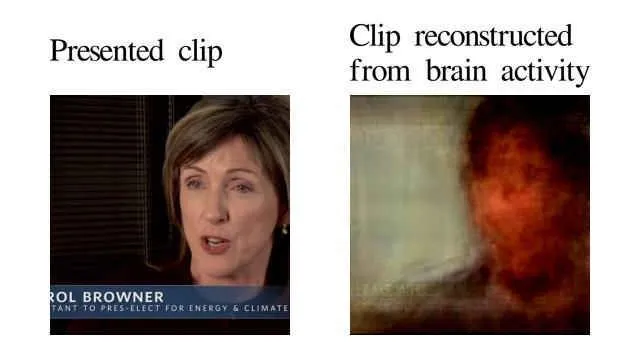
Recently, a lot of research is being done in this field. In 2011, scientists at the University of California, Berkeley studied the brain waves of people watching movie clips. Then, just by studying those brainwaves, they could translate and reconstruct those same movie clips! Sure, they weren’t in the best resolution, but the brain perceives what the brain perceives. Who are we to question it?
In 2014, another research study was conducted. This time, two scientists attempted to send thoughts to each other using a brain-to-brain link. Researchers in India made one person think ‘Hola’ and ‘Ciao’, while his brain recordings were studied and sent to France. There, a machine converted it into a brain stimulation that was perceived as flashes of light by another person. From just the flashes, the French person could identify the greeting!
New Research
A new computer program can now decode a person’s thoughts in almost real time! Researchers achieved this feat by studying electric signals coming from electrodes implanted in the brain.
The only problem with conducting this experiment is that to implant electrodes, you have to split the skull open.

However, fortunately for scientists, there were plenty of people waiting around in hospitals with their skulls already open! Patients with severe epilepsy are sometimes offered a treatment that involves putting a sheet of electrodes all over their brain, so that the next time they begin to suffer a seizure, the doctors can analyze which part of the brain is becoming overheated and then focus their attention on only that part of the brain. Given that epileptic patients can get seizures anytime, they usually hang around waiting in the hospital with their skulls invitingly split open for neuroscientists to investigate.

With the consent of 7 such epileptic patients, Rajesh Rao, a neuroscientist from the University of Washington in Seattle, implanted additional electrodes over the temporal lobes of the patients’ brains (the temporal lobe is the part of the brain that helps recognize objects and faces). Rao and his colleagues then showed these participants a computer screen on which several images flickered by, such as pictures of faces and houses, even an upside-down house.
The electrodes were hooked up to a powerful computer that analyzed the different parts of the brain that lit up in response to different pictures. For the first two-thirds of the exercise, the program was silently watching and studying the brain processes. For the last one-third, however, it started predicting the responses (with 96% accuracy!) all within 20 milliseconds of the instant the participant looked at the image!

And things have moved fast since then. In 2023, researchers at the University of California, San Francisco wired a paper-thin sheet of electrodes onto the brain of a woman who had been unable to speak since a stroke, and an AI model turned her brain activity into text and into a talking on-screen avatar at roughly 78 words per minute. The same year, a team at the University of Texas at Austin pulled off something even spookier: a decoder that uses an fMRI scanner (no surgery, no open skull) to reconstruct the gist of what a person is hearing, or even just imagining, as a flowing stream of text. It does not catch your exact words, but it gets the idea. The catch, reassuringly, is that the decoder has to be trained on your brain first, and it only works if you are actively cooperating. Think distracting thoughts and it falls apart.
Uses
Imagine the different uses for this kind of computer! It would definitely help those people who have trouble communicating for various reasons, such as ALS patients. Also, it would be a boon for those who suffer from strokes, allowing them to communicate with other people again (which, as the UCSF avatar shows, is no longer just a thought experiment). Imagine how much easier Stephen Hawking’s life might have been during the decades he relied on a single twitching cheek muscle to type out his words! Think of all the various theoretical applications as well! We could finally fully understand the human body while it is experiencing a coma. We could literally map out thought patterns, bringing us one step closer to achieving artificial intelligence.

Of course, not everyone is on board with such mind-reading technology. Some people believe that it could lead to dystopian situations, the ultimate breach of privacy. It’s true…. this could be a terrible weapon in the wrong hands. However, it is too soon to foresee any kind of future for this tech. For now, it’s just inarguably and downright cool!
References (click to expand)
- Scientists use brain imaging to reveal the movies in our mind. The University of California, Berkeley
- Spontaneous Decoding of the Timing and Content of Human Object Perception from Cortical Surface Recordings. PLOS Computational Biology
- Conscious Brain-to-Brain Communication in Humans Using Non-Invasive Technologies. PLOS ONE (PMC)
- Brain activity decoder can reveal stories in people's minds. The University of Texas at Austin
- A high-performance neuroprosthesis for speech decoding and avatar control. Nature