Rifling is the set of helical grooves machined into the inside of a gun barrel. As the bullet travels down the bore, the grooves spin it about its long axis; the spinning bullet then has gyroscopic stability that resists tumbling in flight, giving the firearm dramatically more range and accuracy than a smoothbore barrel.
Back when firearms were first introduced into the theater of warfare, combatants were content with the fact that they had a weapon in their hands that discharged small objects which could hurt (or at least maim or severely injure) their opponents from a few dozen yards. Early smoothbore muskets were notoriously slow to reload, prone to jamming, and inaccurate beyond about a hundred yards.

However, the most vexing aspect of those guns was their range. Combatants had to stand quite close to the enemy to be able to take an “effective” shot, which, as you can imagine, was not ideal in the midst of a battle. In order to fix that, two changes were made: one in the design of the bullet and the other in the barrel of the smoothbore guns.
A bullet has an inherently aerodynamic design; it’s basically a cylinder with a somewhat pointy top. Such a design makes a bullet’s trajectory smoother and more stable as it sails through the air.
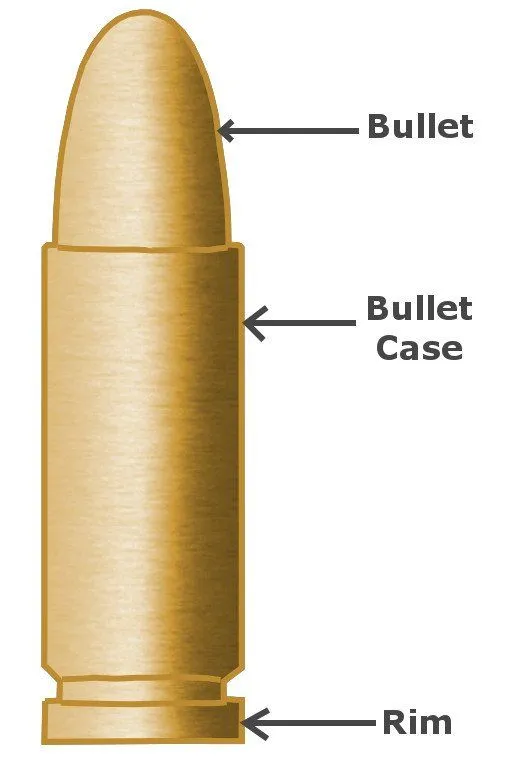
However, for longer range and accuracy, a better design won’t help much, unless it’s supplemented by some physical force, such as angular momentum, which is imparted to the bullet by rifling.
What Is Rifling?
Most modern firearms (pistols, rifles, machine guns, and many artillery pieces) have a series of helical grooves cut into the internal surface of their barrel (the bore). That pattern is what is called rifling. If you look down the barrel of one of these guns and observe closely, you will see the grooves engraved on the inside. Some older or specialised cannons are rifled too, although the main guns on nearly all modern main battle tanks (such as the 120 mm Rheinmetall on the Leopard 2 and the M256 on the M1 Abrams) are actually smoothbore, because their armour-piercing rounds are stabilised by fins rather than spin.

What Is The Purpose Of Rifling In A Gun?
Rifling imparts spin to the bullet along the latter’s lengthwise axis. This helps the bullet maintain a stable trajectory when it leaves the gun and enhances both the range and target accuracy of the gun. That’s the short answer.
But how does spinning the bullet help improve its stability during flight?
Two words – angular momentum.
Angular momentum, in essence, is the ‘quantity’ of rotation in a body. Just as a body moving linearly (i.e., along a straight line) has linear momentum, a rotating body has angular momentum.
The best example of angular momentum in action is a spinning top.
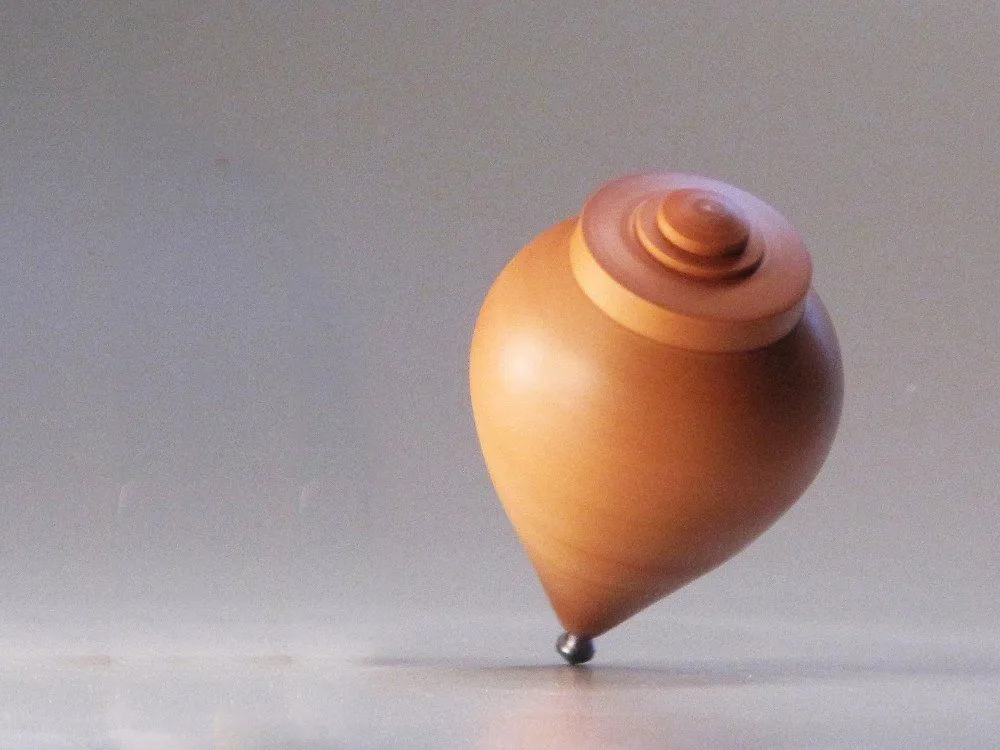
You have likely noticed that a spinning top, especially a fast-moving one, doesn’t fall over easily, even when you give it a little nudge. The only change that you may notice after nudging a spinning top is that it starts describing a little circle with its tip. This is called precessing.
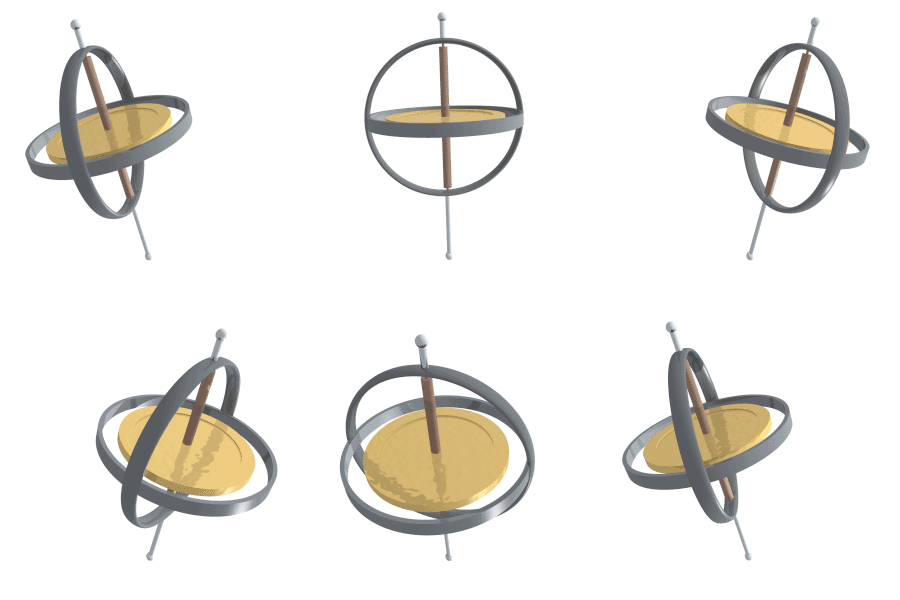
The technical term for what is keeping the bullet from cartwheeling end over end is gyroscopic stability: the bullet’s angular momentum resists the aerodynamic torques that would otherwise tip it sideways. The small conical wobble you sometimes hear called “precession” is actually a side-effect of this gyroscopic behaviour, not the stabilising mechanism itself. Had there been no rifling in the gun (as was the case in primitive smoothbore muskets), the fired bullet would not spin, and would consequently “tumble out” of its course pretty soon after emerging from the muzzle.
Most modern bullets have a soft lead core wrapped in a harder copper or copper-alloy jacket (the “full metal jacket” or FMJ design, plus jacketed hollow-points, soft-points and similar variants). The jacket is still softer than the steel of the barrel, so the rifling engraves itself into the bullet, but it is hard enough to stop the lead from smearing inside the bore.
When the round is fired, a huge amount of chamber pressure builds up: handgun cartridges peak at roughly 21,000-35,000 psi (about 145-240 MPa, with .45 ACP near the lower end and 9 mm Luger near the upper end per SAAMI standards), while modern rifle rounds run much higher, with 5.56×45 mm NATO around 55,000 psi (379 MPa) and .308 Winchester around 62,000 psi (427 MPa). The bullet is sized slightly larger than the bore’s land-to-land diameter, so as it is forced down the barrel, the raised lands cut into its jacket. That is what imparts the spin: the bullet has to follow the helical grooves, and the only way it can do that is by rotating rapidly about its long axis as it travels down the barrel.
In this way, a small structural change in the design of the barrel of guns made a massive impact on their range and performance that we still see to this day!
A Brief History Of Rifling
Rifled barrels were not always the norm. The earliest known rifled barrels appeared in late-15th-century Europe; Augsburg gunsmiths around 1498 and, a little later, Nuremberg’s August Kotter (circa 1520) are usually credited with the first true spiral grooves. For more than three centuries after that, though, rifling stayed a niche feature of expensive hunting and target weapons, because rifled muskets were slow and awkward to load.
The decisive military breakthrough was the Minié ball, introduced by the French army captain Claude-Étienne Minié in 1849. The Minié ball was a soft-lead bullet with a hollow base that expanded into the rifling under the pressure of the propellant; suddenly a soldier could drop an undersized round down a rifled muzzle as easily as a smoothbore ball, but still get full rifling engagement on firing. Within a few years, rifled muskets had extended infantry lethal range from around 100 yards (~90 m) to around 300 yards (~275 m), with grim consequences in the Crimean and American Civil Wars.
Conventional Rifling vs. Polygonal Rifling
Not all rifling looks like the M75 cannon picture above. Many modern handguns from Glock, Heckler & Koch, CZ, Kahr, and Walther use polygonal rifling, in which the bore is formed into a smooth, many-sided polygon (typically hexagonal or octagonal) instead of sharply defined lands and grooves. Polygonal rifling gives a slightly tighter gas seal, marginally higher muzzle velocities, less bullet deformation, and longer barrel life. The trade-off is that most manufacturers recommend against shooting unjacketed lead bullets through polygonal barrels, since lead fouling builds up faster in the shallower bore profile.
Whichever profile is used, the question of how fast the bullet should spin is settled by a quick rule of thumb that ballistic engineers still teach. In 1879, British mathematician Sir Alfred George Greenhill published an approximation for the ideal twist rate: twist (in inches per turn) ≈ 150 × D2 / L, where D is the bullet diameter and L its length in inches (the constant rises to about 180 for velocities above 2,800 ft/s). Modern ballistic software has since produced better formulas (the Miller stability formula is the current standard), but Greenhill’s rule, almost 150 years old, still gives a usable first answer.
How Is Rifling Cut Into A Gun Barrel?
Carving a precise spiral into a tube of hardened steel is no small feat, and gunmakers have devised several ways to do it. Cut rifling is the oldest; for more than 400 years, each groove was carved one at a time by dragging a single-bladed, hook-shaped cutter down the cold bore, shaving off a sliver of metal on every pass and then indexing across to the next groove. It is slow and unsuited to mass production, but the control it offers is so fine that it remains the go-to method for match-grade and sniper barrels.

Broach rifling speeds things up by mounting a row of progressively taller cutting teeth on a single bar; as the broach is pulled through, every groove is cut at once in one pass, each tooth biting slightly deeper than the one ahead of it. Button rifling does away with cutting altogether. A bullet-shaped tungsten-carbide “button”, engraved with the mirror image of the rifling, is forced through the bore so that it squeezes the grooves into the steel by displacement rather than by removing metal. It is fast, leaves a glassy bore finish, and holds more bench-rest accuracy records than any other method.
Finally, hammer forging works from the outside in. A mandrel bearing the negative of the rifling is slid into an oversized blank, and banks of radially opposed hammers pound the tube down onto it, simultaneously forming the bore, the rifling, and sometimes even the chamber and outer profile in a single operation. The cold working leaves the steel exceptionally strong, which is why it is a favourite for high-volume hunting rifles and pistols.
How Does Rifling Help Solve Crimes?
Rifling does more than steady a bullet in flight; it also leaves a calling card. As a bullet is squeezed past the lands and grooves, those raised and recessed surfaces scrape a pattern of fine parallel scratches, called striations, into the soft jacket. Because the cutting tools, polishing, and ordinary wear leave every barrel riddled with its own microscopic imperfections, no two barrels engrave quite the same pattern. In effect, a rifled barrel gives each bullet it fires a fingerprint.

Forensic firearm examiners sort these marks into two groups. Class characteristics, such as the calibre, the number and width of the lands and grooves, and the direction of the twist, narrow a bullet down to a family of weapons; most barrels twist to the right, though some makers, famously Colt, cut a left-hand twist. Individual characteristics, the unique striations, can tie a single recovered bullet to one specific barrel.
To make the comparison, an examiner test-fires the suspect weapon, often into a long water tank that stops the bullet without marring its surface, then lines up the test round against the crime-scene bullet under a comparison microscope and looks for “sufficient agreement” between the two sets of striations. Since 1997, the United States has also run a national database operated by the Bureau of Alcohol, Tobacco, Firearms and Explosives, the National Integrated Ballistic Information Network (NIBIN), which uses the Integrated Ballistic Identification System (IBIS) platform to scan digital images of fired bullets and cartridge cases and flag possible matches across thousands of unsolved cases. It is the same painstaking logic that lets science turn a crime scene into evidence.
References (click to expand)
- Sidra I. Silton, Paul Weinacht - Effect Of Rifling Grooves On The Performance Of Small-Caliber Ammunition - CiteSeerX
- No. 2273: Rifling - University of Houston. The University of Houston
- Class Characteristics, Individual Characteristics, & Sub-Class .... Academia.edu
- Physics of Guns - Home. The University of Alaska Fairbanks
- (1944) The Rifling Meter. Northwestern University Pritzker School of Law
- FIREARMS DEFINITIONS. The Tennessee Supreme Court
- Claude-Étienne Minié. Encyclopædia Britannica.
- ANSI/SAAMI Z299.4 - Voluntary Industry Performance Standards for Pressure and Velocity of Centerfire Rifle Sporting Ammunition. SAAMI.
- Boatright, J. (2012). A Coning Theory of Bullet Motions. arXiv:1205.2071.
- NRA Family: Gun Barrels - How Does Rifling Work?
- Popular Rifling Types: Advantages & Disadvantages. American Rifleman.
- Forensic firearm examination. Wikipedia.
- How can a bullet be traced to a particular gun? Scientific American.