If your gun is well-maintained, relatively new, and not used often enough for wear and tear to affect its safety mechanisms, there is almost no chance of the gun accidentally firing if it is dropped.
Gun safety is critical because guns are heavy, make people nervous, and are quite bulky and awkward to carry. This leads to a high number of guns being dropped each year. This brings us to the question of the day: can a dropped gun go off?
Physics Of Firing A Gun
When you fire a bullet from a gun, a rather simple process takes place inside. The bullet consists of three parts: the primer, the propellant, and the bullet itself. Upon firing, the primer acts as a fuse, which then lights the propellant (the main accelerator for the bullet). The bullet itself is what rockets out of the barrel of the gun and does the majority of the damage.
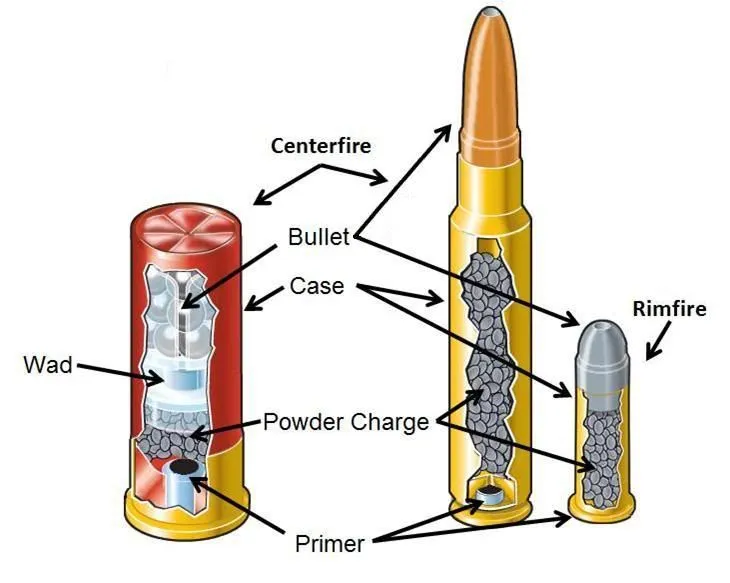
However, in order for a gun to go off, that first step must occur (the primer being ignited), which is where the metal firing pin comes in. A spring-loaded hammer pushes the firing pin into the back of the bullet when you pull the trigger, thus igniting the primer and firing the gun. When you ready the hammer on a gun, poised over a chamber containing a live bullet, you are one finger twitch away from discharging your weapon. So, if you never put your finger on the trigger, your gun is safe, right? Even if you drop it?
The Danger Of Accidental Discharges
The unintentional firing of a gun is known as an accidental discharge. This can occur due to mishandling, improper storage, damaged firearms, overheating, or dropping the gun.
Hollywood has portrayed this idea through comedic and tragic scenes, leading to the misconception that a dropped gun can go off. However, the reality is more complex than this portrayal.
Significance Of The Firing Pin Block
Firearm design, as in every other long-term industry, has evolved and improved over time, and when it comes to guns, a lot of that innovation has been focused on additional gun safety.
Back in the Wild West, it wasn’t uncommon for a cowboy to shoot himself through the holster, or drop his gun off the back of his horse and have it fire when it hit the ground. This is because the shoot-’em-up westerns of the past occurred before the advent of the drop-safety, or firing pin block.
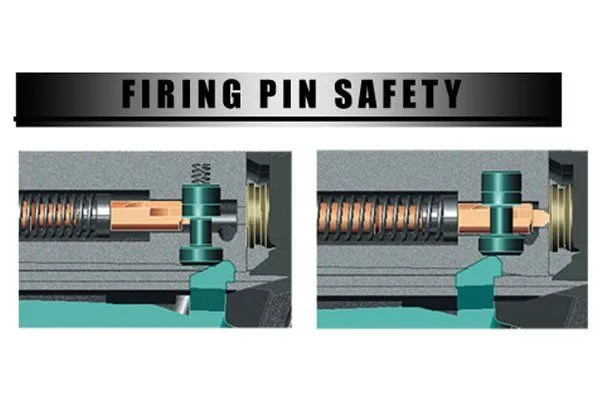
The vast majority of modern handguns come with this “safety”, which isolates the firing pin, not allowing it to slam into the primer, and thus preventing accidental discharges, even if the gun is dropped. A common myth is that federal law forces every American-made gun to pass a drop-safety test. It does not. Firearms and ammunition are actually exempted from the federal Consumer Product Safety Act, so there is no national design-safety standard for domestically produced guns. The widely used drop tests written by the Sporting Arms and Ammunition Manufacturers’ Institute (SAAMI) are voluntary. Mandatory drop testing exists only where individual states require it: California, for example, has refused to certify a handgun for sale since 2001 unless it passes a state drop-safety test, and a handful of other states and Washington, D.C. apply similar rules. The good news for the rest of the country is that modern manufacturers build to those test protocols anyway, because a gun that flunks a drop test is a lawsuit waiting to happen.
That being said, this isn’t true for all guns, particularly “long” guns, like rifles and others used for hunting or precision shooting. These long guns typically don’t have a safety, as their internal mechanism and design is slightly different. These guns do pose a risk of firing when dropped, particularly on the butt of the gun, as that impact can cause the firing pin’s inertia to move it forward, even if the hammer isn’t ready.
During World War II, there was a lack of understanding regarding drop safeties and proper gun safety measures. Even today, issues persist, such as the sear on a pistol wearing out over time, which is responsible for holding back the hammer. Modern revolvers are considered the safest type of gun in terms of accidental drops, as they have a slide bar between the hammer and firing pin.
In general, if your gun is well-maintained, relatively new (manufactured in the past 10-20 years), and not subject to frequent wear and tear that could compromise its safety mechanisms, the likelihood of it firing when dropped is extremely low.
However, if you’re handling authentic, worn-down Civil War-era weapons and have a known tendency to be clumsy, it’s important to exercise extra caution.
Can A Loose Bullet Go Off If You Drop It?
So far we’ve been talking about a loaded gun hitting the floor. But what about a single round of ammunition, sitting on a table or rolling out of a box? Plenty of people quietly worry that a dropped cartridge might explode like a tiny grenade. The reassuring answer is that, in everyday handling, it almost never happens.

Remember how the gun fires: the firing pin has to land a sharp, focused blow on the center of the primer. A cartridge tumbling onto the carpet rarely lands primer-first onto something hard and pointed, so the priming compound is almost never compressed the way it needs to be. SAAMI, the body that writes the industry’s ammunition standards, puts it plainly: cartridges “may ignite if the primer is struck when the cartridge is dropped, struck, or otherwise mishandled”. The operative word is the primer being struck, not the case merely landing on the ground.
Even in the rare event that a loose round does go off, it is far less dangerous than the same round fired from a gun. Without a chamber and barrel to contain the pressure, there is nothing to turn that burning powder into a high-speed bullet. As SAAMI explains, an individual cartridge “will burst if ignited outside the chamber of a firearm” and may fling “the primer and possibly the projectile and/or fragments of case material” a short distance. In open-burning tests the brass case, not the bullet, is the bigger hazard, and stray fragments were rarely found beyond about 12 to 15 meters (40 to 50 feet). The reason the bullet barely moves is the same physics behind the loud bang a gun makes when it fires: it’s the sealed barrel that lets pressure build and launch the projectile, and a loose cartridge simply doesn’t have one.
Can A Gun Go Off By Itself?
This is one of the most common questions people type into a search bar, often after a heart-stopping near-miss: can a gun just fire on its own, with nobody touching the trigger? A well-made, undamaged modern firearm with the safeties intact should not. The internal safeties we’ve described, the firing pin block in a pistol and the transfer bar in a revolver, exist precisely so that a jolt or a drop can’t drive the firing pin into the primer on its own.
The catch is the phrase “well-made and undamaged”. The most famous real-world exception in recent years involved the SIG Sauer P320, a hugely popular striker-fired pistol. In 2017, independent testers showed that some early P320s could fire when dropped at an angle onto the rear of the slide, because the trigger was heavy enough that inertia alone could release the striker. SIG launched a voluntary upgrade program to fix it, and the episode became a textbook lesson in why drop testing matters.

What about the safety catch? A manual safety is a genuine backstop, but it is a mechanical part, and worn or damaged ones can fail. That’s also why simply switching on the safety is not a substitute for keeping a finger off the trigger and the muzzle pointed somewhere safe. In short, a gun “going off by itself” is almost always traced back to a defect, heavy wear, or a finger or object that brushed the trigger unnoticed, not to spontaneous self-firing of a sound, modern firearm.
What Is A “Drop Gun”?
If you searched for “drop gun”, you may have been after something completely different from a dropped firearm. In crime fiction and true-crime reporting, a drop gun (also called a throwdown gun) is an untraceable, usually unregistered weapon that a corrupt officer or a criminal plants at a scene to manufacture false evidence, for instance, to make an unjustified shooting look like self-defense. It has nothing to do with whether a gun fires when you drop it, and everything to do with covering up a crime.
The idea shows up in real allegations, not just on screen. In one Miami-Dade lawsuit, for example, a family claimed a “throw-down” weapon had been placed at a shooting scene to support a self-defense story. Whatever the outcome of any individual case, the practice is plainly illegal, since it amounts to fabricating evidence and obstructing justice. We mention it here only because the phrase trips people up. The science of a dropped firearm and the slang of a planted one share three words and absolutely nothing else.
Last Updated By: Ashish Tiwari
References (click to expand)
- Heim, C., Schmidtbleicher, D., & Niebergall, E. (2006, September). The Risk of Involuntary Firearms Discharge. Human Factors: The Journal of the Human Factors and Ergonomics Society. SAGE Publications.
- The Importance of Firing Pin Impressions in the Identification ....
- Heim, C., Schmidtbleicher, D., & Niebergall, E. (2006, July 1). Towards an understanding of involuntary firearms discharges. Policing: An International Journal of Police Strategies & Management. Emerald.
- Recommendations for Safe Ammunition Storage and Handling. Sporting Arms and Ammunition Manufacturers’ Institute (SAAMI).
- Facts About Sporting Ammunition Fires. Sporting Arms and Ammunition Manufacturers’ Institute (SAAMI).
- Design Safety Standards. Giffords Law Center to Prevent Gun Violence.
- Gun Safety: How Passive Safety Systems Work. NRA Family.
- Lawsuit alleges new injuries from Sig Sauer P320 pistol that plaintiffs claim fires without trigger pull. New Hampshire Public Radio (NHPR).
- Family of Perrine Police-Shooting Victim Says Miami-Dade Cops Planted Gun at the Scene. Miami New Times.