Table of Contents (click to expand)
No, crows and ravens are not the same bird. They belong to the same genus, Corvus, but are separate species, so they share many traits while differing in key ways. Ravens are noticeably larger, croak instead of caw, and favor wilder, open country, while crows are smaller, caw, and thrive around people.
Apart from pigeons, crows might be one of the most successful birds alive today. Success, though, brings another problem—fame and recognition. Most of us would look at the photo below and identify it as a crow.
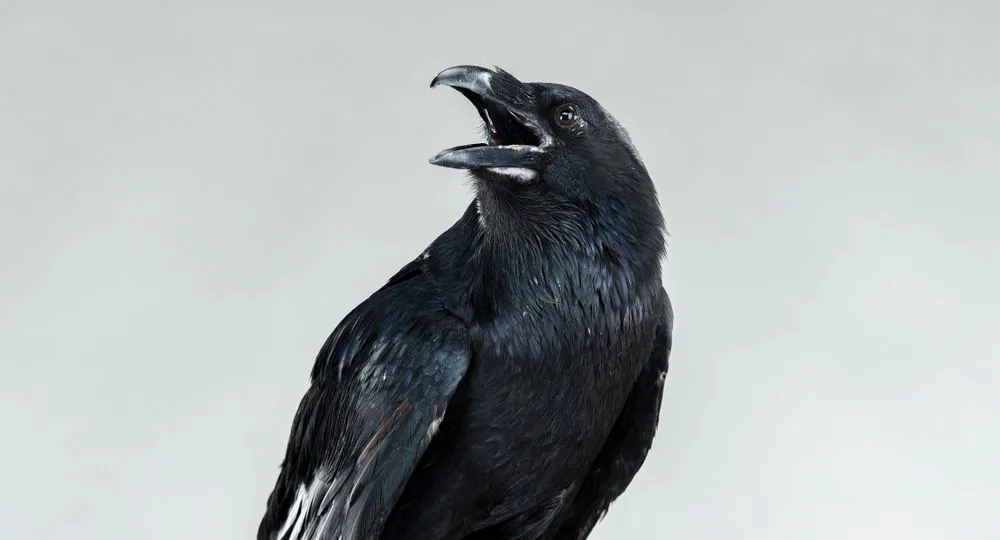
Most of us would also be surprised to know that we are wrong. The bird in the picture is actually a raven.
What’s the difference between a crow and a raven? Let’s find out!
Crow Vs. Raven
Crows and ravens suffer from the same problem that pigeons and doves face—a classic case of mistaken identity.
They are members of the same genus. Crows and ravens are both proud members of the Corvus genus, but they aren’t members of the same species. Corvus is a big genus, with around 45 species worldwide that we loosely call crows, ravens, and rooks (the smaller, sociable cousins are jackdaws, now usually placed in their own genus). As members of the same genus, crows and ravens share very similar attributes or characteristics. This also means that they’re placed very close to each other on the phylogenetic tree. Even so, crows and ravens are decidedly not the same bird.
The crow versus raven debate rages on quite intensely in North America. Much of this simply comes down to the fact that ravens and crows are the only two birds decked out in all black (from beak to tail) across the whole continent.
How Similar Are Crows And Ravens?
As mentioned before, crows and ravens are completely black. They both also possess shiny plumage. If you were to come across either bird on a sunny day, their bodies would glimmer in the sunlight.
They’re both also incredibly intelligent animals. A study in 2014 aimed to determine exactly how smart corvids (members of the larger Corvidae family) really are. Researchers at the UC Santa Barbara, USA and University of Auckland, New Zealand worked with New Caledonian crows. They found that these corvids could perform tasks nearly as well as seven- to ten-year-old human children. In essence, with just around five months of training, New Caledonian crows were able to perform alien tasks (based on water displacement) as well as, or sometimes even better than first graders.
Similarly, in Germany, at the Osnabrück University, researchers used a broad array of tasks to measure the intelligence of young ravens. According to Simone Pika, lead author of the study, young ravens were found to possess an incredible quantity of intelligence for their age. In her own words, Pika had the following to say to Scientific American about raven intelligence, “We now have very strong evidence to say that, at least in the tasks we used, ravens are very similar to great apes.”
Members of the Corvus genus have also been well-documented in their use of tools. They’ve been observed using tools like sticks or branches to reach into logs to pick out small bugs.
In fact, the idea that crows are clever tool-users is an old one. It goes back at least to the fable “The Crow and the Pitcher,” credited to the ancient Greek storyteller Aesop (who lived around 620–564 B.C.E.). In the tale, a thirsty crow drops pebbles into a pitcher one by one to raise the water level high enough to drink. For centuries this was just a story, but the water-displacement experiments above show that real corvids can pull off something remarkably close to it.
So, How Can We Tell The Two Apart?
Ravens are larger than crows. A typical crow runs about 43 to 53 cm (17 to 21 inches) from beak to tail, while a common raven stretches to roughly 56 to 69 cm (22 to 27 inches). Ravens are almost comparable to a few species of hawks in terms of size. They’re notably longer in length and have a greater wingspan than crows, with a raven’s wings spanning well over a meter (around 3 to 4 feet).
Another way to tell them apart is the shimmer in their feathers. Both birds get this iridescence the same way (from microscopic structures that scatter light, not from colored pigment), but the tints often differ. Crows tend toward a duller, greenish gloss, while ravens flash a glossier blue and purple in good light.
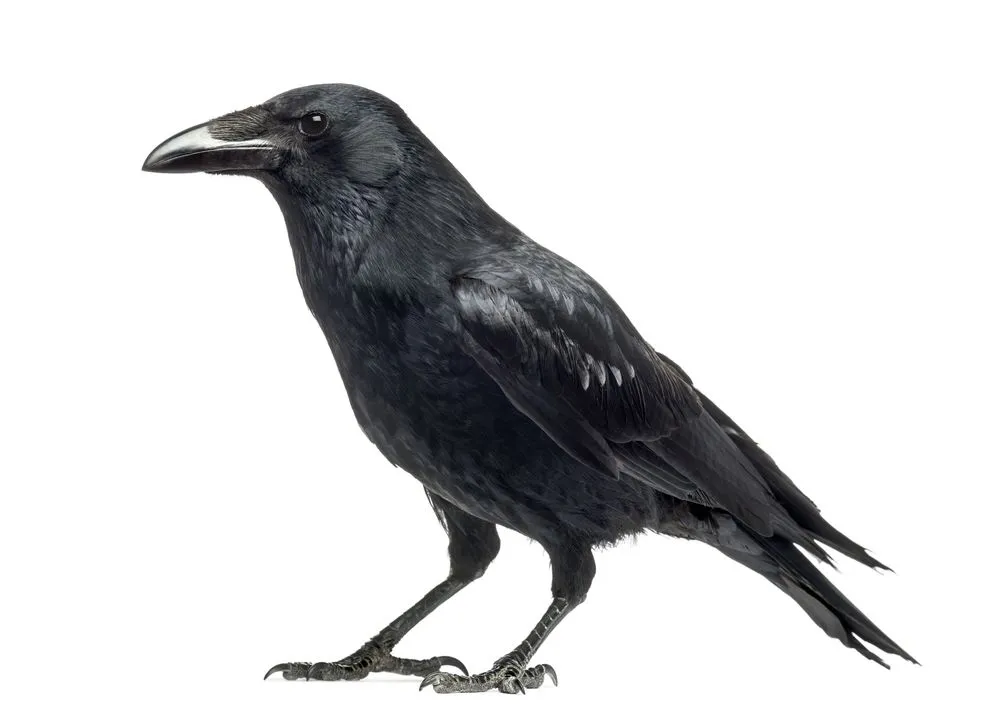
Although we can find both birds in cities and in the wild, each has its own quirky habitat preferences. Crows like living around human civilizations and are more social and outgoing in terms of their personalities. On the contrary, ravens prefer open spaces and can be more commonly found in wilder areas.
Surprisingly, one of the easiest ways to tell crows apart from ravens is not a visual cue at all. Instead, it’s auditory. Crows make a very distinct “caw-caw” call. It’s very hard to miss, mainly because it’s one of the first sounds we ever learn about (dogs bark, cows moo, crows caw, and so on). It’s always very high-pitched and screechy in nature. Ravens, on the other hand, are more hoarse. They don’t screech at all, but rather croak (yes, like frogs). They make a very characteristic and low-pitched “gronk-gronk” call.
Can Crows And Ravens Interbreed?
This is one of the most common follow-up questions, and the short answer is no, not in any normal sense. Because crows and ravens are separate species, they have different courtship displays, calls, and mate preferences, and these behavioral barriers keep them from pairing up in the wild. Confirmed crow-raven hybrids are essentially unheard of.
That said, “same genus” does leave the door cracked open. Different species within Corvus do occasionally hybridize where their ranges overlap. The classic example is the carrion crow and the hooded crow, which interbreed along a narrow band running across Europe from Scotland down through Germany and into Italy. So while a crow and a raven mating is vanishingly rare, closely related crows can and do blur the lines now and then.
Conclusion
Crows and ravens are two incredible, yet very different kinds of birds. So, next time you spot a black bird flying about in the sky, don’t automatically assume it’s a crow. Use a bit of that mighty human intelligence and give these corvids the respect they deserve by identifying them correctly!
References (click to expand)
- How To Tell the Difference Between a Crow and a Raven. coloradovirtuallibrary.org
- Smarter Than a First-Grader? | The UCSB Current. The University of California, Santa Barbara
- Young Ravens Rival Adult Chimps in a Big Test of General .... Scientific American
- Raven | Size & Facts - Encyclopedia Britannica. britannica.com
- Logan, C. J., Jelbert, S. A., Breen, A. J., Gray, R. D., & Taylor, A. H. (2014). Modifications to the Aesop's Fable Paradigm Change New Caledonian Crow Performances. PLoS ONE. Public Library of Science (PLoS).
- Crows and Ravens (Genus Corvus) - iNaturalist. T
- Pika, S., Sima, M. J., Blum, C. R., Herrmann, E., & Mundry, R. (2020, December 10). Ravens parallel great apes in physical and social cognitive skills. Scientific Reports. Springer Science and Business Media LLC.
- Poelstra, J. W., et al. (2014). The genomic landscape underlying phenotypic integrity in the face of gene flow in crows. Science. American Association for the Advancement of Science (AAAS).