Table of Contents (click to expand)
Pigeons don’t actually bob their heads at all. In a classic 1978 experiment by Barrie Frost, slow-motion footage revealed that walking pigeons thrust the head sharply forward and then hold it perfectly still (5–8 times per second) while the body catches up. The behaviour helps stabilize their vision and, as a 2021 study showed, supports motion-parallax depth perception.
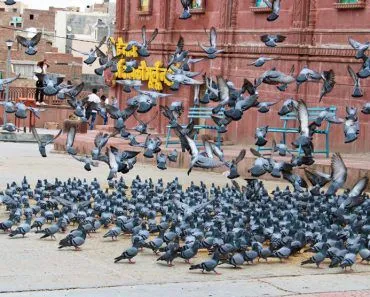
There are an estimated 400 million feral pigeons in the world today (though estimates vary widely depending on methodology), and most of them live in cities. Chances are high that you’ve come across one as well, in which case you know that they are pretty amusing animals.
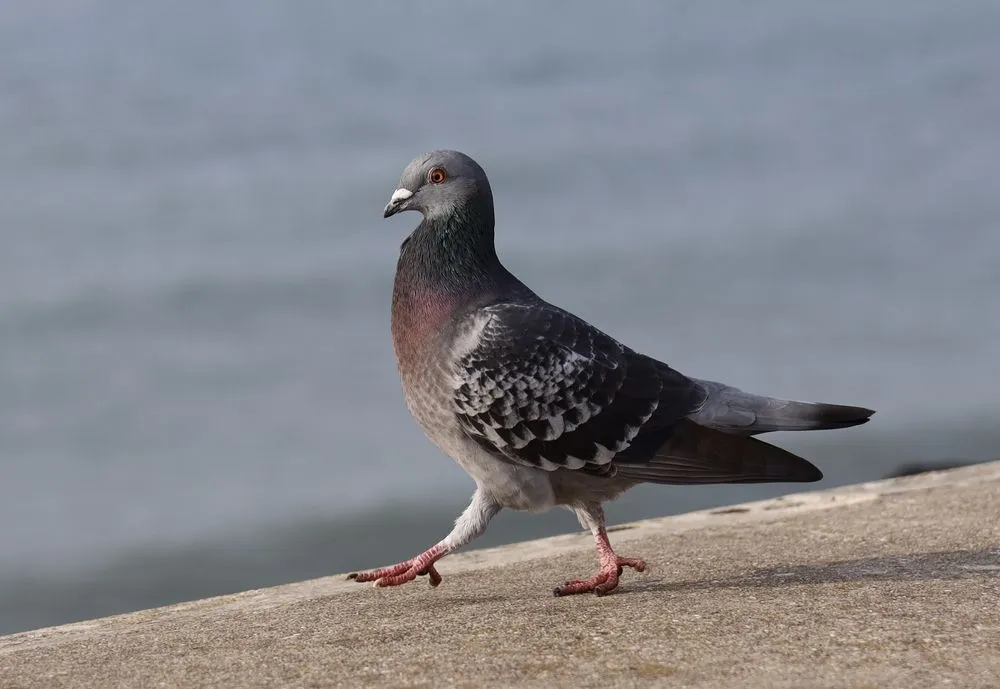
If you’ve ever observed a pigeon walking along the ground, you have surely noticed that they walk in a peculiar manner. As they walk, pigeons continuously (and comically) bob their heads back and forth. Not only that, but they also have a pretty wide stance for birds, along with disproportionately short legs. These combined factors seem to ensure that their gait will gain them no respect. In fact, they look pretty silly.
So, apart from looking incredibly silly, why exactly do pigeons bob their head while walking? Let’s find out!
A Way To See Better
Head bobbing isn’t just limited to pigeons. Many other birds, like crows and chickens, also seem to bob their heads in a similar fashion while they walk.
This behavior in birds has stumped scientists and ornithologists for a very long time. It was first systematically studied in 1978 by Barrie J. Frost, then a psychologist at Queen’s University in Kingston, Ontario, who constructed an elegant experiment to try and figure out why pigeons appear to bob their heads while they walked.
To run the experiment, Frost built a clear plexiglass enclosure containing a pigeon treadmill. The trick: when the bird walked on the treadmill but the visual surroundings stayed stationary, the head-bobbing stopped entirely — proving the behaviour is triggered by visual flow rather than leg motion.
Researchers would then observe as a pigeon continuously walked on the treadmill.
What Did They Find Out?
The researchers’ (hilarious) efforts were not in vain. They unearthed some pretty cool conclusions as to why pigeons bob their heads while they walk.
Their first conclusion was a very important one, namely that pigeons don’t actually bob their heads at all. They don’t even move their heads when they walk!
Seems a little confusing. After all, if you were to ask anyone in the world, including the researchers who conducted the study, if they had noticed that pigeons bob their heads while they walk, they would say yes.
So, the study must be wrong… right?
It seems highly improbable that everyone in the world is subject to the same visual error, but this is precisely what happens!
Researchers recorded all their observations so they could review them. When they reviewed the footage in slow-motion, they noticed something incredible. The dynamic movements making up a pigeon’s locomotion can actually be broken down into two distinct phases. They referred to these phases as the “thrust” and “hold” phases.
In the first phase, the “thrust” phase, the pigeons will push their heads forwards. Then, in the “hold” phase, pigeons move their bodies forward.
It’s at the “hold” phase where things get fuzzy. As pigeons terminate their “thrust” phase movements and initiate their “hold” phase movements, the pigeons’ bodies move forward, but they continue to hold their heads stationary.
In essence, pigeons are actually giving their bodies time to catch up, positionally, with their heads. They never actually move their heads backward… ever.
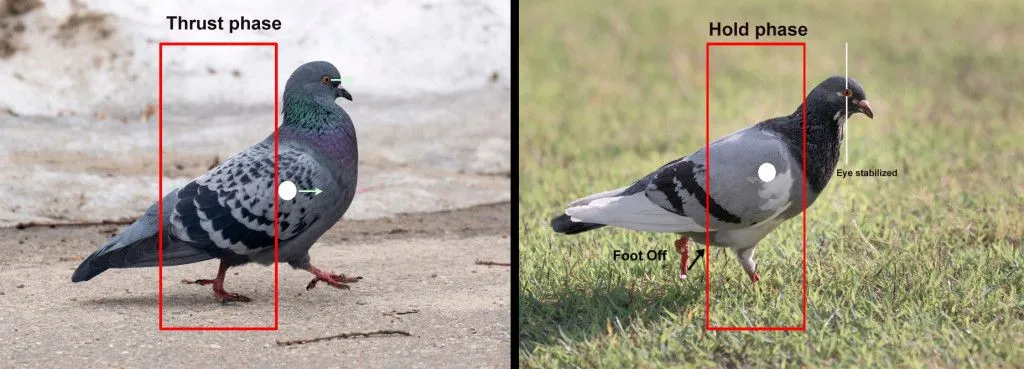
So, when we observe birds like pigeons walking around, what we actually fail to process visually is the combinations of movements that make up their gait. Pigeons will move their heads forward and then wait for their bodies to catch up, effectively doing the same “thrust” and “hold” phases of movement over and over again. However, humans don’t perceive these movements as individual phases. Rather, our brains instead process the visual cue as a “bob”
This is because the pace of a pigeon’s movements is incredibly fast. According to Aaron Blaisdell, a psychology professor at UCLA who directs the university’s Comparative Cognition Lab, pigeons “bob” their heads, on average, five to eight times per second as they walk. Blaisdell further noted, “That’s fast enough that our minds don’t process it as the actual event unfolds. Instead, it’s treated like a bob.”
Why Do Pigeons Bob Their Heads?
Researchers didn’t just find out that pigeons weren’t bobbing their heads; they also found out why pigeons walk in such a strange way.
Every animal in the world has their own way of processing the visual stimuli all around them. This is because, on a fundamental level, movement and vision simply don’t complement each other.
Think about it… when you’re taking a picture of something, you try to be as still as you possibly can. If you quiver (even a little), as you click your photo, all you end up with is a blurry image, without a clear focus or subject.
Animal eyes work the same way. Humans need to stabilize their positions in space to clearly process visual information; every moving animal in the world must come up with some method of visual stabilization to contend with this movement-vision mismatch. Pigeons, in turn, “bob” their heads to stabilize the world around them.
Conclusion
A few other birds do the same thing as pigeons. It’s tempting to generalize head-bobbing to all birds, but only a minority actually do it — around 21 of the 187 or so avian families studied, according to a 2007 review. What do those birds have in common? They’re usually ground-foragers and waders: chickens and other galliforms, doves, cranes, herons, coots, magpies and mynahs all spend a lot of time on the ground or in shallow water, walking around and scanning for their next meal.