Table of Contents (click to expand)
The main difference is size: rats are larger and heavier than mice, with stouter heads, blunter muzzles and proportionally smaller ears. They are also separate genera (Rattus versus Mus) that cannot interbreed, and they carry different chromosome numbers. The catch is that a young rat and an adult mouse can look almost identical.
One easily identifiable anatomical difference is the number of nipples each species has. Rats have six pairs of nipples, while house mice have five.
Amongst the more than 2,000 diverse species of rodents (rodents make up roughly 40% of all mammal species), rats and mice are the ones most commonly found in human dwellings. Owing to their almost indistinguishable resemblance, mice have become frequent victims of slander that is traditionally attributed to rats. Despite belonging to the same family of gnawers, rats and mice are actually very different species of animals.
The names ‘rat’ and ‘mouse’ aren’t scientific classifications, but merely common names to describe medium and small-sized species of rodents. Like humans and chimpanzees, both species are descendants of a common ancestor. However, the precise time the thick branch split into finer twigs is still under debate. Most estimates place the split between the rat and mouse lineages at roughly 10 to 14 million years ago.
The original rodents themselves trace back to early rodent-like animals called anagalids. These animals sit near the base of the group that gave rise to rabbits and hares too. Rats and mice followed humans everywhere in their conquests of colonization. They traveled along with explorers in carts and ships, gradually colonizing every speck of land on every continent in every climate.
Of course, even novices can enumerate the basic differences between them; rats are larger and heavier than mice, but young rats and adult mice are quite hard to tell apart. The difference between rats and mice might concern someone looking for a new pet or someone desperately looking to free his house from pesky gluttons munching on electric wires. That last habit is known to have grievous consequences; chomped wires are a common cause of house fires. However, complete eradication of these rodents is extremely difficult without professional help. So, what are some other characteristics that might help us differentiate between them?
The Differences
Genetic tests are obviously infallible when it comes to differentiating between two organisms. While both species are known to be fairly intelligent (rapid conditioning and learning of mazes renders them highly popular in labs), Norway rats have 21 pairs of chromosomes (a diploid number of 42), whereas house mice have 20 pairs (a diploid number of 40). These tests represent the most meticulous and optimum methods to classify them. That being said, most people don’t carry an expensive molecular microscope everywhere, nor do they know where to look.

Physical Differences
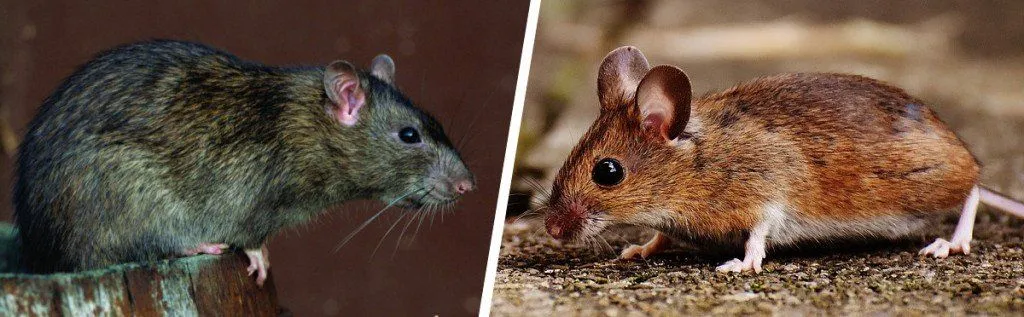
One easily identifiable anatomical difference is the number of nipples each species has. Rats have six pairs of nipples (twelve in total), while house mice have five pairs. Another conspicuous characteristic is their morphology; an adult Norway rat is heavier, typically weighing between 200 and 500 grams (7-18 oz), and is also longer, boasting 16-28 cm (6-11 inches) of body with a slightly shorter tail. House mice, on the other hand, usually weigh just 12 to 30 grams (under an ounce) and grow 7-10 cm (3-4 inches) of body, along with an equally sized tail.
Furthermore, a rat’s head is heavy and stout with a wide muzzle, whereas mice have smaller and converged, triangular heads with narrow and pointed muzzles. A rat’s tail is thick, and its ears are small relative to its head, whereas, mice have thinner tails and their ears are large in relation to their heads. These morphological differences are the reason why traps designed for mice do not necessarily work on rats.

In fact, catching rats is much more difficult than catching mice. Rats are creatures of habit who rarely try anything new; they are very cautious and despise new obstacles, which they try to avoid by any means possible. On the other hand, mice are curious animals who are easily lured and consequently duped into investigating new paths and potential traps. In view of their obnoxious and elusive behavior, it is no surprise that rats are one of the world’s absolute worst invaders.
Eating, Breeding And Other Differences
Both species eat just about anything, but while mice have an affinity for cereal grains and plants, rats find fresh grain and meat irresistible. However, unlike rats, mice do not burrow. Instead, they build their nests in hidden areas in the proximity of a food source. Being essentially gnawers, their teeth constantly grow. They regulate this growth by chewing on anything remotely chewable. Still, mice have weaker teeth, which forces them to retire to softer objects such as wires and wood. A rat’s teeth are so well-built, however, that they can gnaw through soft metals like aluminum and lead, and even work their way through cinder blocks and crumbling concrete!
Rats are excellent swimmers, which is why living in the sewers isn’t a big deal for them. Mice, however, are not only adept at swimming, but also jumping, climbing and sprinting. A mouse can give birth to around 5 dozen children each year, who subsequently attain their own fecundity after 6 weeks of their 9-12 month lifespan. Rats are just as prolific: a single female typically raises 5 or 6 litters of 6 to 12 pups a year, with the young reaching fecundity after about 3 months of their 12-18 month lifespan. For all their family resemblance, though, the two cannot interbreed. Rats and mice belong to separate genera (Rattus and Mus) with different chromosome counts, so a rat and a mouse simply cannot produce offspring together.
Both species are nocturnal, which means that they resent bright lights. Their gregariousness reaches its peak between dusk and dawn. They compensate for their poor vision with their tactile, olfactory and auditory acuity. However, aside from these trivial traits, the only difference that stands out is a few rats’ penchant for spices and culture. Even though only a handful of them illustrate this delightful eccentricity, don’t be surprised to find one preparing a delicious aligot in your nearest French restaurant right now.