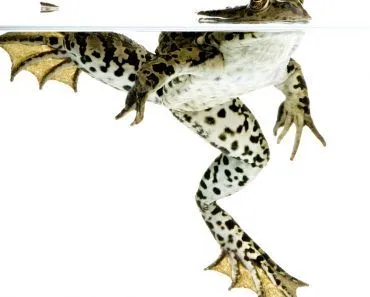
No — fish cannot survive in liquids other than water for any meaningful length of time. Their gills evolved to extract dissolved oxygen from water, and their cells are tuned to a very specific salinity, pH and density. Drop a fish into milk, cola, juice or tea and it suffocates from low dissolved oxygen, its cells either swell up or shrivel from the wrong osmotic balance, and the abnormal pH burns its delicate gill tissue. Death follows in minutes.
On those lazy afternoons staring numbly into your fish tank, wondering what mysteries are bouncing around in your aquatic pals’ heads, you may have occasionally longed for such a free-floating lifestyle. Fish are incredible creatures, able to survive underwater with the the help of many specialized adaptations. Those of you with a rudimentary understanding of fish know that they possess gills, like so many other marine creatures, which allow them to extract oxygen from the water in order to breathe.

This enviable position of fish may cause one to think… what would happen if I placed a fish in a different kind of liquid? Would it survive?
Before you launch into an at-home science experiment with your precious finned friends, you should know a few things about fish, water, gills and the delicate balance that allows fish to thrive in different parts of the world.
How Do Fish Breathe Underwater?
As you likely know, the water on our planet has a high level of dissolved oxygen within it; for those who don’t know, dissolved oxygen is the concentration of non-compound, free oxygen in a liquid. In water, these unattached oxygen molecules (O2) are not counted among the oxygen molecules bonded to hydrogen (H2O). This dissolved oxygen is therefore available to be used, if it can be separated from the H2O!
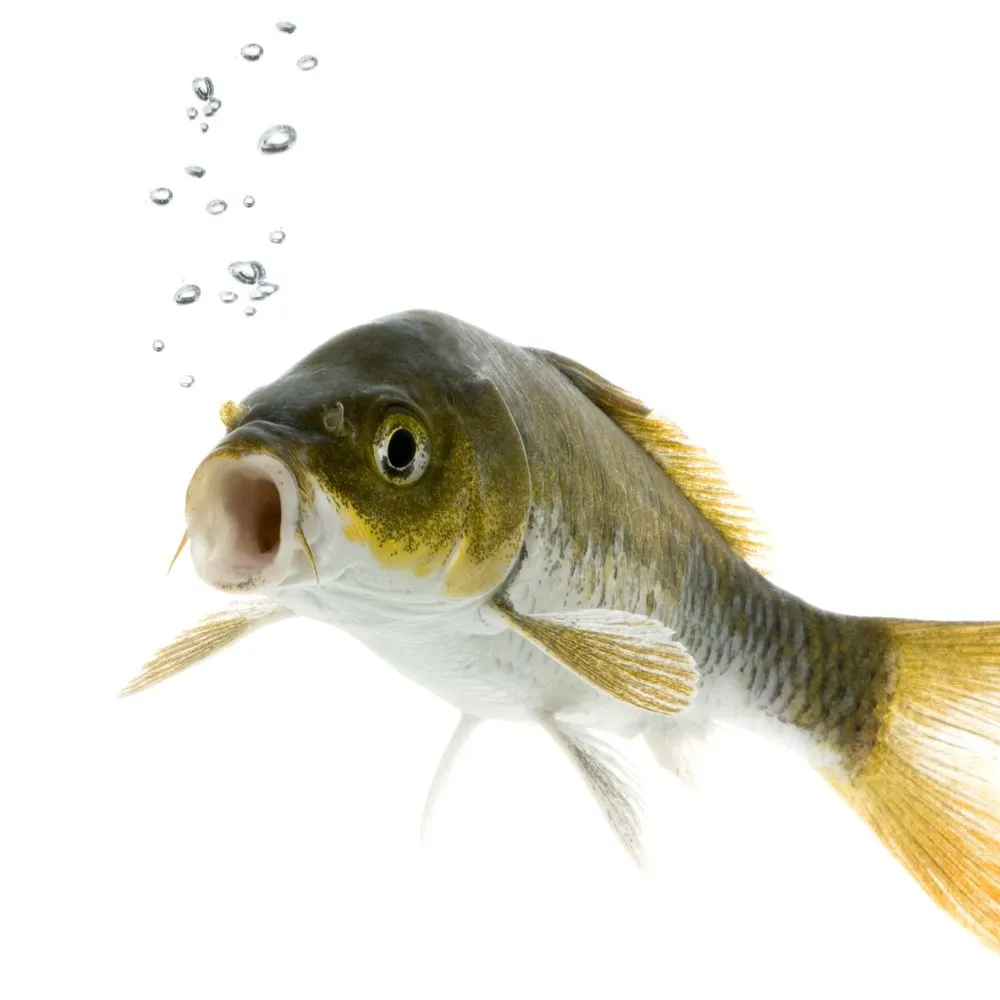
To overcome this issue and utilize the oxygen found in water, fish developed gills—feathery organs that are covered in blood vessels. When fish open their mouths and take in water, they then force that water back over their gills, where the dissolved oxygen is filtered and taken in through the thin blood vessel walls. This is how fish are able to respirate, as is the case for many different forms of marine life. This dissolved oxygen in the water is produced as a byproduct of photosynthesis from aquatic plants (e.g., algae and seaweed), but it also enters the water by slowly diffusing across the surface of the water from the air.
This sounds like a simple enough process, but it is also highly contingent on variables in the water, such as the salinity, which is why salt water fish cannot survive in fresh water, and vice versa. You can read about this in more detail in this article.
There are other factors that also must be considered, such as the density of the water , other solute concentrations, other dissolved gases and the pH balance of the water. There are more than 36,000 species of fish that have been described to date (FishBase, 2024), each of which is specially adapted to its respective ecosystem. The waters in these particular areas are optimal for their survival, a large part of which depends on their ability to breathe clean oxygen, avoid pollutants, and function normally in the liquid.
Why Can't Fish Breathe Air Out Of Water? (And The Fish That Can)
Here is the puzzle that trips up almost everyone: air holds far more oxygen than water does, yet lift a typical fish out of its tank and it suffocates within minutes. If a stranded goldfish is so desperate for oxygen, why can't it simply gulp it from the air, where there is so much more of it on offer?
The answer is in the architecture of the gills. Underwater, a fish's gill filaments and the thousands of tiny folds covering them (the lamellae) are held apart by the surrounding water, fanning out like the pages of an open book to expose an enormous surface area for absorbing dissolved oxygen. Lift the fish into air and that support disappears. The delicate lamellae collapse and stick together, the way a wet book's pages clump as they dry, so the surface area available for gas exchange all but vanishes. The moist membranes also dry out quickly, and oxygen cannot cross a dry surface into the blood. So even when surrounded by oxygen-rich air, the fish simply cannot use it, and it asphyxiates.

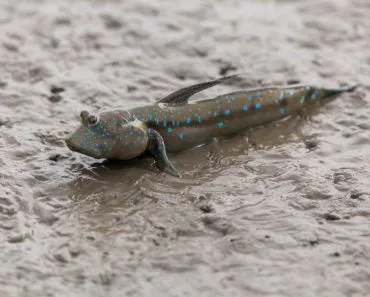
Not every fish is bound by this rule, though. Evolution has produced a surprising roster of air-breathers. Lungfish possess true lungs and gulp air at the surface; when their pool dries up, most species burrow into the mud and wait out the drought in a mucus cocoon for up to two years until the water returns. Labyrinth fish such as bettas and gouramis carry a maze-like structure above their gills (the labyrinth organ) that extracts oxygen from air swallowed at the surface, which is how they cope in the warm, stagnant, low-oxygen pools they often live in. Mudskippers spend much of their lives hopping around tidal mudflats, breathing through their skin and the moist lining of their mouth and throat, and can stay out of water for around three and a half days. The record holder is the mangrove rivulus, a tiny killifish that can survive roughly two months on land by breathing entirely through its skin. For these specialists, leaving the water is a feature, not a death sentence.
Fish Breathing In Other Liquids
While the most important aspect of breathing underwater is the oxygen content, this is not the only consideration. In some liquids, such as tea, a fish might find very similar levels of oxygen, as tea is largely composed of water. However, the other substances in the water—even on a molecular levels—would be foreign to the body of the fish, and the concentrations would be different than what their body was adapted to handle.
In a substance like Coca-Cola or orange juice, the solute concentrations would be extremely different than in water, and there would likely be less dissolved oxygen in these liquids, essentially suffocating the fish.
Fish are able to control their osmotic balance very well, but if they are suddenly put in an environment where the solute concentration is dramatically higher or lower than their typical ecosystem, their cells will either take in too much water, swelling to the point of bursting, or they will completely empty out, similarly leading to cell death. Furthermore, the pH of these liquids is significantly different from water, which would also be fatal.

In the case of milk, a popular suggestion for such a question, the water level is also quite high, but there would not be as much available dissolved oxygen, as there are many other molecules in milk—fat, protein, etc.—that would make it difficult to breathe.
Depending on the liquid, fish may be able to survive for varying amounts of time, and may even behave normally when returned to their water-filled tank. However, other liquids will quickly kill a fish as the result of suffocation or other unpleasant ends. There has been a dearth of formal research on this subject, but anecdotal evidence from at-home experiments and clear common knowledge about the needs for fish respiration suggest that the vast majority of fish would be unable to survive in liquids other than water for an extended period of time. Unless the liquid was tested, perfectly balanced and carefully manipulated to replicate pond, lake, stream, ocean or river water, it would have negative health effects on your fin-flapping companion.
Can A Fish Survive In Milk, And For How Long?
Of all the "what if" liquids people ask about, milk comes up the most, usually paired with a follow-up: how long would the fish last? The short answer is not long at all. A fish dropped into milk would survive for minutes, not hours, and it would not be a pleasant few minutes.
Milk looks deceptively water-like, but it is really an emulsion of water, fat, protein, sugar (lactose) and dissolved minerals. Three things go wrong at once. First, milk holds very little dissolved oxygen compared with a healthy aquarium, so the fish is effectively starved of breathable oxygen from the moment it goes in. Second, the fat and protein coat and clog the fine gill lamellae, gumming up the very surfaces that are supposed to absorb oxygen. Third, milk's mineral and salt content is nothing like the water the fish is adapted to, so osmosis drags its internal fluid balance out of equilibrium, stressing and damaging its cells. Swapping in chocolate milk only makes things worse, since the added sugar and cocoa solids lower the available oxygen further and thicken the liquid.
This is also why the common phrasing "can a fish drown in milk" is not quite right. The fish is not inhaling milk into lungs (it has none); it is suffocating because milk cannot supply oxygen the way water can, while its osmotic balance is wrecked at the same time. The outcome is identical either way: a milk bath is fatal, and fast.
Can Fish Drown?
This is the question that brings most people to a page like this, usually phrased bluntly: can a fish drown? Strictly speaking, no, not the way a person does. Drowning means inhaling fluid into air-breathing lungs, and a typical fish has gills, not lungs. But if you mean "can a fish die from a lack of oxygen while completely surrounded by water," then absolutely yes. Scientists call it asphyxiation, or hypoxia when the cause is low oxygen, and it kills fish all the time.

The usual culprit is a drop in dissolved oxygen. The U.S. Environmental Protection Agency defines hypoxia as dissolved oxygen falling below roughly 2 to 3 milligrams per litre, a level at which many fish begin to struggle and die. Oxygen crashes for a few reasons: warm water holds less dissolved gas than cool water, and when a bloom of algae dies, the bacteria that decompose it consume enormous amounts of oxygen. The result is a "dead zone" where the water looks perfectly normal but can no longer keep fish alive, which is exactly how many mass fish kills unfold.
A fish can also suffocate even when the water is rich in oxygen. Fast swimmers like tuna and mackerel are "ram ventilators" that have to keep moving to force water across their gills; hold one still so it cannot swim, and it suffocates. Gills physically clogged by silt, debris or spilled oil fail in much the same way. And the air-breathing fish we met earlier face the opposite trap: an obligate air-breather such as the blue gourami can suffocate in a well-oxygenated tank if a tight lid stops it from reaching the surface to gulp air. So while a fish cannot drown in the human sense, there are plenty of ways for one to run out of breath surrounded by water.
A Final Word
We have made some suggestions in this article about different liquids in which a fish could potentially survive for a limited time. However, we in no way condone this type of at-home testing, as we don’t advocate for injury to or informal experimentation on animals/pets. This is more of a thought experiment than a practical one, and a discussion that can be reasoned through based on what we already know. That’s the beauty of scientific advancement—everything we know informs everything we have yet to know!
References (click to expand)
- How Can pH Affect Your Fish? | Sciencing. sciencing.com
- Hughes, G. M. (1984). 1 General Anatomy of the Gills. Fish Physiology. Elsevier.
- Perry, S. F., & Laurent, P. (1993). Environmental effects on fish gill structure and function. Fish Ecophysiology. Springer Netherlands.
- Madsen, S. S., Larsen, B. K., & Jensen, F. B. (1996, June). Effects of freshwater to seawater transfer on osmoregulation, acid-base balance and respiration in river migrating whitefish (Coregonus lavaretus). Journal of Comparative Physiology B. Springer Science and Business Media LLC.
- Hypoxia 101 | US EPA. epa.gov
- Hypoxia in fish | Wikipedia. en.wikipedia.org
- Amphibious fish | Wikipedia. en.wikipedia.org
- Anabantoidei (labyrinth fish) | Wikipedia. en.wikipedia.org
- Can Fish Survive in Milk? | RealClearScience. realclearscience.com