Frog larvae, also known as tadpoles, breathe through gills, as they are aquatic. As tadpoles metamorphose into adult frogs, they begin to breathe through lungs. The lungs of frogs aren’t well-developed, so frogs also breathe through their skin.
A frog’s croaking may be annoying, but to counteract its aesthetically ugly voice, it has one of the most fascinating abilities in the animal world—frogs breathe through both their lungs and skin. Not only that, frogs actually change how they breathe as they mature from a baby frog to a mature adult frog!
Frogs Are Amphibians
The name amphibian comes from the Greek word amphibios, which means ‘a being with a double life’. Their “double life” refers to the fact that amphibians can coexist between living on land and living in water.
The frog, like its other amphibian cousins, such as toads and salamanders, begins life in the water. The female frog will lay her soft transparent eggs in the water (unless you’re a Surinam toad). Out of the eggs will come baby frogs! However, the baby frogs, or tadpoles, look nothing like their parents.
They have an alien sperm-like appearance with a large flat oval head that tapers into a tail. For the first few weeks of its life, the tadpole swims around eating algae and aquatic plants, building its reserves for when it will begin its transformation into an adult.
This transformation, called metamorphosis, will happen over many weeks, wherein the sperm-like tadpole will undergo a host of physiological changes, growing in size, developing four legs, and slowly retracting its tail.
These changes will make the frog eligible to make the land its permanent abode.
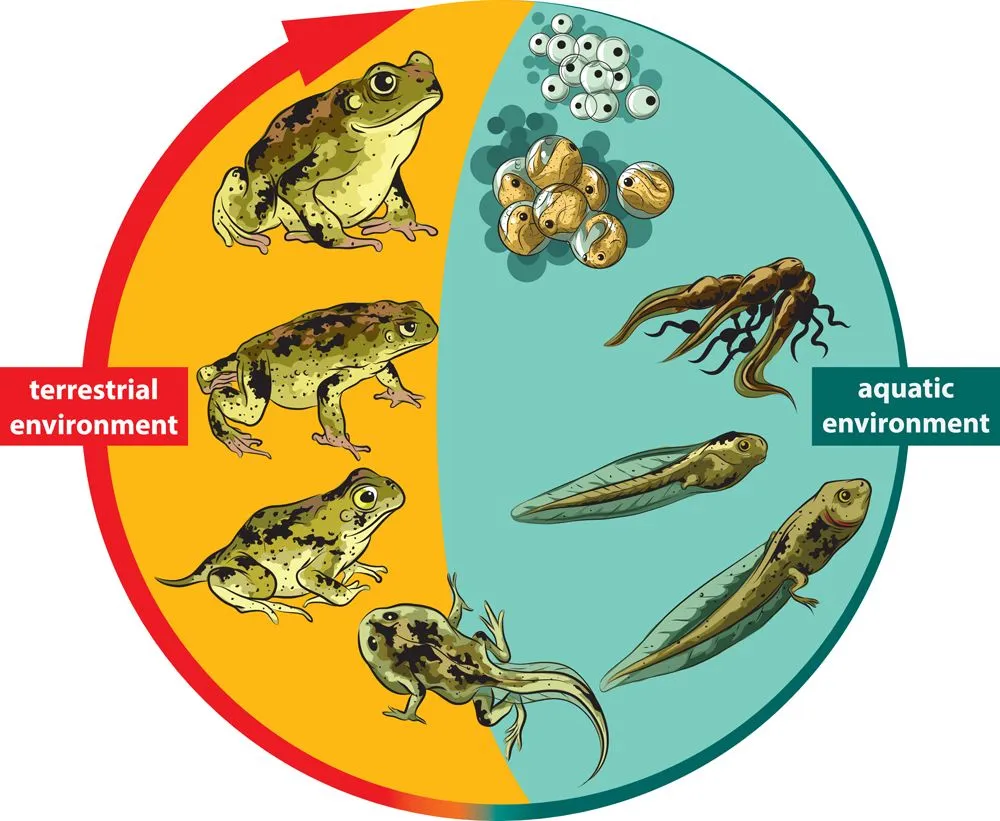
Unfortunately for the frog, air and water don’t facilitate breathing in quite the same way. This means that the frog must also adapt its breathing accordingly to its new life.
Tadpoles Breathe Through Gills
Tadpoles have gills that allow them to breathe during their underwater phase of life. The gills, which are usually covered with a flap of skin, are located on the side of their head.
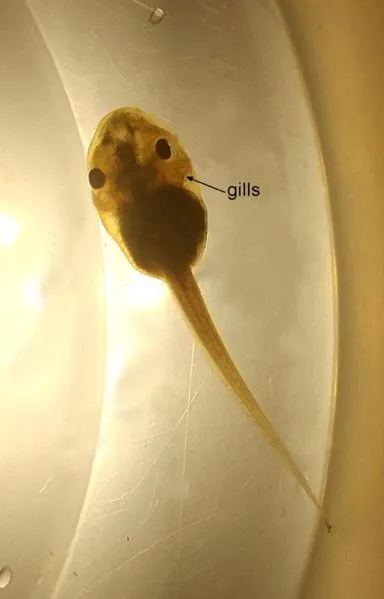
As tadpoles age, they also develop a pair of lungs alongside their gills. These lungs help them survive in water with low oxygen concentrations. To breathe air, tadpoles need to reach the surface, but they are too small to break the surface tension of water with their heads. They instead come up just under the surface and suck in air bubbles through their mouths in a behaviour called bubble-sucking.
Adult Frogs Can Breathe Through Their Lungs
The tadpoles ditch their gills eventually, developing a new pair of lungs to adapt to their life on land. That said, adult frogs lungs don’t work like human lungs.
Frogs don’t have a ribcage nor a diaphragm, two body parts that help mammalians change the pressure inside their lungs and facilitate breathing. Instead of expanding their chests and breathing in air, the frog gulps in air.
To take in air, a frog will expand its throat by lowering the bottom of its mouth. Air rushes into the expanded mouth cavity through the nostrils. Then the frog simply gulps that air into its lungs by contracting the bottom of its mouth. When the frog breathes out, the whole process happens in reverse, pushing air from its lungs into its mouth and then out into the world!

Though frogs have lungs, they aren’t well developed enough to do the job by themselves. So, to meet all their oxygen needs, frogs have one more ingenious mode of breathing up their sleeves.
Frogs Can Breathe Through Their Skin
The frog’s skin, believe it or not, picks up the slack for the lungs.
To exchange gases, the frog’s skin is thin and smooth. Thick and tough skin with scales, feathers, or fur would impede, rather than aid, gaseous exchange. Interestingly, some frogs can change the thickness of their skin in response to the concentration of oxygen in water. The less oxygen in the water, the thinner their skin was found to be.
If you’ve ever had the displeasure of touching a frog, you know that they are quite slimy. This slime is a mixture of mucous and proteins that helps keep the frog’s skin moisturized, as dry skin doesn’t allow for effective skin breathing.
Capillaries beneath the skin take in the oxygen and supply it to tissues close by.
For some frogs, skin breathing can be so efficient, that they primarily or, in some instances, solely rely on it.
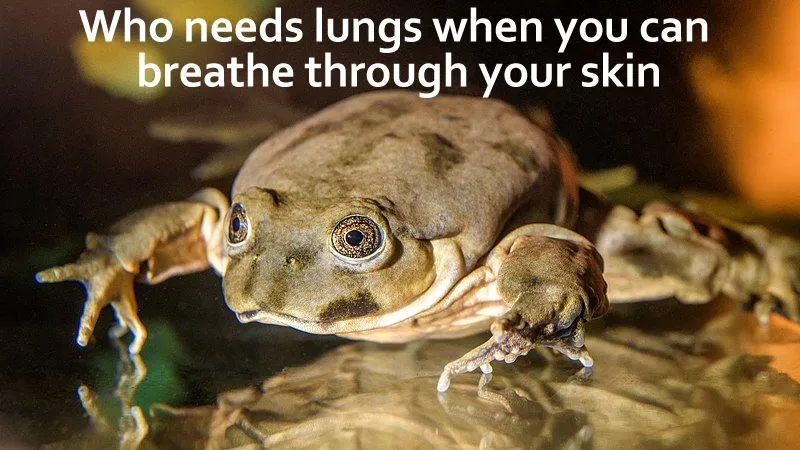
Take the Titicaca water frog, for example. This underwater frog solely breathes through its skin. It has numerous skin folds that increase the creature’s surface area, thus allowing more gaseous exchange. In fact, the frog often performs underwater push-ups to ensure that water reaches all its many skin folds.
Another example is the hairy and slightly scary Astylosternus robustus. This hairy frog’s skin is heavily penetrated with capillaries for skin breathing. With reduced lung size and capacity, the hairy frog doesn’t have much of an option other than skin breathing.
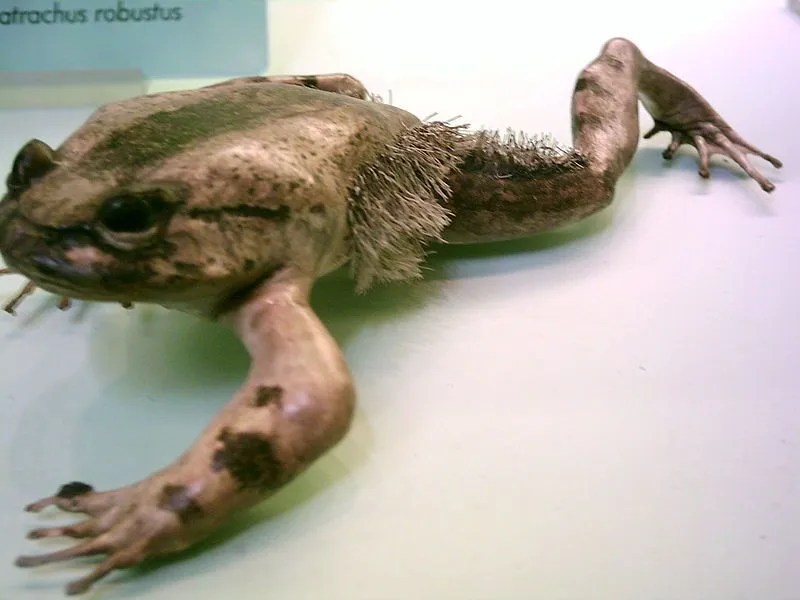
This becomes a concern when the male frogs embark on their very elaborate and energy-consuming mating ritual.
To make sure it doesn’t run out of breath, a male frog will create additional folds in its skin. This action makes it look like the frog has erupted hundreds of gruesome moles on its back, so it’s a good thing the females don’t care much about traditional beauty!
Can Frogs Breathe Underwater?
Here’s a question that puzzles a lot of people: if an adult frog breathes air with its lungs, how can it spend so much time underwater? The answer, once again, is its remarkable skin. Because a frog can absorb oxygen straight from the water through its skin, it can stay submerged for long stretches without ever surfacing for a gulp of air.

This skill becomes a lifesaver in winter. Many frogs, including bullfrogs and green frogs, ride out the cold months hibernating at the bottom of a pond, breathing entirely through their skin for months on end. With their body temperature and metabolism dropping close to that of their surroundings, their oxygen needs shrink to a trickle that the skin can easily supply. Conveniently, cold water holds more dissolved oxygen than warm water, so a chilly pond is actually a well-stocked larder of the gas they need.
There is a catch, though. Unlike turtles, frogs can’t burrow deep into the oxygen-poor mud and slow their metabolism enough to survive down there. Instead, they lie on top of the mud, only partly tucked in, and may even paddle around occasionally to keep oxygen-rich water flowing over their skin. As long as the pond doesn’t freeze solid all the way to the bottom, a hibernating frog can keep breathing underwater until spring.
Do Adult Frogs Have Gills?
If you’ve ever typed “do frogs have gills” into a search bar, the honest answer is that it depends on the frog’s age. Tadpoles have gills; adult frogs do not.

A tadpole starts life as a fully aquatic animal and uses gills to pull oxygen from the water, much like a fish. As it matures, though, it faces a tricky engineering problem: it has to swap a water-breathing system for an air-breathing one without ever leaving itself unable to breathe. Nature solves this with careful timing. The tadpole grows and matures its lungs first, and only once those lungs are ready for the job does it begin to resorb its gills.
During this metamorphic climax, a surge of thyroid hormone tells the gill tissue to shut down and be broken down by the body, with the building blocks recycled rather than wasted. Skin grows over the spot where the gills used to be. By the time a tadpole becomes a tiny froglet, the gills have vanished completely and the enlarged lungs have taken over. From then on, the adult frog draws its oxygen from just two sources, its lungs and its skin. So no, the frog hopping around your garden doesn’t have a single gill to its name.
How Do Other Amphibians Breathe?
Frogs may be the headline act, but they aren’t the only amphibians with unusual ways of breathing. Their cousins, the salamanders and the worm-like caecilians, lean on the same moist-skin trick, sometimes to an even greater degree.

The most striking example is a whole family of salamanders called the Plethodontidae, or lungless salamanders. They make up the majority of all salamander species, and as the name suggests, they have no lungs at all. Every scrap of oxygen they need passes through their skin and the thin lining of their mouth and throat. To keep that working, they’re tied to cool, damp places where their skin never dries out.
At the other extreme is the axolotl, a salamander that never really grows up. Through a quirk called neoteny, it keeps its feathery external gills for its entire life and stays in the water as a permanent “larva”, instead of transforming into a land-dwelling adult the way a frog does. Between the frog’s three-stage career, the lungless salamander’s all-skin approach, and the axolotl’s lifelong gills, amphibians turn out to be the great improvisers of the breathing world.
A Final Word
If you think about it, it’s remarkable that one animal can breathe through its gills, its lungs, and its skin—all in the same lifetime. We frequently think that breathing is performed by a separate breathing organ—gills for fish, trachea for insects, or lungs for humans—but for the frog, breathing is a far more dynamic and flexible process!
References (click to expand)
- Frog Respiration. Brown University
- Skin Breathing in Vertebrates - Scientific American. Scientific American
- Noble, G. K. (1925, June). The integumentary, pulmonary, and cardiac modifications correlated with increased cutaneous respiration in the amphibia: A solution of the ?hairy frog? problem. Journal of Morphology. Wiley.
- Schwenk, K., & Phillips, J. R. (2020, February 19). Circumventing surface tension: tadpoles suck bubbles to breathe air. Proceedings of the Royal Society B: Biological Sciences. The Royal Society.
- All About Frogs. Burke Museum, University of Washington.
- Where Do Frogs Go in the Winter? Virginia Department of Wildlife Resources.
- Chang, L., Zhu, W., & Jiang, J. (2024). What frog gill resorption brings: loss of function, cell death, and metabolic reorganization. Frontiers in Zoology.
- Respiratory System. Comparative Vertebrate and Human Anatomy: Ecology, Evolution, and Function.
- Lungless Salamanders (Plethodontidae). Encyclopedia.com.