Table of Contents (click to expand)
We have agricultural lands and gardens where we grow plants, and we keep animals as livestock and pets, but are humans the only species that do these things? Research has found that a few animal species do perform agricultural activities, the most sophisticated of which may be ants growing fungi gardens for food and rearing aphids like cattle.
Humans were once hunter-gatherers, constantly moving around in search of food. Then, about 12,000 years ago, we began the process of agriculture. Groups of humans settled in areas with fertile land and began selectively cultivating certain plants (crops) for food. These small settlements around the agricultural land slowly evolved into civilizations with cities and towns. The beginning of farming is a remarkable turning point in the history of humanity, and we’ve often used this advancement to set ourselves apart from other species.
However, we’ve discovered that we aren’t the only species farming on the planet! The practice is not being performed by some highly evolved primates or other food chain-topping group, but actually by a teeny tiny group of invertebrates, the small but mighty ANTS!
Ants started farming a very long time ago, on the order of 50 to 60 million years. In fact, a 2024 study suggests the very first ant farmers may have appeared around 66 million years ago, right after the asteroid impact that wiped out the dinosaurs darkened the skies and let fungi flourish on all the dead and decaying plant matter. Like humans, the insects came to depend on their “food crops” and developed specialized worker groups within their colonies to tend them. Apart from ants, a few species of beetles and termites also perform such agricultural efforts, but this behavior is mostly exhibited by insects that live in groups.
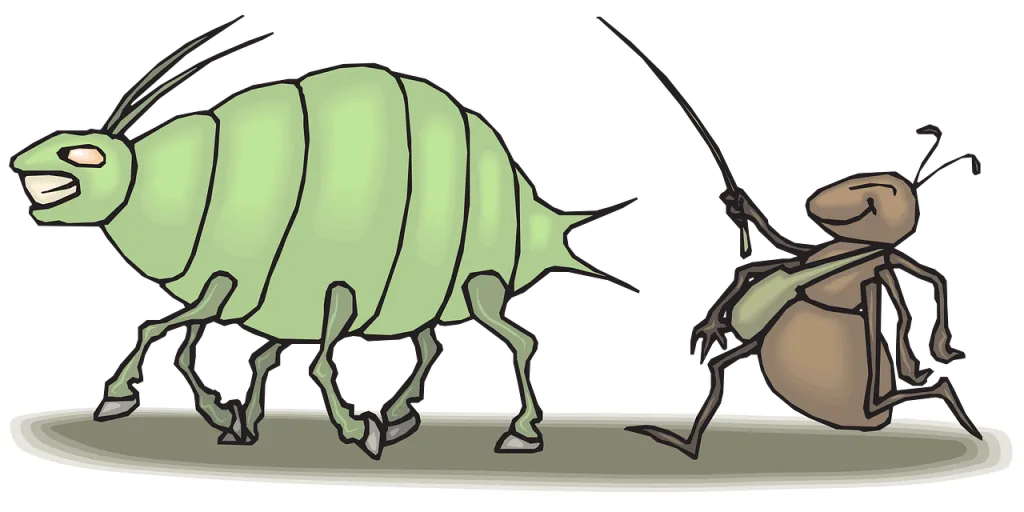
There are two types of ant farming: some ants farm fungus, while others rear aphids.
Fungus Farms
There is a well-known species of ants known as leafcutter ants that make their nests underground or within rotten logs. As their name suggests, the ants cut leaves into tiny pieces and then carry them to their fungus gardens. They also lick the leaves down, which is said to serve an anti-bacterial function.
Within their nests, they have an area demarcated to grow fungus, a fungal garden!
Here is the clever part. The ants can’t actually digest tough leaf material themselves, so they let the fungus do it for them. The fungus produces nutrient-rich swellings called gongylidia, packed with fats, proteins, and enzymes, and the ants eat these. They can’t digest the fungal enzymes, though, so the enzymes pass straight through and end up in the ants’ droplets. The ants then dab these enzyme-loaded droppings onto freshly chewed leaves, which fertilizes the garden and breaks the leaf matter down for the next crop of fungus.
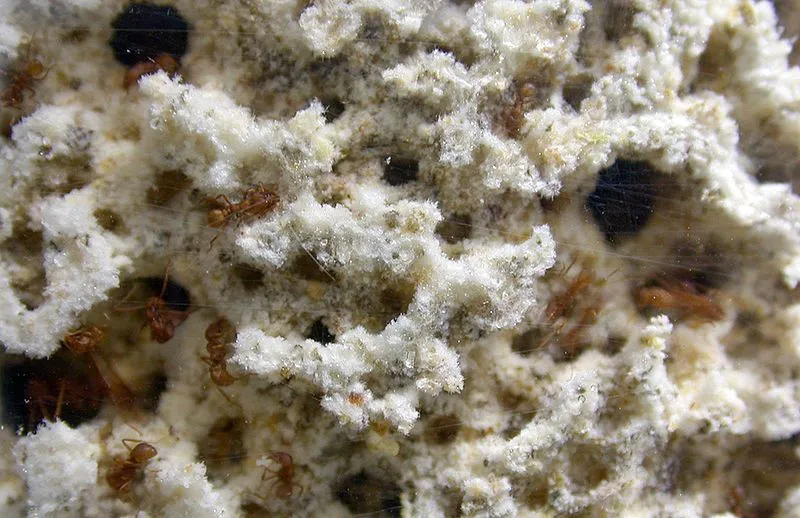
The ants get their nutritious food in this creative way. The fungus produces enzymes that break down plant tissues into a form the ants can eat, turning leaves that would otherwise be useless to them into a meal. For the fungus, it is an excellent chance to thrive on a steady supply of leaf substrate without competition from other microbes, and it gets round-the-clock protection from the ants in the bargain.
The fungal type grown by each species of ant is unique. When a queen ant leaves the nest to start a new colony, she carries a tiny bit of fungus along with her, just like your mom might give you a plant to take with you when you move out of the house!
Aphid Farms
Aphids are members of the insect superfamily Aphidoidea. They are really small (smaller than ants), they live in groups, and are commonly called greenfly or ant cows.
Aphids have long and thin mouth parts that they use to cut into the stems and tender parts of plants and then suck the juices out of them. Following this, they generate a sugary liquid called honeydew, which the ants love.
Ants house groups of aphids in their nests and treat them like cows. The well-fed aphids are stroked gently on their backs (a process called milking) by ants with their antennae. When ants do this, the aphids secrete honeydew, which the ants drink up eagerly.
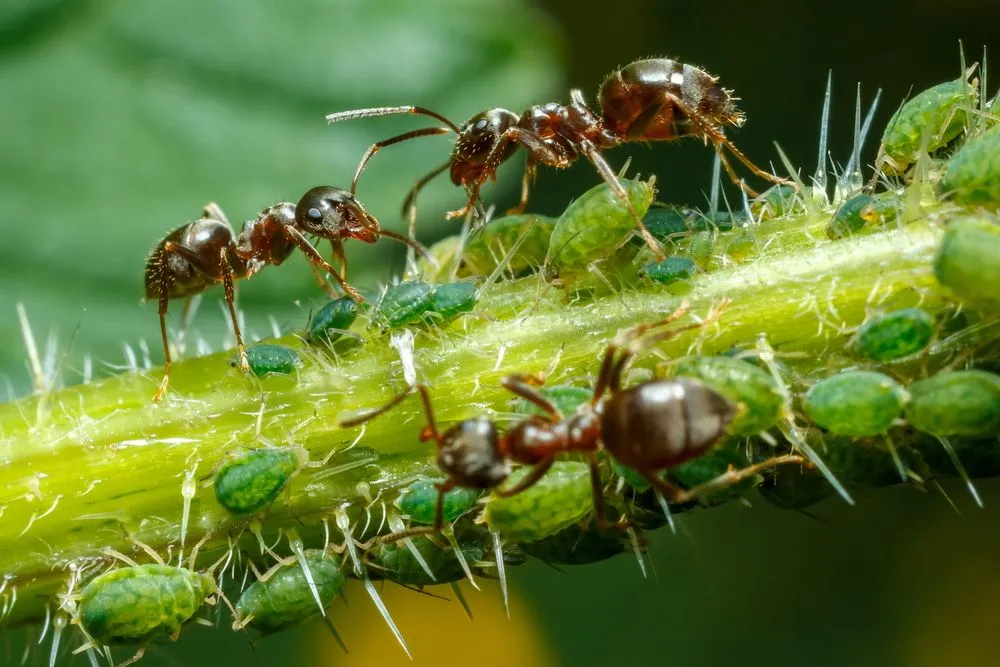
The ants protect the soft-bodied aphids, as they have little to no defense capabilities, and the ants get a constant, energy-rich food supply in return. Certain chemicals secreted by ants have also been observed to have a tranquilizing effect on aphids.
At times, it has been observed that ants will take aphids to plants to feed and then herd them back to their nest. Not too different from what humans do with cattle, right?
They also remove dead or microbially infected aphids to keep their nests clean and safe. Again, when a queen ant leaves the nest, she will carry an aphid egg with her to start a new farm. Aphid-tending isn’t limited to a single group of ants; it shows up across several subfamilies, including Myrmicinae and Dolichoderinae. The most devoted aphid farmers, though, belong to the subfamily Formicinae, especially familiar genera like Formica and Lasius.
Conclusion
Such interactions, in which organisms belonging to different species have a long-term connection, are called symbiotic relationships. Here, both parties involved benefit from the other, making it a mutualistic interaction. Their relationship can either be obligate, as in the case of fungus, in which they cannot survive without each other, or it can be facultative, like with aphids, in which the interaction is optional. Such cooperative behavior in nature makes both species evolve more specializations, which makes them more efficient in building and maintaining that symbiotic relationship.
Do you think the relationship between humans and their cattle/crops is also mutualistic?
References (click to expand)
- Mueller, U. G., & Gerardo, N. (2002, November 18). Fungus-farming insects: Multiple origins and diverse evolutionary histories. Proceedings of the National Academy of Sciences. Proceedings of the National Academy of Sciences.
- North, R. (1997, October). Evolutionary aspects of ant-fungus interactions in leaf-cutting ants. Trends in Ecology & Evolution. Elsevier BV.
- Rønhede, S., Boomsma, J. J., & Rosendahl, S. (2004, January). Fungal enzymes transferred by leaf-cutting ants in their fungus gardens. Mycological Research. Elsevier BV.
- Denton, K., & Krebs, D. L. (2016). Symbiosis and Mutualism. Encyclopedia of Evolutionary Psychological Science. Springer International Publishing.
- Andrews, E. A. (1930, October). Honeydew Reflexes. Physiological Zoology. University of Chicago Press.
- Nielsen, C., Agrawal, A. A., & Hajek, A. E. (2009, November 18). Ants defend aphids against lethal disease. Biology Letters. The Royal Society.
- CH Coulson. t ARIZONA AGRICULTURIST;. The University of Arizona
- (2005) Ecology and Evolution of Aphid-Ant Interactions - JSTOR. JSTOR
- Natural history and phylogeny of the fungus-farming ants (Hymenoptera: Formicidae: Myrmicinae: Attini) - Natasha J. MEHDIABADI & Ted R. SCHULTZ - www.antwiki.org