Table of Contents (click to expand)
Pigeons thrive in cities because tall buildings and concrete ledges mimic the natural cliffside habitat of their wild ancestor, the rock dove (Columba livia). Cities also offer abundant year-round food from human leftovers, few natural predators (DDT use after WWII decimated raptors like falcons and hawks), and warm shelter that lets pigeons breed year-round. The result is dense urban populations that can rival the human population, with New York famously claiming roughly one pigeon per resident.
Human history is intermingled with some of nature’s mightiest species, but there also exists a not-so-mighty species that rise above them all. They are underrated, but have been human companions for millennia…
…the noble pigeon!
Dovecotes: Man-made Houses For Pigeons
On The Origin Of Species
If you open the book On The Origin Of Species and read the first chapter, you’ll notice that Darwin doesn’t start with animals that he famously observed in the tropics. He doesn’t start with the tortoise, nor does he start with the finches or the giant fossilized armadillos.
Instead, he starts explaining his theory with pigeons.
Darwin was intrigued by the resilience and adaptability of these flying creatures. He was amazed that pigeon fanciers had bred more than 350 distinct pigeon breeds from a single species, Columba livia, the rock pigeon. He then used pigeons as an example to expound his own game-changing theory of natural selection.

Columba livia, the rock dove (Photo Credit : Diego Delso/Wikimedia Commons)
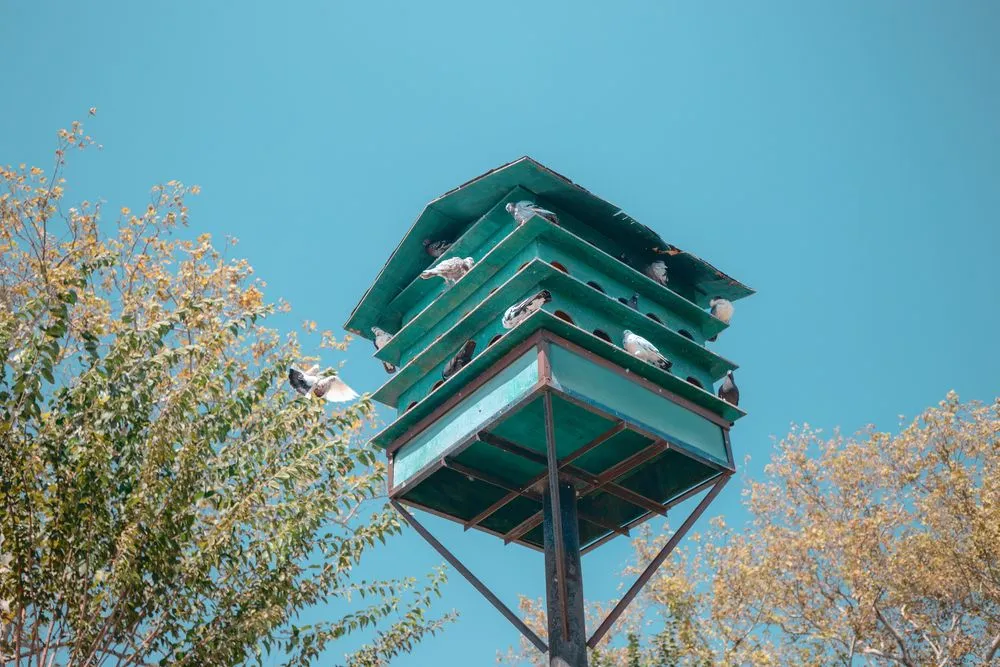
Thousands of years before pigeons began feasting on hot dog buns and other leftovers of human food, these birds were found on seaside cliffs. However, as humans learned the art of agriculture and animal husbandry, rock pigeons were soon domesticated by humans for food and as pets. In fact, we built dedicated homes for them, called dovecotes, which are still found in some parts of Europe and Asia. It was a sign of honor to build these giant pigeon houses.
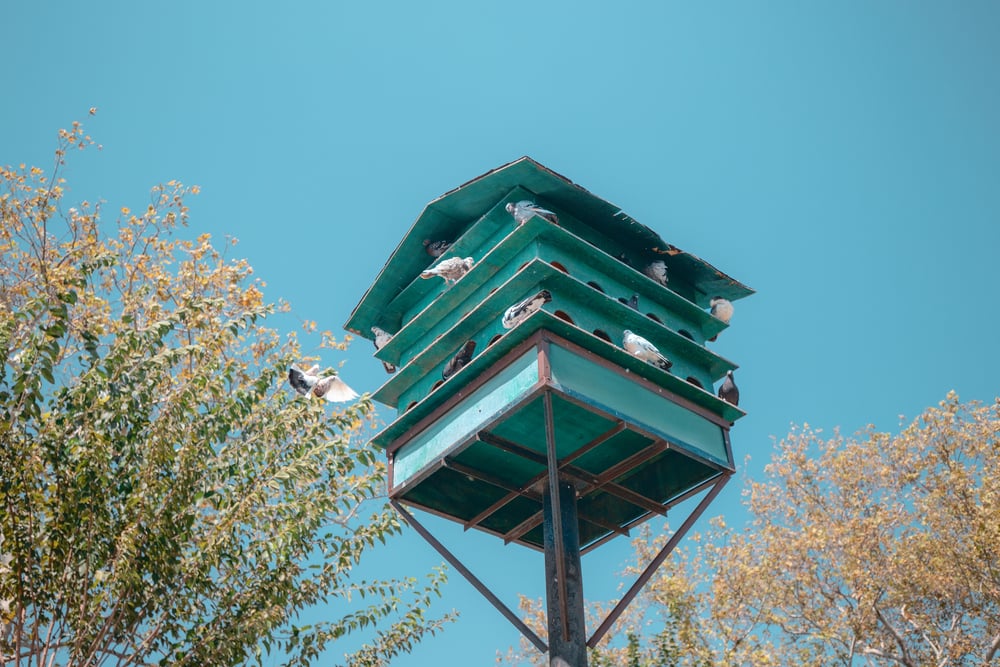
Pigeon dovecote (Photo Credit : frantic00/Shutterstock)
How did pigeons come to the US? Well, the Europeans brought them!
Europeans were very fond of these birds, so when they began crossing the Atlantic in the early seventeenth century, they brought pigeons with them — French settlers are credited with bringing the first rock pigeons to Port-Royal (in present-day Nova Scotia) around 1606. Some of the pigeons escaped and proliferated across cities in America where the human population was growing.
Gradually, population of pigeons exploded in cities like Boston, San Francisco and New York because, believe it or not, cities are tailor-made for pigeons!
Easy Access To Food
Pigeons love cities with dense human populations, because that translates into better availability of food for them. Unlike other birds, pigeons can easily thrive on human food, including leftovers. They are often seen eating leftover rice, bagels, doughnut, buns and potato chips in American cities. Thus, the ability to consume human’s leftover food has made them very suitable for city life.

Easy Shelter
In their original habitat, rock pigeons nest on cliffs and spend their life near the sea. However, as cities and civilizations started to prosper near the sea, they moved in. For these pigeons, buildings were just like cliffs, albeit with better architecture!
Pigeons have a natural affinity for hard surfaces. They like concrete, marble and stone structures, which are abundant in cities. Pigeons are uniquely suited for city life because they have mastered the art of nesting on these hard structures, as they mimic their rocky and hard natural habitat. Cities are abundant with places that make good nesting places for pigeons, such as AC units, fire escapes, or even the ledges decoratively built on some old buildings.
More Reproduction
Easy access to food, an easy home… what else do you need? Easy breeding! Pigeons are a species that breed throughout the year. The easy availability of food and shelter means that pigeons spend a lot less time searching for food and more time mating! That’s why we see the pigeon population exploding out of control in certain cities.
Excellent Navigating Capabilities
Another reason why pigeons are highly successful in cities is that they are incredible navigators. Scientists are still working to understand the mechanism behind their navigation abilities. Some pigeons can be driven hundreds of miles away, yet still manage to navigate back to their home! These navigation skills aid pigeons in moving through the complex cityscape.
Pigeons appear to rely on multiple overlapping cues: a magnetic compass, olfactory “maps”, the position of the sun, and learned visual landmarks. One intriguing hypothesis from a study in the Journal of Experimental Biology is that they also tune in to infrasound — ultra-low-frequency sound waves generated by ocean waves and reflected off terrain — to help build a mental map of the landscape. It is not yet the consensus model, but it is one piece of how pigeons stay oriented.
Pigeons also see the world in four primary colors instead of our three: they have a fourth cone type tuned to the violet/near-UV range, with colored oil droplets in front of the cones that act as built-in filters. The result is colour discrimination beyond what humans can perceive — another asset for spotting food in any neighborhood.
Dearth Of Natural Predators
Another thing that worked in favor of pigeons in cities is the dearth of natural predators, like falcons and hawks. In the case of cities in the US, pigeons didn’t have natural predators for a long time. This is partly due to the heavy use of the insecticide DDT, which began in the United States during and after World War II (Paul Hermann Müller of Geigy AG discovered its insecticidal properties in 1939) and was widely sprayed until the EPA banned it in 1972. DDT’s persistent metabolite DDE made the eggshells of raptors like falcons and hawks very thin, leading to a decrease in their population.
Interestingly enough, pigeons are good at avoiding predators and other moving objects, like automobiles. A 2015 study in PNAS by Williams and Biewener (Harvard) showed that pigeons switch between two distinct postures — a wing-pause and a fully-folded tuck — to thread through tight gaps, trading flight efficiency for stability as obstacles get harder. Pigeons are quite acrobatic, so it’s not easy for predators to prey on pigeons.
When The Pigeon Population Exploded Beyond Control
In New York, there’s an adage: there’s one pigeon for every New Yorker. That would put the count somewhere around 8 million birds. The real number is anyone’s guess (published estimates range from a few hundred thousand to several million, because no one has ever attempted a proper census), but many urbanites in New York feel that the city isn’t large enough for both species. In 2003, things got so bad in iconic Bryant Park (New York) that a professional falconer was hired to scare the pigeons away. Pigeons were flocking the park and littering all around. The idea was to terrify pigeons regularly with predators like falcons, so that they eventually stopped roosting and feeding in Bryant Park.
In Thailand’s capital, Bangkok, pigeons have flocked beyond the city’s limit. The Bangkok Metropolitan Administration enacted a ban on feeding pigeons in public in September 2018. Violators face up to three months in jail, a fine of up to 25,000 baht (about $770), or both. Italy got there first: since 2008, Venice has made it illegal to feed pigeons in St Mark’s Square, with fines now reaching up to €700.

How Many Pigeons Are There In The World?
Here is the honest answer: nobody really knows. Feral pigeons are so widespread, and so good at tucking themselves onto ledges, rafters and rooftops, that no one has ever managed a proper worldwide census. What we have instead are estimates, and they vary a lot. Europe alone is thought to hold somewhere between 17 and 28 million rock doves and their feral descendants, while figures for the global total have been put as high as 120 million birds.

To put that in perspective, a single European city can carry a startling number of them. When researchers tried to tally the breeding feral pigeons in Sheffield, England (a city of roughly half a million people), they arrived at an estimate of about 12,000 birds for the summer of 2005, with the densest concentrations sitting right in the middle of the city. Descended from escaped domestic pigeons, feral flocks like these have since colonized towns and cities across nearly every corner of the inhabited world. The rock dove is still listed by the IUCN as a species of “Least Concern”, which is a polite way of saying we are not going to run short of pigeons any time soon.
Do Pigeons Only Live In Cities?
Not at all, even though the crowded town square is where most of us meet them. The city pigeon is simply the feral form of the wild rock dove, and truly wild rock doves have never needed a city in the first place. Across their native range in western and southern Europe, North Africa and into South Asia, they nest in the crevices of sea cliffs, caves, gorges and rocky canyons, usually close to farmland or open scrub where seeds and grain are easy to find.

Their feral cousins have spread well beyond the pavement too. Away from big cities you will find them roosting in old farm buildings, barns and rural bridges, all of which stand in nicely for a cliff face. Cities are not the only home a pigeon can use, just the richest one, which is why feral pigeons reach their highest densities in the central parts of towns. Genuinely wild rock doves, by contrast, have become surprisingly hard to find. So many domestic and feral birds have bred back into the wild population that “pure” rock dove colonies in Britain are now largely confined to the rocky coasts of north and west Scotland, its offshore islands and Northern Ireland.
Do Pigeons Live In Groups?
Yes, pigeons are thoroughly social birds. They flock together to feed, to sun themselves and to roost, and that sociability is one more reason they thrive in the busy, crowded setting of a city. When someone drops a bag of chips or scatters bread in a park, pigeons pile in quickly, gathering in large, dense groups around any reliable source of food.
Those feeding flocks are more organized than they look. Behavioral studies describe two roles within a group: “producers”, the birds that actively search out and find food, and “scroungers”, which hang back and help themselves to whatever the producers uncover. A typical flock carries more scroungers than producers, so a lucky find by one bird quickly becomes a meal for many. Gathering in numbers has another payoff, as more eyes mean a better chance of spotting a hawk in time, so a pigeon in a flock is a little safer than one on its own. Come the breeding season, that same sociable bird pairs off with a single mate to raise its young, before rejoining the flock once the chicks have fledged.
A Final Word
For centuries, pigeons have been the companions of humans. Initially, they served as a good source of protein in the form of squab. For some, they were cute cuddly flying pets. In fact, we even built dedicated homes (dovecotes) for them! But with rapid urbanization and the human population gradually concentrating in cities, our relationship with pigeons seems to have changed.
Many of us now see them as pests, proliferating in our cities, often beyond control. In the US, the pigeon is one of the few birds that doesn’t come under federal protection. In fact, there’s an entire industry dedicated to their removal. Whether or not you support this industry, one thing you must surely appreciate about pigeons is their incredible ability to adapt and navigate through complex city environments, even if it does mean the occasional dropping on a car windshield!
References (click to expand)
- Ramsay, J., Tepper, Y., Weinstein-Evron, M., Aharonovich, S., Liphschitz, N., Marom, N., & Bar-Oz, G. (2016, October). For the birds — An environmental archaeological analysis of Byzantine pigeon towers at Shivta (Negev Desert, Israel). Journal of Archaeological Science: Reports. Elsevier BV.
- Hagstrum, J. T. (2000, April 1). Infrasound and the avian navigational map. Journal of Experimental Biology. The Company of Biologists.
- DDT and Birds. Stanford University
- Jail birds: Thailand considers prison for feeding pigeons. Reuters
- In Bryant Park, Hawks Are Circling and the Pigeons Are Nervous. The New York Times
- Rock dove. Wikipedia
- Feral pigeon. Wikipedia
- Columba livia (common pigeon). Animal Diversity Web, University of Michigan Museum of Zoology
- Rock Dove / Feral Pigeon. Royal Society for the Protection of Birds (RSPB)