Table of Contents (click to expand)
Yes, peacocks can fly. They are not flightless birds, but they only manage short, low bursts, typically flapping up to a roost or branch about 8 meters (26 feet) high and covering well under 100 meters (330 feet) before landing. A startled bird fleeing a predator can climb higher, but peacocks spend most of their time on the ground.
If you’ve ever been to the zoo, the bird exhibit may not be your first choice, lacking the grandeur of the elephant enclosure or the big cats, but when it comes to beautiful animals, few can compete with the legendary peacock. With full-grown males boasting a spectacular tail display of nearly 200 feathers, the remarkable coloring and patterning on their oversized tail feathers have mesmerized people for thousands of years.
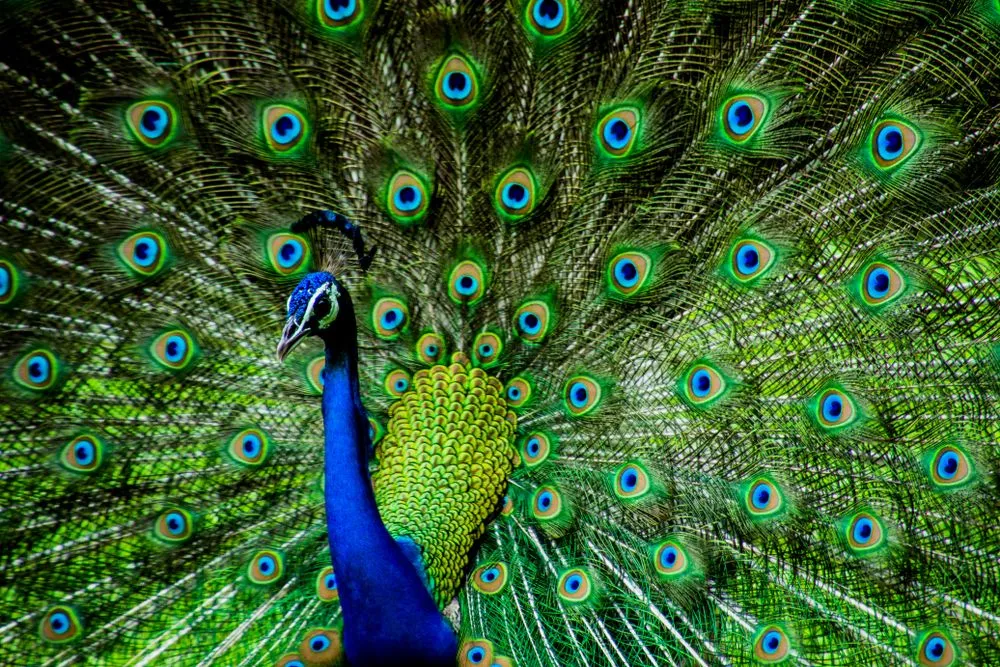
Peacocks look almost normal while walking on the ground, trailing their impressive feathers behind them. In fact, if they weren’t moving, you might mistake them for any other bird, poised to leap into flight if you got any closer. However, in the case of peacocks, given their nearly 6-foot train of feathers and penchant for the ground… can they fly?
Peacocks In Flight
On one of those trips to the zoo mentioned above, once you were enthralled beside the peacock exhibit, you probably didn’t see the peacocks flying about the enclosure, diving and darting between the branches. Generally, you will see peacocks strutting about on the ground, or lounging in the shadows, which has led many people to believe that they are flightless birds.
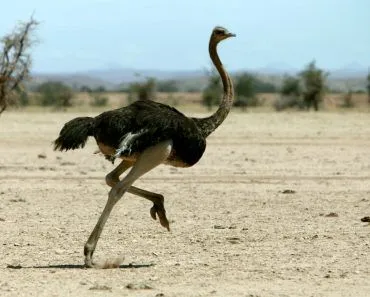
The concept isn’t so strange, after all, since ostriches, emus, penguins, moas, cassowaries and numerous other birds are unable to take to the skies. In many of those cases, natural selection decided that other attributes were more vital to survival and reproduction, eventually leaving the creatures without the ability to fly.
This is not, however, the case with peacocks! Though you may never have seen it happen, peacocks are able to take to the skies and flap their wings, the bountiful tails flowing behind them. The only catch is, of course, that they aren’t able to fly particularly far at any one time, nor very high. A typical flight is a short, noisy burst, often just a hop up to a tree branch or a roost roughly 8 meters (26 feet) off the ground, rarely covering more than 100 meters (330 feet) before they touch back down. A bird that’s genuinely spooked by a predator can flap its way higher still. If you have been lucky enough to see a peacock leap from the ground and flap its way into a branch, you may have noticed that they aren’t especially graceful in the act; the entire process looks much clunkier than it does in other birds.
Given how apparently vulnerable these birds are, not to mention their brightly colored tails making it difficult for them to blend in, why haven’t peacocks been completely wiped out by now? Are their massive tails to blame for their struggles to get airborne?
Well, while their tails don’t help the situation, they are far from the only reason why these beautiful beasts are usually earthbound.
Peacocks On The Ground
Peacocks are a member of the pheasant family, meaning that they are also closely related to turkey, grouse and partridges. If you’re up to date on your bird knowledge, you know that these birds are not known to be exceptional flyers either. They are often referred to as “ground birds” and have adapted to a life generally spent out of the air.
In the case of such birds, the wings that are typically evolved for flight will become more rounded, rather than streamlined and pointed. These birds are also quite large, and can hold a good amount of body weight, posing an additional obstacle to easy flight.
Most of the food that pheasants consume can be found on the ground, so instead of flying and diving or hunting from the air, these birds adapted the ability to move quickly and hunt at the same level. These birds are often natively found in forested or wooded areas, where they may be closed in with dense foliage.
The ability to fly isn’t very helpful in evading predators when you also have to dodge branches to make an escape. Their large size also makes them less maneuverable in the air.
See, these types of ground birds aren’t flightless, but they have a number of anatomical elements that makes it inconvenient for them to fly. If you haven’t noticed, we haven’t even mentioned the peacock’s tail as the impediment to their flight!
So What About That Tail?
It’s hard to ignore a peacock’s tail, but remember that the peahens (females) of the species don’t have such massive tails, because they are not competing for the males’ attention; rather, the males are competing for theirs. As is true in many different species around the world, the males are the sex that put on grand mating displays to allure a potential mate.
The peacock tail is a remarkable example of runaway sexual selection, in which a trait that is deemed notable for a good mate is selected for over and over again, causing a certain evolutionary element of a species to continue out of control. The outlandishly large tail feathers of male peacocks are not advantageous for survival, but they are considered advantageous for reproduction, and thus the survival of their genes. This continues on in subsequent generations, thus pushing an entire species in a given physiological direction.

Some other classic examples of runaway sexual selection include certain species of warblers who have incredibly complex and lengthy mating calls, lasting for minutes or even hours, as they will more likely be chosen by a mate if their song is longest. Other species of birds, such as African widowbirds, also boast ridiculously long tails that attract potential mates.
So, now that we understand why peacocks have such elaborate tails, we can ask the final question: do their tails contribute to their struggles with flying?
The surprising answer is “not as much as you’d think.” It seems obvious that hauling around a train that can weigh roughly 300 grams (about 0.7 lb) and stretch beyond 1.5 meters (5 feet) would weigh a bird down, but the experiments don’t bear that out. When researchers filmed peacocks taking off in high-speed video before and after their trains were removed, they found no significant difference in take-off flight performance. Wind-tunnel tests showed the train roughly doubles aerodynamic drag, yet overcoming that drag turns out to be only a tiny fraction of the power a peacock uses to launch itself into the air. On top of that, let’s not forget that female peacocks (peahens) do not have such elaborate tail displays, and yet they’re also not known as the keenest flyers in the avian kingdom. In other words, the train is a costly ornament, but it isn’t what keeps peacocks largely earthbound.
A Final Word
Peacocks are a wonderful example of not judging a biological book by its cover. You may see an animal and make assumptions about why it behaves in a certain way, or why evolution has guided it to look a certain way, but those assumptions may be completely incorrect! The natural world continues to impress and surprise researchers in every corner of science, particularly with our knowledge of genetics and evolutionary history progressing at such a breakneck pace!
References (click to expand)
- Watch a peacock get a female's attention by making her head vibrate. Science (AAAS)
- Runaway selection hypothesis | biology | Britannica. britannica.com
- The elaborate plumage in peacocks is not such a drag. Journal of Experimental Biology (The Company of Biologists)
- Adaptations for Flight. Stanford University
- Why Fly? Flightless Bird Mystery Solved, Say Evolutionary .... National Geographic