Table of Contents (click to expand)
A dog's sense of smell is roughly 10,000 to 100,000 times more sensitive than a human's. Dogs carry around 220 to 300 million olfactory receptor cells (versus about 5 to 6 million in humans), and the region of their brain devoted to processing smell is proportionally about 40 times larger than ours, which is why they can detect explosives, narcotics, and even certain cancers and infectious diseases.
Dogs are known as man’s best friend. Dogs are also known for their loyalty, which is probably why they are mankind’s most beloved pets. Just as striking is a dog’s sense of smell, which is far greater than a human’s.
Dogs’ sense of smell is essentially what sense of sight is to humans. Dogs interpret the world through their nose, as compared to humans, who are dependent on their sight to see the world.
Dog Nose Vs. Human Nose
When we try to smell something, we inhale air with our nose and we use the same passage in our nose to exhale that air. Therefore, all the smell that we get when we are inhaling is lost when we exhale that air. However, a dog has two different air passages, one for breathing and another for smelling. This means that dogs are able to store the smell in their nose even while breathing out the air!
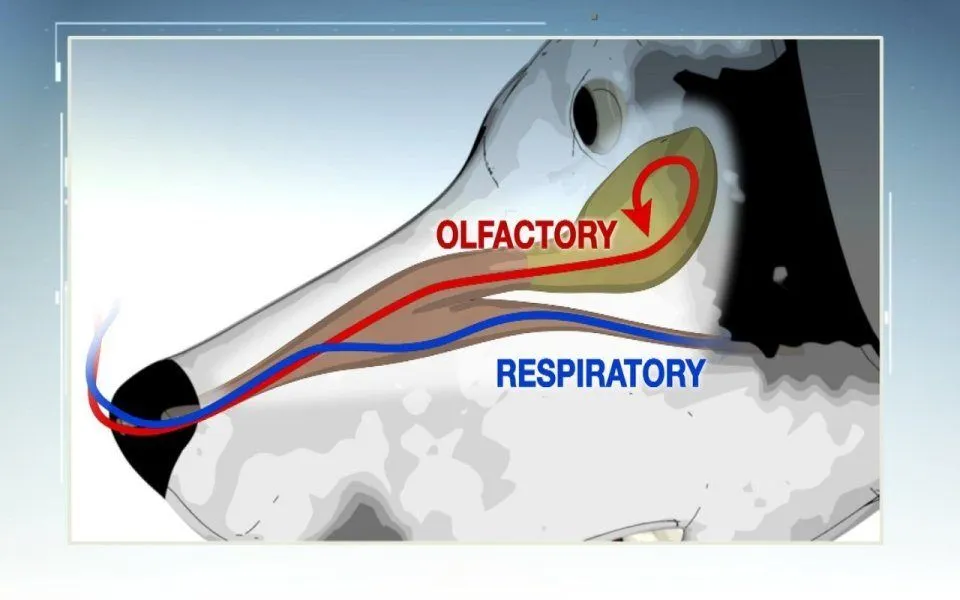 When dogs exhale, they send air out through the slits of their nose, but the manner in which this air is exhaled through their nose helps the dogs to draw in new odor molecules. This also helps dogs capture more smells when sniffing.
You must have noticed that dogs’ noses are always wet, but have you ever wondered why? The mucus on the dog’s nose helps it smell by capturing scent particles. A dog also has the ability to smell independently from each nostril, this helps the dog to understand from which direction the smell is coming.
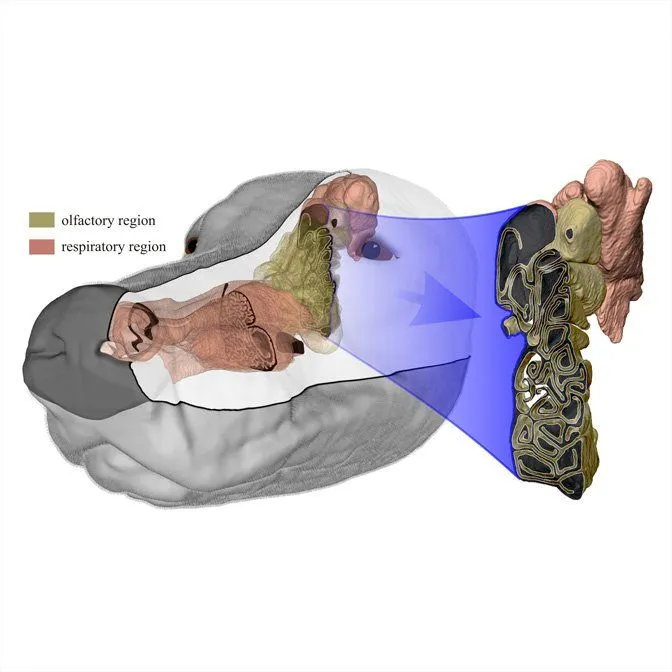 The passage through which dogs smell the air contains highly specialized olfactory receptor cells, which are responsible for receiving smells. A dog has between roughly 220 and 300 million olfactory receptor cells in its nose, depending on the breed (bloodhounds sit at the high end), compared to about 5 to 6 million in a human nose. Dogs also have more than 800 functional olfactory receptor genes, versus around 400 in humans.
Dog Brain Vs. Human Brain
By now, we clearly know that dogs have a nose that can smell roughly 10,000 to 100,000 times better than a human (the lower estimates assume average dogs, the high end refers to scent-bred breeds like bloodhounds), but how are dogs able to remember all the different smells they have sensed throughout their lives?
The answer lies in the difference between the brains of dogs and humans. A human brain has a larger visual cortex than a dog’s, whereas a dog’s brain devotes a far greater share of its processing power to smell than ours does. The visual cortex is responsible for processing visual information, while the olfactory system handles the sense of smell. According to VCA Animal Hospitals, the area of the canine brain devoted to analyzing odors is proportionally about 40 times larger than the comparable part of the human brain, even though a dog’s brain is much smaller overall.
Dog’s Sense Of Smell
Humans perceive the world through their vision, while dogs experience the world through their nose. Every smell is different for a dog, and each smell has a story behind it. When a dog smells a person, another dog, or any random scent, he is trying to determine the history behind it.
Dogs have a second olfactory system above the roof of the mouth called the vomeronasal organ (or Jacobson's organ), which is specialized for detecting pheromones, the chemical signals other animals release. The vomeronasal organ helps dogs identify potential mates and tell whether another animal is friend or foe. Picking up on human emotions like fear or happiness actually happens through the main olfactory system (a 2018 study by D'Aniello and colleagues at the University of Naples showed that dogs can detect human fear and happiness from sweat samples alone).
The power of the canine sense of smell is unique and has helped humans in a number of ways. With proper training, dogs are used to detect explosives, narcotics, missing persons, and certain cancers. More recently, sniffer dogs have been deployed at airports and hospitals to screen for COVID-19 from sweat samples (Grandjean and colleagues, 2020, 2022), and ongoing research suggests some dogs can detect Parkinson's disease from skin secretions and even malaria from worn socks. They can sense the emotions of humans and react appropriately in a time of need, and they help in the early detection of cancers like breast, lung, ovarian, and prostate by sniffing breath, urine, or skin samples.
In What Ways Do Humans Use A Dog’s Sense Of Smell?
Have you ever wondered why an airport guard walks a dog past your luggage, or why a hospital trial might ask a Labrador to sniff a sweat sample? Because a dog’s nose is the most sensitive odor detector we have ever had on call. Working dogs put that nose to use across security, search and rescue, conservation, and medicine, and in many of these jobs no machine yet matches them.

The largest group of working scent dogs are explosives and narcotics detection dogs. Detection dogs are trained for a long list of targets, including explosives, narcotics, contraband, weapons, ignitable liquids, and human remains, and explosives dogs in particular are used routinely to screen the people, goods, and cargo passing through airports, seaports, and other transport hubs. The U.S. Transportation Security Administration runs its own Canine Training Center and deploys more than a thousand explosives detection canine teams across U.S. airports, which together conduct hundreds of thousands of explosives sweeps each year.
Search and rescue is another classic job. Trained dogs locate missing people quickly and accurately, which makes them invaluable after avalanches, earthquakes, and building collapses, where they can pick out a living person buried under rubble. Separate cadaver dogs help recovery teams find human remains.
The newest frontier is medical detection. Many diseases change the cocktail of volatile organic compounds a body gives off, and dogs can be trained to flag that scent signature. A 2021 review in BMC Infectious Diseases notes that a dog’s olfactory acuity is more than 100,000 times stronger than ours, sensitive enough to register odors at the parts-per-trillion level, and documents trained detection of epileptic seizures, low blood sugar in people with diabetes, several cancers, malaria, bacterial infections, and viral infections. During the pandemic, dogs were trained to screen for SARS-CoV-2 from sweat samples with high reported accuracy, and ongoing research is testing whether dogs can smell diseases such as cancer early enough to make a difference.
In other words, the same nose that lets your dog read a fascinating story off a lamppost is being trained to read explosives off a suitcase and disease off a breath sample.
A dog does not care how you look or dress, but if he gets good vibes from your smell, then a dog will love you. The world is truly a better place because of these wonderful creatures that we are lucky enough to welcome into our lives.
Why not make the world smell a bit more beautiful for them?
References (click to expand)
- The Nose Knows: Inside the Astonishing Olfactory World of Dogs. American Kennel Club.
- D'Aniello B. et al. Interspecies transmission of emotional information via chemosignals: from humans to dogs. Animal Cognition (2018).
- The dog olfactory receptor repertoire. Genome Biology (2005).
- Grandjean D. et al. Screening for SARS-CoV-2 using sniffer dogs and axillary sweat samples. PLOS ONE (2022).
- How Dogs Use Smell to Perceive the World. VCA Animal Hospitals.
- Jendrny P. et al. Canine olfactory detection and its relevance to medical detection. BMC Infectious Diseases (2021).
- TSA Canine Training Center. Transportation Security Administration.