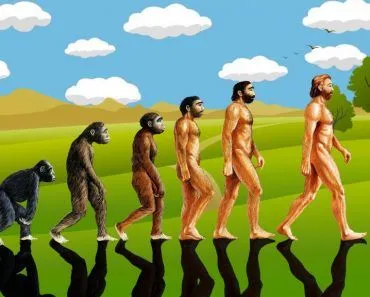
What makes us human is mostly what our brains do. Researchers point to self-awareness, mental time travel (the ability to revisit the past and imagine the future), abstract reasoning, language, cumulative culture passed down across generations, and the ability to act on moral codes rather than pure survival instinct. Biologically we are animals (and share about 96% of our genome with chimpanzees), but these cognitive abilities, supported by an unusually large and highly connected human brain, set us apart.
Philosophers, scientists, politicians, scholars, and every other human being on the planet has, at one point or another, looked at the world around them and asked the “Big Questions”. Why are we here? Is there an afterlife? Are we alone in the universe? And of course, the big one… What makes us human?
It sounds like a rather broad question, and it can be taken in a number of ways. Fortunately, with over 7 billion humans on the planet, we have plenty of “brainpower” to tackle these tough questions of existence.
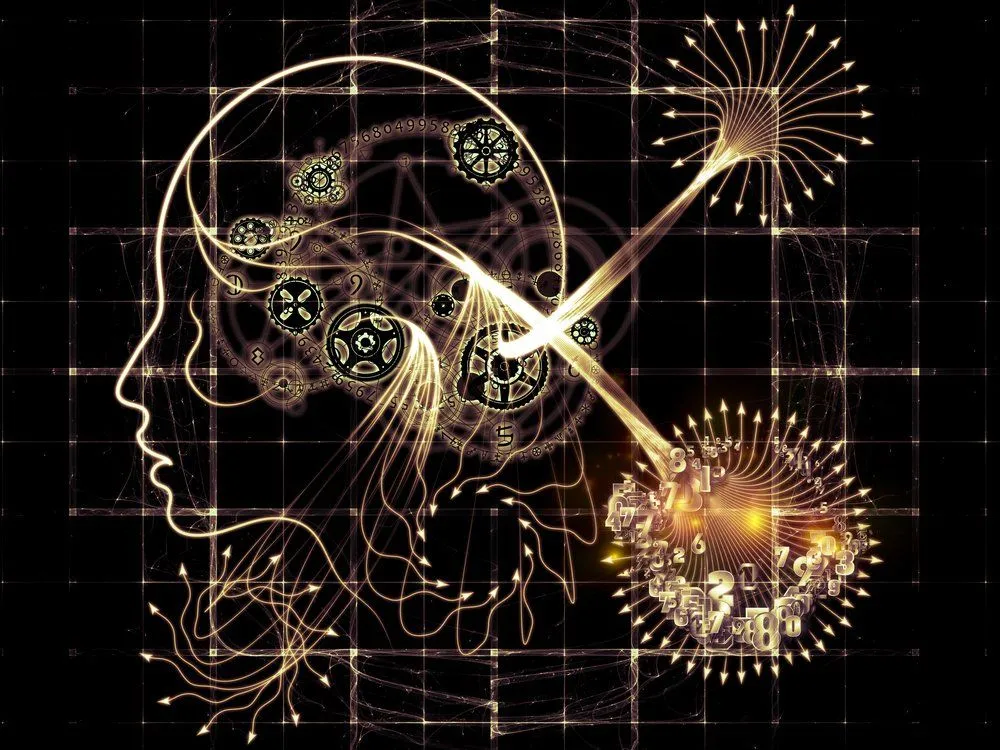
What separates us from the animals? What characteristics (physical, emotional, philosophical) actually define us as another species on this planet? Is there some secret spark that makes us special?
Let’s put our brains to the test and take a closer look.
The Only Human Species Left
When we talk about humanity, we are referring to Homo sapiens, the latest in a long string of hominin species. And while we are the only one left today, Earth was a much more crowded hominin neighborhood for most of our history. Neanderthals lived alongside us in Europe and western Asia until about 40,000 years ago, the Denisovans (only identified in 2010, from a finger bone in a Siberian cave) overlapped with us in Asia, the tiny Homo floresiensis ("Hobbits") survived in Indonesia until roughly 50,000 years ago, and Homo luzonensis was named from Philippine fossils in 2019. On a geological clock, we became "the only human species" only very recently.
The deeper backstory goes like this: hominins first left Africa nearly two million years ago in the form of Homo erectus. Later, the common ancestor we share with Neanderthals (probably Homo heidelbergensis) split roughly 500,000 to 700,000 years ago. One branch in Eurasia evolved into Neanderthals (and a parallel one into Denisovans), while the African branch became Homo sapiens, whose oldest fossils, from Jebel Irhoud in Morocco, are about 300,000 years old. Archaeological dating now puts the disappearance of European Neanderthals at around 40,000 years ago.
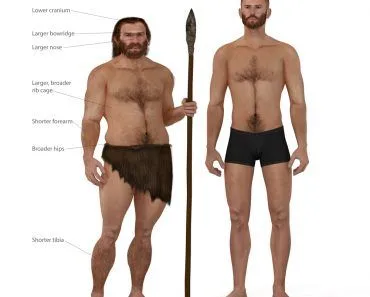
We have discovered many things about Neanderthals, namely that they were very similar to us in every way, except above the neck. The shapes of our skulls are quite different, and researchers believe that impacted the development of the brain. In other words, our skull gave us a cognitive edge, which could have helped with many things, such as the development of tools, language creation, and higher-level thinking.
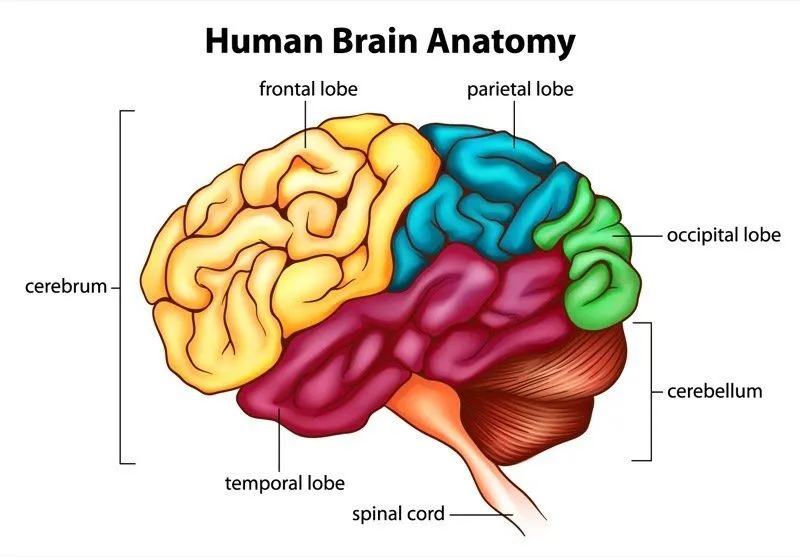
In the harsh, unsettled environment of our planet back then, these skills were essential for survival. This new shape of our skull had more room for the temporal and parietal lobes, which hold our centers for hearing, language, and speech, as well as our abilities related to spatial understanding. Getting that brain boost helped modern humans thrive and spread across the planet as the only human species!
However, don’t get too cocky, because at some point in history, the humans who eventually left Africa crossed paths with Neanderthals (and had sex). Non-African modern humans today carry roughly 1–2% Neanderthal DNA in their genomes, and many people of Asian and Oceanian ancestry carry additional Denisovan DNA on top of that.
Are We That Different From The Animals?
Now, what separates us from other human species is one question, but what about our separation from other animals? We understand most of our evolutionary progression from the great apes, and based on our behaviors and culture, humans look wildly different from our tree-climbing cousins. However (and you may want to sit down for this) we share roughly 96% of our DNA with chimpanzees once insertions and deletions are counted, or about 98.8% if you only count single-letter substitutions, according to the chimpanzee genome reference paper (Chimpanzee Sequencing and Analysis Consortium, Nature, 2005).
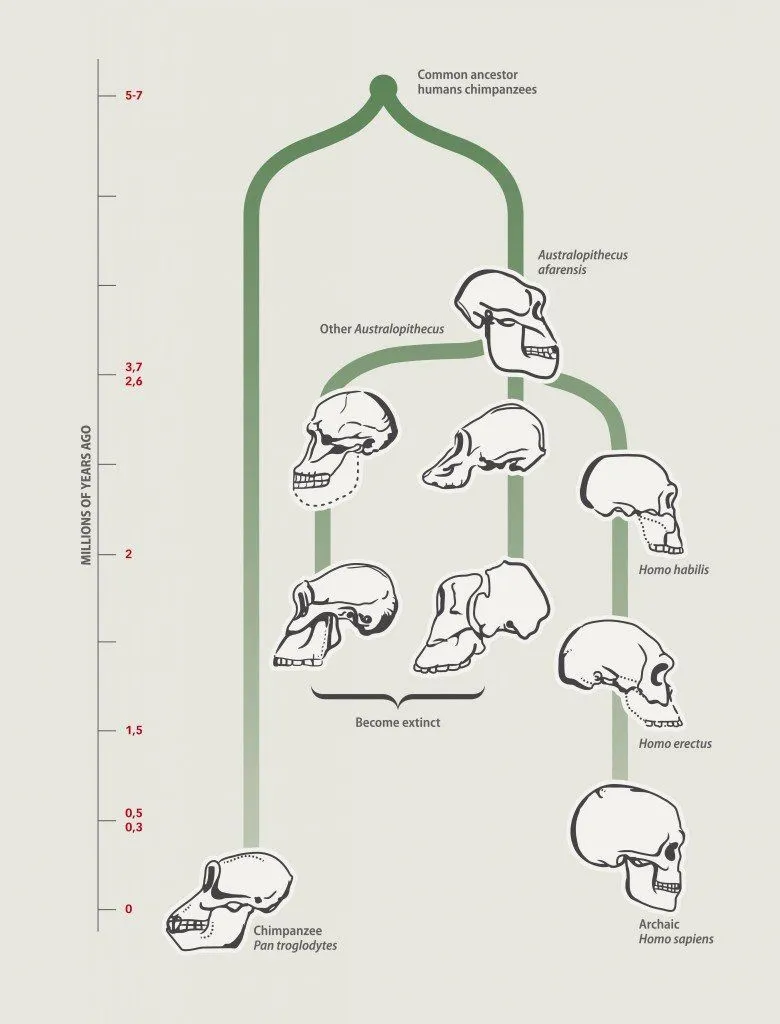
Either way, our last common ancestor with chimpanzees lived between roughly 6 and 8 million years ago, and the differences in the DNA aren’t huge on their own. The big gap, then, has to lie in what those genes go on to build, namely the brain and the behavior it produces.
People are quick to point towards agriculture, language, the use of tools, and various other “differentiating points”, but that theory falls short, as we are not the only species with these abilities. Various insects, birds, and small rodents use some form of agriculture or harvesting, chimpanzees use tools, and it could be said that birds use language to communicate.
So, if we can poke holes in those explanations, what does that leave us? Once again, we must return to the brain, and higher level thinking – just like what separated us from other hominid species.
Are Humans Animals, Scientifically Speaking?
Here is a fact that trips up a lot of people: scientifically speaking, humans are animals. When biologists file life away into its nested categories, we land squarely inside the animal kingdom (Animalia), right alongside jellyfish, houseflies, and blue whales. From there the labels get more specific. We are chordates (animals with a nerve cord running down the back), mammals (Class Mammalia, warm-blooded and nursing our young on milk), and primates (Order Primates), the branch that also holds lemurs, monkeys, and apes. Carl Linnaeus, the naturalist who built this whole ranking system, formally named our species Homo sapiens back in 1758.

Zoom in one more step and it gets uncomfortable for anyone hoping we occupy a branch all our own. Humans sit inside the family Hominidae, the "great apes," together with chimpanzees, bonobos, gorillas, and orangutans. We are not merely related to apes in some distant, arm's-length way. In the eyes of taxonomy, we are apes. The deeper you follow the story of human evolution back, the clearer that placement becomes. So when someone asks, "are humans animals?", the honest biological answer is a flat yes.
That is exactly what makes the question of human uniqueness so interesting. We are not held apart from the animal kingdom by our cells, our anatomy, or our family tree, all of which are thoroughly animal. Whatever sets us apart has to live in what our bodies and brains actually do, not in some special category that quietly lifts us out of nature.
The Brainpower Of Humanity
The general consensus at this time, across the board of researchers, is that self-awareness is the most fundamental difference between us and the animals. Human beings are capable of self-analysis, mental time travel, imagination, abstract reasoning, cultural establishment, and morality. These higher level skills separate us from the beasts, and form the basis of our global culture as a species.
As children, once we pass the age of 2 or 3, our ability to create different mental scenarios increases exponentially. Most great apes and chimpanzees have the mental acuity of a toddler, but as we continue to grow in the world and test the limits of human experience, we quickly surpass our primate cousins. Being raised within a culture that promotes and stimulates high-level cognition is crucial to this development, unlike being “raised by wolves” and embracing a more primal or unstructured existence.
We have the capacity to learn rapidly, a trait shared by other species, but our skills are so much greater than those of any other species. We can formulate vast narratives, consider the effects of dozens of scenarios in our decision-making, and analyze our situations well enough to draw from previous experience and avoid earlier mistakes. Our actions are based on far more than base desires for food, shelter, and survival. We consider moral doctrines and societal rules before acting, which is something that truly puts a gap between man and beast.
So, while we may look differently, our superiority over beasts of the earth, sea, and sky has much more to do with the way our brain functions within this dynamic and complex world.
The Philosophical Answer: The "Rational Animal"
Long before anyone could sequence a genome, philosophers were chewing on this same question, and their most famous answer still echoes today. The ancient Greek thinker Aristotle argued that the defining feature of a human being is the capacity for reason. In his Nicomachean Ethics, he described the human as the creature that lives "according to reason," carrying a rational principle on top of the nutritive life we share with plants and the instinct-driven life we share with other animals. Later scholars distilled this into a tidy Latin tag, animal rationale, the "rational animal," a definition that steered Western thought for centuries.

Notice the exact wording. Not "not an animal," but a rational animal. Even Aristotle planted us firmly inside the animal world and then pointed to reason as the trait that sets our branch apart, the same conclusion the biology keeps circling back to.
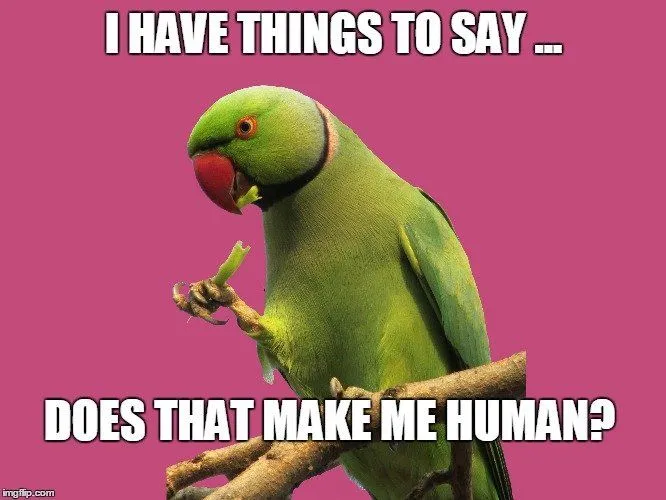
The French philosopher René Descartes sharpened the idea in the 1600s. In Part Five of his Discourse on the Method, he treated reason as a kind of "universal instrument" that animals simply lack, and he singled out language as the decisive test. Every person, he observed, even those who are deaf or otherwise cannot speak, can arrange words or signs to express fresh thoughts, whereas "there is no other animal, however perfect," that genuinely does the same. A parrot can mimic sounds, Descartes granted, but it does not understand what it says.
Modern science muddies this tidy picture, since animals do show flashes of reasoning, tool use, and communication. Yet the philosophers' central hunch, that our defining trait lives in the mind rather than the body, lines up remarkably well with what neuroscientists conclude today.
References (click to expand)
- What Distinguishes Humans from Other Animals? | Live Science. Live Science
- What Makes Us Uniquely Human? | Psychology Today. Psychology Today
- What separates us from other animals? | New Scientist. New Scientist
- What Separates Us From the Animals. Slate
- Human taxonomy. Wikipedia
- Homo sapiens (modern humans). Australian Museum
- Human Nature. Stanford Encyclopedia of Philosophy
- Discourse on the Method, René Descartes. Project Gutenberg