Butterflies don’t fly in straight lines because their erratic, looping flight is a defense, not a flaw. By flexing their wings and constantly shifting their body weight, they jerk and bob unpredictably, making it nearly impossible for birds, bats, and other predators to guess where they’ll move next.
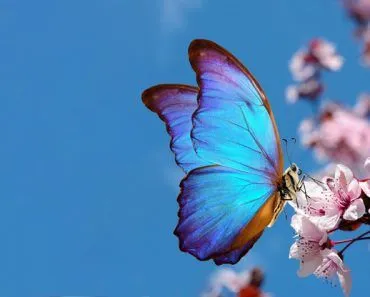
Depending on where you are in the world, if you’ve ever found yourself walking through a flower-filled field in the height of summer, there’s a good chance you’ve come across a butterfly or two. These majestic and diversely colored insects are some of the most beautiful and entrancing creatures of the natural world, seeming to worship nothing but the lure of flowers and their own mad style of flight.
If you pay attention to a single butterfly at a time, it’s difficult to ignore their seemingly random manner of flight. They dart and bob, changing directions and heights on a whim, making it impossible to know where they’ll move next. Unlike other insects, like bees or dragonflies, butterflies seem to lack any control of their “drunken” flight. Despite this apparent inability to maintain stable flight, butterflies flourish and are found all over the world. This naturally raises the question: why can’t butterflies seem to fly in a straight line?

The Flight Of The Butterfly
While watching the stumbling, rambling, seemingly drunken flight of a butterfly, it doesn’t make much sense. It takes a longer time to move between flowers and get anything done, and it seems to draw more attention to the insects, which surely can’t be good for survival. Butterflies, after all, are not equipped with many defense mechanisms.
However, researchers have found that the generation of such an erratic flight pattern is by design, as it makes it nearly impossible for a potential predator (bird, bat, larger insect, etc.) to predict where a butterfly will move next. Most creatures have certain limitations to their movement based on their exoskeleton or skeleton; essentially, this makes movements more predictable, particularly for a skilled hunter. In the case of butterflies, however, they have developed a number of techniques and physical adaptations that allow them to so masterfully control their flight, creating a complex dance that even the most sharp-eyed predator cannot decode.

Some of these physical adaptations involve the shape and composition of butterfly wings, which are far more flexible than previously thought. Certain types of flapping generate unique airflow patterns, including vortices, that allow for such rapid changes in height and direction. These complicated upstrokes and wing flaps provide more lift and versatility in movement than the typical wing flaps of birds. In fact, researchers are working on duplicating some of the aerodynamic properties of butterflies in order to create miniature drones with similar capabilities.
A study from Lund University in Sweden, published in 2021, added a surprising twist to this picture. Using high-speed footage of freely flying butterflies, the researchers found that on the upstroke a butterfly claps its flexible wings together, where they cup into a pocket shape that traps a slug of air and squirts it backward, like clapping your hands together underwater. This clap produced roughly 22% more thrust than rigid wings would, and it accounts for nearly all of the forward push during takeoff. So those “floppy” wings aren’t a weakness at all; they are a finely tuned propulsion system.
Another fascinating study conducted at the National Taiwan University has revealed a unique physical adaptation that enables some of the butterflies’ mesmerizing flight. Using high-speed cameras and analyzing the movements of butterflies in a closed setting, the researchers identified a change in the body mass placement of butterflies in the instants before they change direction or height. Butterflies constantly rotate and tip their bodies during flight, which shifts their center of gravity and body weight, allowing them to utilize more of the energy with each wing flap. This perpetual movement of their main body mass helps them avoid the downward forces associated with each flap of the wing. This makes their flight more efficient and allows them to climb and plummet so rapidly, and in complete control.
Exceptions To The Rule
Some of you who just read the above section will be shaking your head, knowing that at some point in your memory, you saw a butterfly moving in a relatively straight line. You may not be wrong, as some butterflies don’t need to rely on their erratic flight patterns to deter potential predators. The most colorful butterflies you see in the wild may also be the most poisonous, as is the case for many creatures. The vibrant colors are a clear signal to predators: “I can afford to be this colorful because I taste terrible.” As a result of this, those butterflies who were guided through natural selection towards being poisonous or toxic to predators, as well as colorful, didn’t need to rely as much on physical adaptations to avoid being preyed upon.
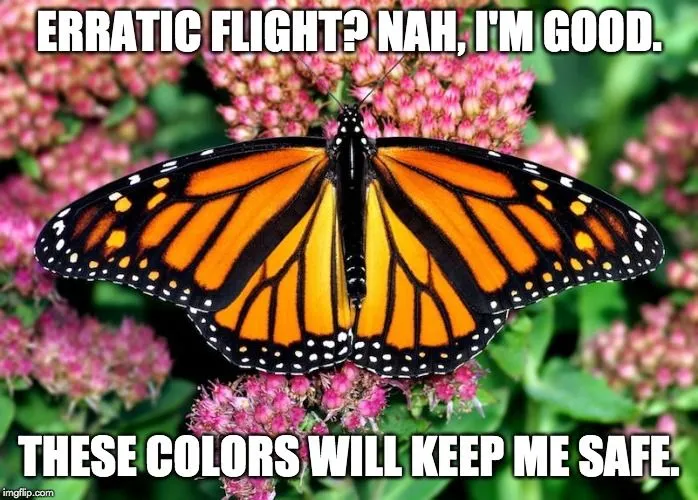
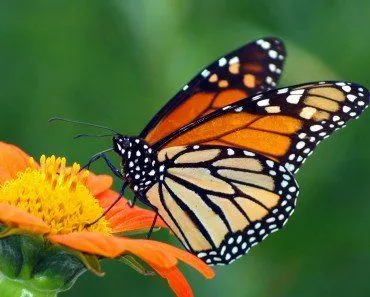
Monarch butterflies, for example, some of the most recognizable and beloved butterflies in the world, are able to eat poisonous plants in their larval and caterpillar stage, and are thus poisonous as adults. They are also vibrantly colored (orange), so you may notice that their flight patterns are a bit more normal. They will glide for long periods and flap their wings similar to birds; while they certainly have the ability to fly erratically when in a swarm or when evading a predator, it isn’t their primary method of defense, and therefore not their constant behavior.
Butterflies And Alcohol
At the top of this article, we joked that butterflies often look as though they are drunk, since they can’t fly in a straight line. While this isn’t the reason for their unique flight patterns, some butterflies do have a taste for alcohol! As a whole, butterflies are attracted to sweet smells, like flowers and other sugary liquids, such as fermenting fruit and juice. Therefore, it should come as no surprise that butterflies like the occasional tipple if some alcohol has been spilled!
In particular, the species that ride out the winter as adults, such as the mourning cloak and various tortoiseshells and commas, need to pack on energy reserves throughout the autumn before they settle into their dormant state (a true hibernation called diapause). As the end of summer approaches, you will see a higher concentration of these butterflies, and many of them, if given half the chance, would gladly slurp up some sweet-smelling fermented fruit. Since ripening fruit naturally brews a little ethanol as its sugars break down, gardeners and butterfly houses often set out a dish of mushy, overripe banana to help them fatten up. Some of the insects get so absorbed in their boozy feast that they can be gently picked up!
What Does It Mean When A Butterfly Flies Around You?
If a butterfly keeps circling you on a hot summer day, it probably isn’t delivering a message from the universe; more likely, it is after the salt on your skin. Butterflies feed mostly on flower nectar, which is loaded with sugar but almost devoid of the sodium and amino acids their bodies need. To top up on those missing nutrients, many species practice a behavior that entomologists call puddling: gathering on damp soil, mud, dung, rotting fruit, and yes, sweaty human skin to sip up dissolved minerals. To a thirsty butterfly, your perspiration is essentially a salt lick.

Curiously, it is overwhelmingly the males that do this. Sodium is vital for the intense neuromuscular effort of flight, and a male butterfly can package the extra salts he collects and pass them to a female during mating as a “nuptial gift” that helps the survival of their eggs. So a butterfly bobbing around your arm is really running a tiny mineral-mining operation.
And when a butterfly suddenly veers away from you as you hike through a meadow? That is the flip side of the same coin. A large, fast-approaching shape reads as a potential predator, and the insect throws itself into exactly the kind of erratic, evasive flight described earlier, buying itself a quick escape.
Do Flies And Moths Fly Erratically For The Same Reason?
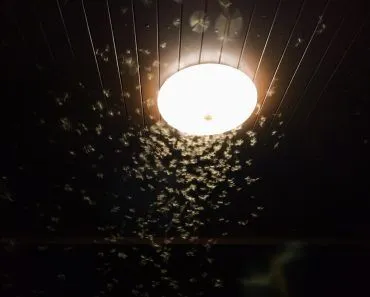
Butterflies aren’t the only insects that seem to fly like they’ve had one too many. Flies and moths are also famous for their jittery, unpredictable paths, but they aren’t all doing it for the same reason.

Take the humble fruit fly. High-speed cameras filming at 7,500 frames per second have caught flies reacting to a looming shape by executing a rapid, banked turn, rolling their bodies 90 degrees or more like a fighter jet peeling away from a missile. Astonishingly, a fly can begin altering its course in less than one hundredth of a second, roughly 50 times faster than you can blink. A fly’s manic zigzagging, then, is partly a hair-trigger escape reflex, primed to fire the instant anything swoops in.
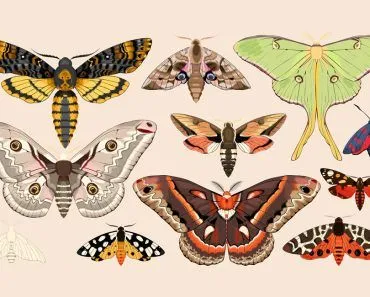
Moths, on the other hand, are often dodging an enemy you cannot even see: bats. Many night-flying moths have simple ears tuned to the ultrasonic calls that bats use for echolocation. A faint call from a distant bat prompts a moth to quietly steer away, while a loud, rapid burst from a bat closing in triggers a last-ditch scramble of loops, spirals, and sudden dives toward the ground. This bat-versus-moth arms race has been running for more than 50 million years, and some moths, such as the tiger moths, have even evolved to answer back with ultrasonic clicks of their own.
How High And How Far Can Butterflies Actually Fly?
Given how wobbly a butterfly looks flitting between flowers, you might assume they can barely clear a garden hedge. In reality, some are astonishing long-distance athletes that climb thousands of feet into the sky and even cross open ocean.

Migrating monarch butterflies don’t simply flap their way south. Glider pilots across North America have repeatedly spotted them soaring in thermals, the same columns of rising warm air that sailplanes ride, at heights of roughly 600 to 1,250 meters (about 2,000 to 4,000 feet) above the ground. By catching a thermal, a monarch can gain altitude for long stretches with barely a wingbeat, turning a costly journey into an efficient glide.
The painted lady is even more extraordinary. In 2024, researchers documented a group that had crossed the Atlantic Ocean, flying at least 4,200 kilometers (around 2,600 miles) from West Africa to the beaches of French Guiana in South America in an estimated five to eight days. On their own fat reserves the butterflies could only have managed about 780 kilometers, so they must have ridden favorable trade winds, alternating bursts of active flapping with long, energy-saving glides. It ranks among the longest journeys ever recorded for an individual insect, and it is proof that a butterfly’s “aimless” flutter can hide a serious flying machine.
A Final Word
Even the most seemingly random phenomena in nature have a good explanation behind them. While most other animals that seem inept at navigation would make them easy prey, butterflies have instead mastered the art of chaotic flight through physical and behavioral adaptations.
References (click to expand)
- Chakravarthy, A., Albertani, R., Gans, N., & Evers, J. (2009, January 5). Experimental Kinematics and Dynamics of Butterflies in Natural Flight. 47th AIAA Aerospace Sciences Meeting including The New Horizons Forum and Aerospace Exposition. American Institute of Aeronautics and Astronautics.
- Fei, Y.-H. J., & Yang, J.-T. (2016, March 25). Importance of body rotation during the flight of a butterfly. Physical Review E. American Physical Society (APS).
- Betts, C. R., & Wootton, R. J. (1988, September 1). Wing Shape and Flight Behaviour in Butterflies (Lepidoptera: Papilionoidea and Hesperioidea): A Preliminary Analysis. Journal of Experimental Biology. The Company of Biologists.
- Johansson, L. C., & Henningsson, P. (2021, January 20). Butterflies fly using efficient propulsive clap mechanism owing to flexible wings. Journal of the Royal Society Interface. The Royal Society.
- BROWER, L. P., & FINK, L. S. (1985, June). A Natural Toxic Defense System: Cardenolides in Butterflies versus Birds. Annals of the New York Academy of Sciences. Wiley.
- Molleman, F. (2010). Puddling: from natural history to understanding how it affects fitness. Entomologia Experimentalis et Applicata, 134(2), 107-113. Wiley.
- Muijres, F. T., Elzinga, M. J., Melis, J. M., & Dickinson, M. H. (2014, April 11). Flies Evade Looming Targets by Executing Rapid Visually Directed Banked Turns. Science, 344(6180), 172-177. American Association for the Advancement of Science.
- Nakano, R., & Mason, A. C. (2018, August 22). Early erratic flight response of the lucerne moth to the quiet echolocation calls of distant bats. PLOS ONE, 13(8), e0202679. Public Library of Science.
- Gibo, D. L. (1981, March 1). Altitudes attained by migrating monarch butterflies, Danaus p. plexippus (Lepidoptera: Danaidae), as reported by glider pilots. Canadian Journal of Zoology, 59(3), 571-572. Canadian Science Publishing.
- Suchan, T., Bataille, C. P., Reich, M. S., Toro-Delgado, E., Vila, R., Pierce, N. E., & Talavera, G. (2024, June 25). A trans-oceanic flight of over 4,200 km by painted lady butterflies. Nature Communications, 15, 5205. Nature Portfolio.